
For years, much of the struggle of the LGTBI collective was focused on achieving the right to exist. To love without fear. To walk down the street without hiding. To name us. To survive. And although many of these achievements came—at least in legal and symbolic terms—there is an uncomfortable question that still remains on the margins of our conversations: what happens when we age?
The LGTBI generation that is beginning to enter old age today is the first to do so, having achieved rights that seemed impossible just a few decades ago. Equal marriage, gender identity laws, social recognition, cultural representation. But it is also a generation marked by an enormous void: we have not yet built a culture of care for our old age.
And that absence begins to become painfully visible.

Because many LGTBI people grow up deeply alone. With ties weakened by years of exclusion, with families broken by rejection, without offspring or with emotional networks that time and precariousness have been eroding. Meanwhile, the system remains organized around a deeply heteronormative idea of life: it is assumed that someone will take care of you because you had children, because you maintained a traditional family structure, or because there is a biological family available to support you.
But what happens to those who were expelled from precisely those family models?
The answer is brutal: too many times, abandonment occurs.
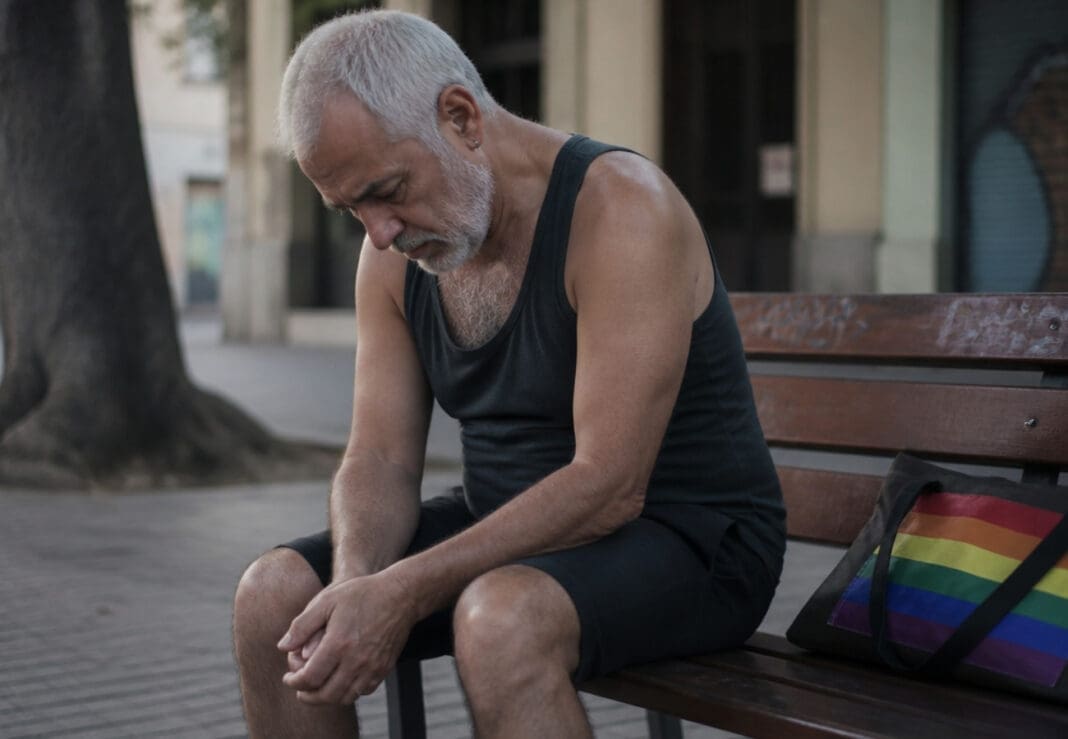
There is a silent violence that is talked about very little and that, however, goes through the experience of many older LGTBI people: the return to the closet in order to be cared for. People who dedicated their lives to fighting to live authentically once again hide who they are by entering nursing homes or depending on institutional care.
It doesn’t happen because pride disappears. It happens because fear appears.
Fear of discrimination among healthcare personnel.
Fear of ridicule from other residents.
Fear of losing dignity.
Fear of being mistreated.

There are couples who stop showing affection in public. Trans people who hear names again that no longer belong to them. Men and women who hide photographs, memories and part of their stories to avoid uncomfortable questions or everyday humiliations.
It is shocking to think that, after decades of struggle, there are still those who need to make themselves invisible to guarantee something as basic as receiving care.
And the problem is not only institutional. It is also cultural. Even within the group itself there is enormous difficulty in looking at old age.
We live traversed by a logic where youth seems to be the only possible territory of desire, beauty and belonging. Ageism operates strongly throughout society, but in many LGTBI spaces it takes on a particular harshness. Getting older seems to be equivalent to disappearing.
Older people are left out of narratives, socialization spaces, cultural representations and, many times, even the political conversation within the group. We constantly talk about diversity, but we rarely talk about those who grew old fighting that fight before us.
Where are the spaces for LGTBI seniors?
Where do we talk about love after 70?
Where do we think about desire, intimacy and affection in old age?
Where are community bonds built that are not crossed by the logic of rapid consumption or contemporary hyper-individualization?
Because that is another of the great wounds of our time: extreme individualism.
They taught us to survive alone, to resolve alone, to protect ourselves. And although autonomy can be a conquest, it can also become a condemnation when the body ages, when illness appears or when life necessarily needs others.
Many LGTBI elderly people are also precarious and impoverished. People expelled from the labor market for years due to discrimination. Trans people historically condemned to structural exclusion. Men and women who could not build economic stability because living already involved too much effort. Loneliness, in these cases, is not only emotional: it is also material.
And perhaps one of the most urgent political questions of our time appears: what model of old age do we want to build?
Because it is not enough to achieve rights if we reach the end of life completely alone. Progressive laws are not enough if there are no real care networks. Representation is not enough if there are no safe spaces to age with dignity.
We need to imagine other forms of community.
We need truly inclusive residences, mandatory training in sexual and gender diversity for care professionals, specific public policies and intergenerational spaces where LGTBI older people are not invisible but central.
But, above all, we need to recover something that historically sustained the group in its most difficult moments: the chosen affective networks.
For decades, many LGBTI people survived thanks to families built out of blood. Friendships that were refuge. Communities that occupied the place that the institutions denied. Maybe the answer still lies there.
Because if this reality makes anything clear, it is that heteronormative structures are not going to think about our old ages for us. And if we do not now begin to build support networks, spaces of care and collective ways of accompanying each other, we run the risk of turning our achievements into a deeply lonely freedom.
The question is not just how we want to age.
The real question is whether we will be able to build a community where no one has to go back into the closet for love, care or dignity at the end of their life.