

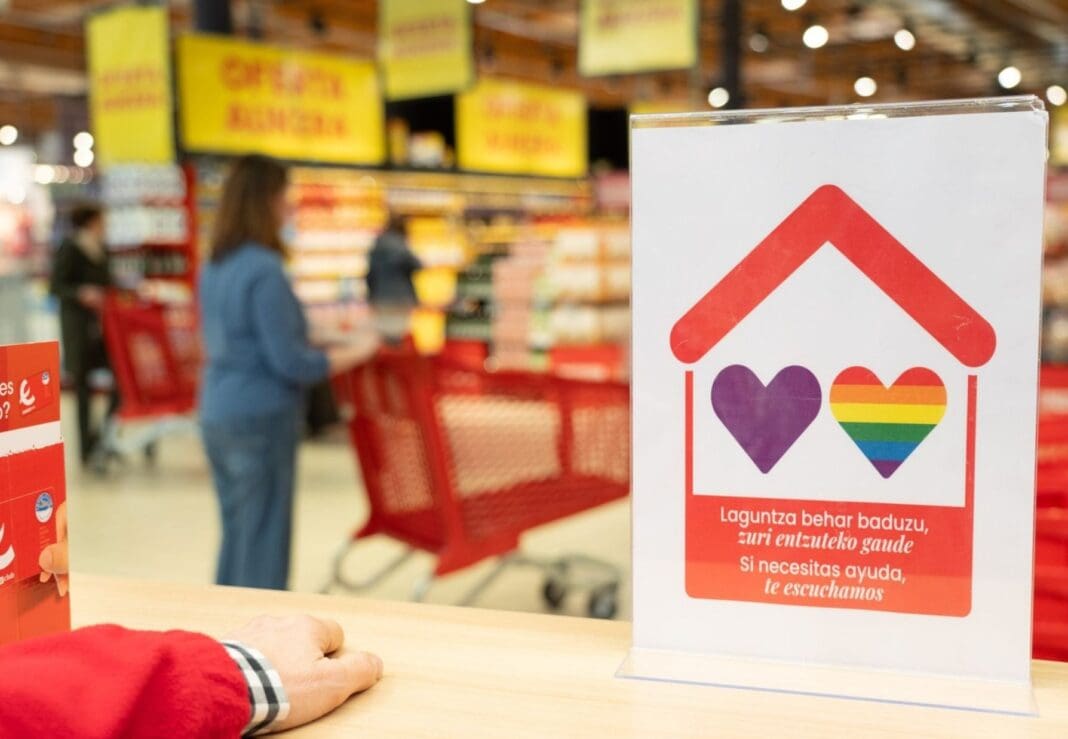

EROSKI has activated a new protocol so that its establishments function as Refuge Points against gender violence and attacks against the LGTBIQ+ community. The measure will be implemented in the Basque Country, Navarra, La Rioja and Cantabria, and will reach hypermarkets, supermarkets, logistics platforms and central offices.
The initiative transforms everyday spaces – places where we go to buy bread, fruit or basic products – into temporary shelter environments for those who are at risk. A decision that directly connects with a key question: can commercial spaces also become protective spaces?
How will the protocol work?
The program establishes that anyone who feels threatened or vulnerable can go to an EROSKI store and request help. There you will find:
- A safe and quiet environment
- Care based on empathetic listening and respect
- Accompaniment towards the resources or services that the person wishes to activate
It is important to emphasize that the stores do not replace emergency services or security forces. They act as a first reception space, always prioritizing the safety of both the affected person and the center staff.
The internal protocol includes clear guidelines for workers: stay calm, listen without judging, not invade decisions and respect the autonomy of those who request help. Because accompanying is not deciding for the other.
The social dimension of the initiative
From the company, Marta Carazo, head of Social Management at EROSKI, explained that the network of stores is part of the daily lives of thousands of people in neighborhoods and towns. Converting these spaces into Refuge Points represents, according to the entity, a coherent way of exercising social responsibility and proximity.
The approach has a clear territorial logic: in many municipalities, especially in rural or semi-rural environments, supermarkets are one of the few spaces open and accessible during large time slots. That capillarity can make the difference in urgent situations.
But it also opens a necessary reflection:
- To what extent should private companies be actively involved in social protection?
- Is this a sign of community co-responsibility or a response to structural deficiencies?
Violence and LGTBIQ+: a persistent reality
The protocol not only contemplates gender violence in the strict sense, but also attacks against the LGTBIQ+ group. In a context in which hate crimes continue to be recorded in different autonomous communities, broadening our perspective is significant.
Violence against LGTBIQ+ people does not always occur in private spaces. It can occur on the street, in work environments or in commercial areas. That a visible, everyday establishment explicitly declares its willingness to offer shelter sends a symbolic message: violence is not tolerated here.
The impact of this type of measures is not measured only by the number of interventions, but also by the deterrent effect and the construction of community culture.
Company, commitment and coexistence
EROSKI frames this decision within its historical commitment to equality, coexistence and respect. As a consumer cooperative, its business model has a declared social dimension, and this initiative reinforces that identity.

However, beyond the corporate discourse, the true scope will be evaluated in practice: continued training, coordination with public resources and monitoring of the protocol.
Because enabling a Refuge Point is not just about placing a badge. It is maintaining a network of trust.
And perhaps that is the key: turning everyday spaces into places where no one feels completely alone.