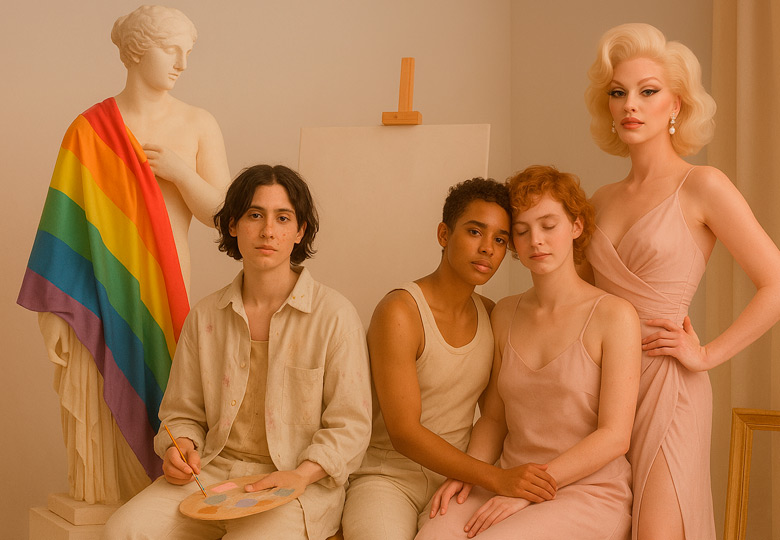

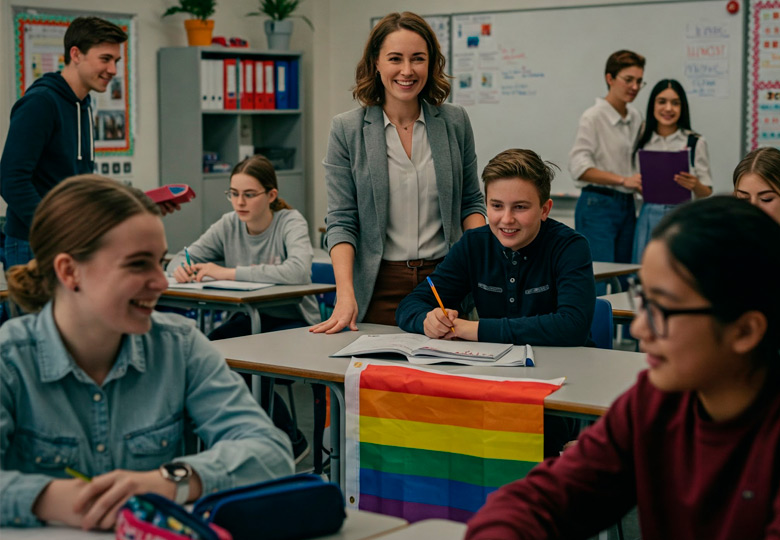
Every morning, thousands of children enter the classrooms with backpacks full of books, dreams… and sometimes, fears. For many LGTBIQ+ students, school has not always been a safe space. However, in recent years, something is changing. Discreetly but firmly, some educational centers are betting on inclusive education that recognizes, celebrates and protects diversity.
What is an inclusive school?
When we talk about “inclusive education”, we are not only referring to adapting content for students with special needs. Let’s go further. It’s about building an environment where every student—regardless of their gender identity, sexual orientation, expression, culture, or family situation—feels valued, respected, and free to be who they are.
An inclusive school not only teaches mathematics and language. It also teaches empathy, respect and critical thinking. It includes materials that make diverse realities visible, promotes language free of stereotypes and actively works against harassment. In short, it is not just a pedagogical model: it is an ethical and social position.
Real transformation examples
In Spain, some centers have already begun to implement pioneering programs. The CEIP Palmireno public school, in Alcañiz (Teruel), has been recognized for its commitment to gender equality and LGTBIQ+ visibility. Through workshops, adapted stories and teacher training, the center has managed to create a school climate where what is different is not hidden, but shared.
Another example is the Martí Pous Institute, in Barcelona, which works with external entities to accompany trans and non-binary students in their social transition within the educational environment. In addition, it offers specific training to teachers and administrative staff to guarantee respect for the chosen names and pronouns.
The key role of teachers
A school does not change only because of its walls, but because of those who inhabit it. Teachers are a fundamental agent to promote an inclusive perspective. But to do this you need tools, training and also institutional support.
Many times, the fear of “messing up” or lack of knowledge about sexual and gender diversity can stop teachers from intervening in situations of discrimination or including LGTBIQ+ content in their classes. For this reason, more and more training is being offered by entities such as Chrysallis, COGAM or FELGTBI+, focused on providing teachers with practical resources and secure frames of reference.
Curriculum and representation: what is not named does not exist
What happens when not a single homoparental family appears in textbooks? Or when the only LGTBIQ+ figures mentioned are presented in a tragic or marginal tone? Representation matters. And a lot.
Including positive and varied references in the curriculum not only benefits LGTBIQ+ students, but also the entire student body. Seeing different ways of loving, being and living reflected allows us to break down prejudices and broaden horizons. As the activist Audre Lorde said: “I will not be a free woman as long as there are still oppressed women”. We could paraphrase it like this: there is no true free education if we continue to silence identities.
Diverse families, diverse schools
An essential part of the change also comes from families. Associations of mothers, fathers and guardians have begun to play an increasingly active role in demanding more open, more plural, more humane schools. Dialogue between families and centers is key so that the inclusive message does not remain in the classroom, but rather permeates the entire educational community.
Some AMPA (Associations of Mothers and Fathers of Students) have promoted projects to make homoparental families visible, have created co-educational libraries or have even drafted specific protocols to address cases of LGTBIphobia in the school environment. Small steps that, added together, transform realities.
What if everything is not so ideal?
Now, it is also advisable to put the critical magnifying glass. Not all inclusive initiatives are as honest as they seem. Some private schools use the discourse of diversity as a marketing strategy without applying real structural changes. In other cases, protocols exist but are not enforced, or faculty feel pressured to avoid certain topics for fear of external reactions.

In addition, progress in inclusion is not always homogeneous: while some centers in large cities embrace diversity, many rural areas continue to face cultural resistance and lack of resources. Inclusive education advances, yes, but not without obstacles.
What can we do as a society?
The answer to this question is neither unique nor closed. Maybe it starts with something as simple as listening. Listen to children who feel different. To the teenagers who still don’t dare to speak. To teachers who want to improve but don’t know how. Listen, too, to the criticisms. And then, act.
Because school is not just a reflection of the world: it is a tool to transform it. And if we want a fairer, freer, more diverse world… shouldn’t we start in the classrooms?