

The Government recognizes the former prison colony of Fuerteventura as a symbol of Franco’s repression against diversity
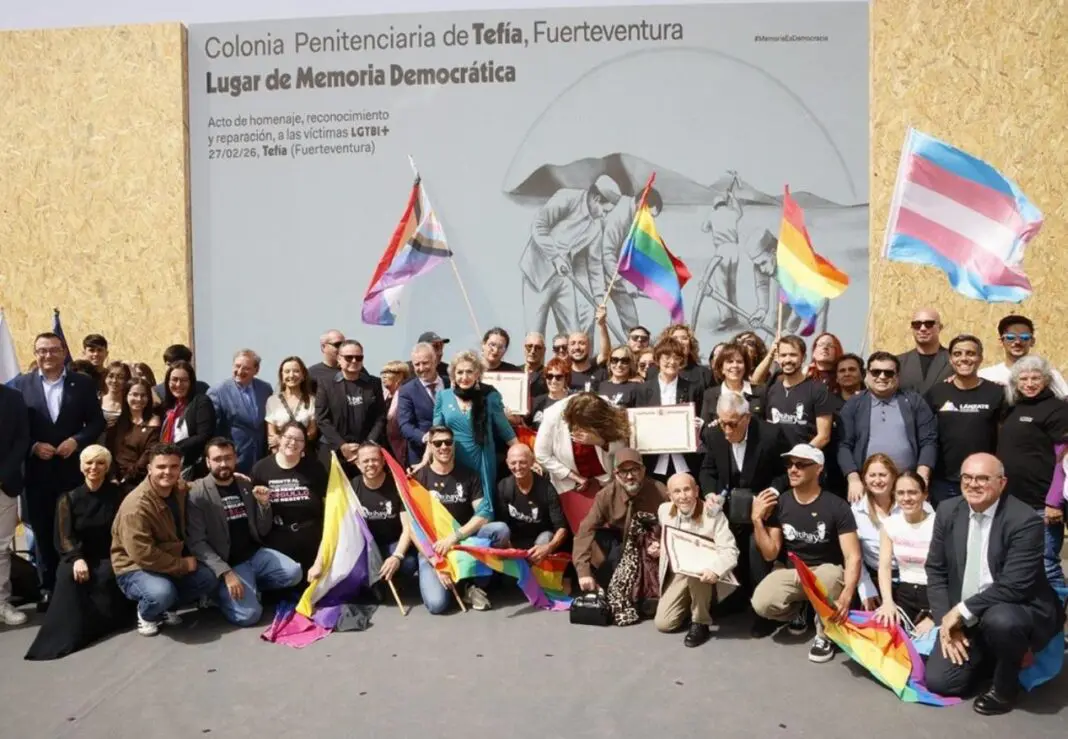
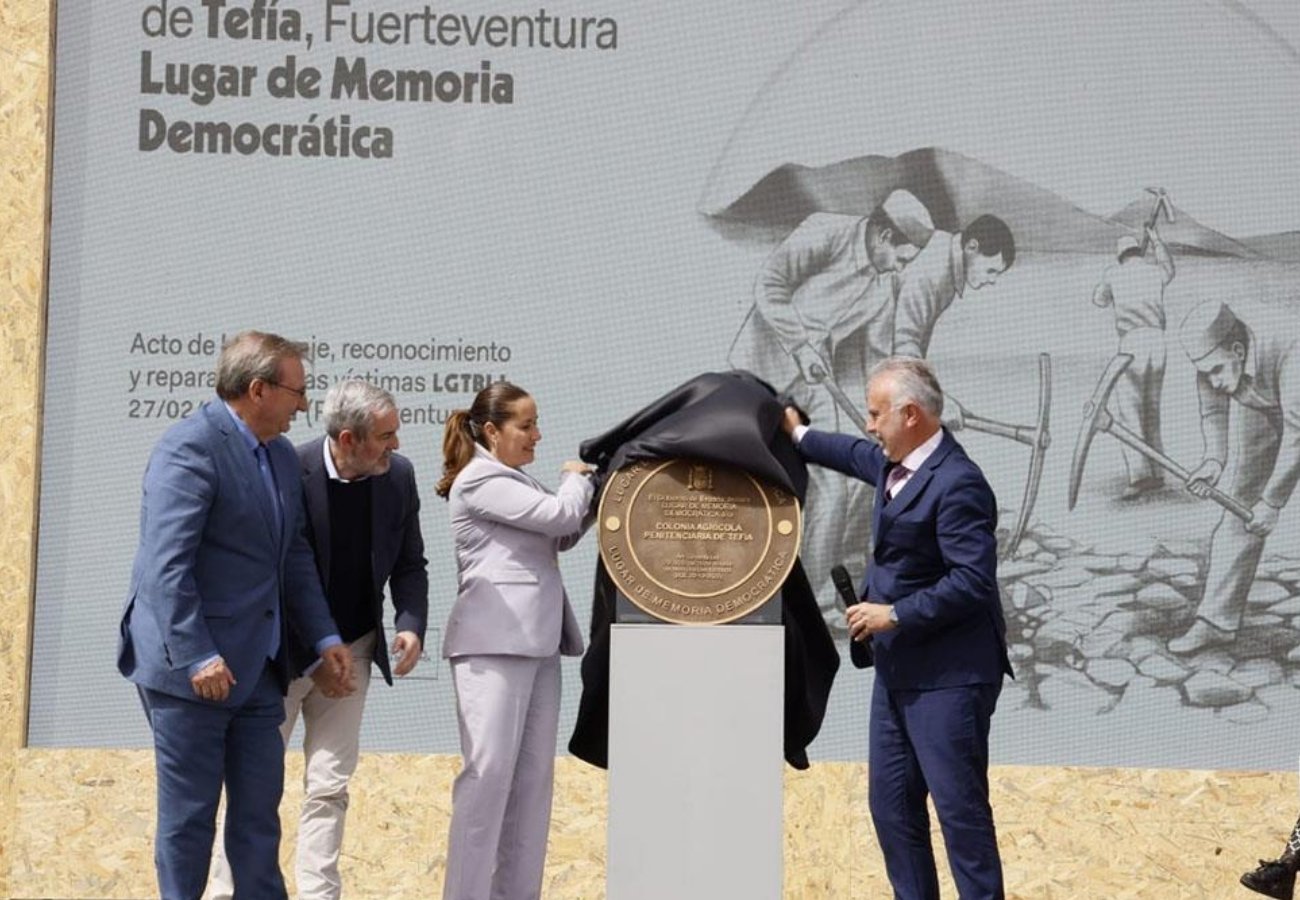
The former Tefía Agricultural Penitentiary Colony, in Fuerteventura, has been officially declared the first Place of Memory dedicated to the LGTBIQ+ collective in Spain. The space, which functioned between 1954 and 1966 as a forced labor camp for homosexual and transsexual people during the Franco dictatorship, thus becomes a state reference for democratic memory linked to repression due to sexual orientation and gender identity.
The declaration act was led by the Minister of Territorial Policy and Democratic Memory, Ángel Víctor Torres, who stressed that Tefía was “the symbol of the shame of a fascist regime” that punished diversity with institutional violence.
A forced labor camp for being who they were
For more than a decade, dozens of people were interned in Tefía under the Vagrants and Criminals Law and later the Dangerousness and Social Rehabilitation Law. There they suffered inhumane conditions: hunger, forced labor, beatings and systematic humiliation.

The declaration as a Place of Memory not only recognizes the physical space, but also the suffering of those who passed through it. During the event, ten declarations of Recognition and Reparation were delivered to victims and significant individuals and groups in the struggle of the LGTBIQ+ movement.
Because memory is not abstract. It has its own names.
Canary Islands and democratic memory
Tefía also becomes the first Place of Memory in the Canary Islands. The minister recalled that, although there was no war front on the islands during the civil conflict, there were thousands of arrests, disappearances and executions.
Ángel Víctor Torres defended that the seed of hatred sown by the Franco regime did not manage to erase the strength of LGTBIQ+ activism in the Canary Islands, historically one of the most deeply rooted in the country. He also recalled that the autonomous Trans Law was approved unanimously in the Canary Islands Parliament.
After Tefía, the next file already started is that of the Masonic Temple of Tenerife, which will be added to the 37 Places of Memory declared or in process throughout the Spanish territory.
A message against the setback
During his speech, the minister issued a warning: involutionist speeches are gaining space, especially among youth and on social networks.
“Being born free does not guarantee dying free,” he stated, appealing to the need to transmit to new generations what happened during the dictatorship.
Tefía’s statement is not just an institutional act. It is a political position in a context where LGTBIQ+ rights are once again being questioned in different parts of the world.
Debate, culture and reparation
The event included a panel discussion moderated by Celeste González, with the participation of the historian and activist Víctor Ramírez, the professor and activist Gracia Trujillo and Miguel A. Fernández, activist of the Pedro Zerolo Foundation.

The day was completed with cultural interventions and musical performances that reinforced the symbolic dimension of recognition.
Because remembering is also a collective act.
What does it mean to declare an LGTBIQ+ Place of Memory?
Converting Tefía into a Place of Memory implies shielding its history from oblivion and providing the space with a pedagogical dimension. It is not just about pointing out a building, but about institutionally assuming that persecution for sexual orientation and gender identity was state policy during the dictatorship.
The question that arises is inevitable:
Are we prepared to integrate this memory into the democratic narrative without diluting its specific LGTBIQ+ dimension?
Democratic memory is only complete when it incorporates all the victims.
And Tefía is already part of that official history.