

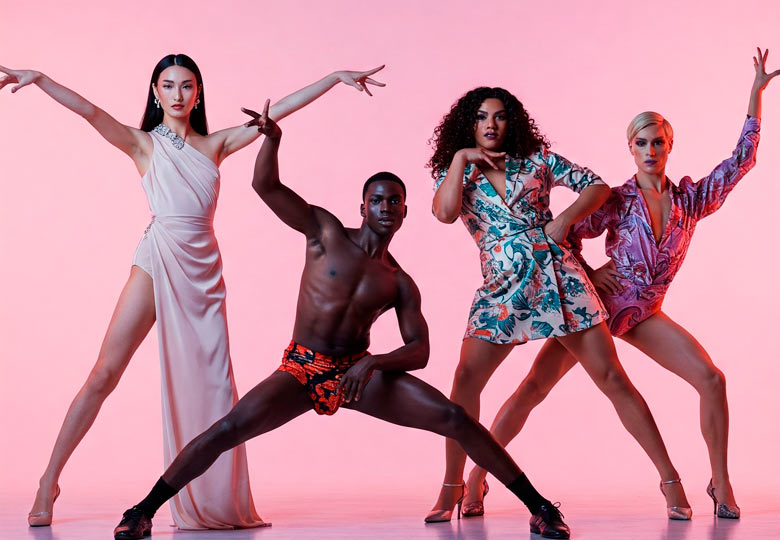
If you’ve seen someone dramatically throw themselves to the ground, contort their body as if defying gravity, or pose as if they were on a catwalk… you’ve probably witnessed a little piece of history. Voguing, more than a dance style, is a declaration of power, a celebration of identity and, yes, a revolution that has left a deep mark on music, cinema and pop culture in general.
But let’s start at the beginning. What exactly is voguing and where does it come from?
Voguing: A culture born from the margins
Voguing was born in New York in the 60s and 70s, in the ballrooms, those safe spaces where racialized LGTBIQ+ people—especially black and Latino people, many of them trans—gathered to parade, compete and, above all, be themselves. At a time when being queer, racialized, and poor was practically a sentence of exclusion (and in many cases, violence), the ballrooms became symbolic homes where the “houses” functioned as chosen families.

The dance style known as voguing is inspired by the poses in fashion magazines, especially Vogue (hence its name), and is characterized by angular, precise and very expressive movements. But this wasn’t just aesthetics: it was politics. Every pose, every duckwalk, every defiant look was a way of resisting, of saying “here I am and you are not going to erase me.”
From the clubs to the mainstream: the great leap of voguing
For a long time, ballroom culture was something very underground, very niche. Until Madonna arrived. In 1990, the queen of pop released her single “Vogue”, directly inspired by the balls and the voguing movements. Although the video clip (directed by David Fincher) and the song put the term on everyone’s lips, it also opened a debate that is still alive today: can a culture be made visible without appropriating it?
From there, the presence of voguing began to grow: choreography in video clips, fashion shows, television programs. Artists like Beyoncé, FKA Twigs, Rihanna or even Rosalía have incorporated ballroom elements into their shows or visuals. Is this homage or exploitation? There is not always a clear answer.
The big screen also gets carried away
In film and television, the ballroom influence has been equally powerful. Documentaries like “Paris Is Burning” (1990) put this culture on the map, although they also generated controversies over who got the credit (and the money). Years later, series like “Pose” (FX, 2018–2021), created by Ryan Murphy, Steven Canals and Brad Falchuk, went a step further by telling real stories featuring black and Latinx trans people, many of them with direct experience in theballs.
“Pose” not only brought to light an era devastated by the HIV crisis and institutional racism, but it elevated stars like MJ Rodriguez, Dominique Jackson and Billy Porter to a place that, until then, Hollywood had denied them.
And more recently, we have seen the phenomenon of “Legendary” on HBO Max, a vogue houses competition that has mixed the realitywith the pure essence of the ballroom. A little more sweetened, yes. But with impact, without a doubt.
Fad or cultural revolution?
Voguing is not just an aesthetic trend or a “cool dance”. It is a living heritage of struggle and collective creation. It is the basis of a culture that has influenced musical genres such as house, electro, pop and even hip hop, although it has not always been given the credit it deserves.
He has also contributed to the visual language of the video clip, from the shots and cuts to the costumes and sets. In many cases, without the general public knowing where all that they are consuming comes from. That’s where the importance of cultural memory comes in.

A necessary critical look
Now, not everything related to the rise of voguing and ballroom culture in the media is cause for celebration. There are those who point out that this visibility is sometimes superficial, reduced to an aesthetic without context. Big brands, cishetero artists or white production companies have capitalized on a culture that was born from exclusion. Where are the true pioneers in these spaces? Is the pie shared or do you only profit from what “sells”?
The challenge is to find a balance between recognition and appropriation. Because if a culture reaches the mainstream but its creators still lack access to resources, visibility or basic rights… something doesn’t add up.
Legacy, present and future
Today, voguing and ballroom not only live in video clips or catwalks: they are on TikTok, in urban dance workshops, in advertising campaigns, in Spotify playlists. But they are also still alive in the streets, in the clandestine balls, in the community centers, in every young queer who finds in that artistic expression a way to resist, to shine and to heal.
And although some people are discovering it today for the first time, this universe has been beating strongly for decades. Perhaps the best tribute we can pay is to listen to it, understand it and protect it.
Because in the end, voguing is not going to fit. It’s about breaking molds. To walk as if the world were yours, even when it seems to deny it to you.