
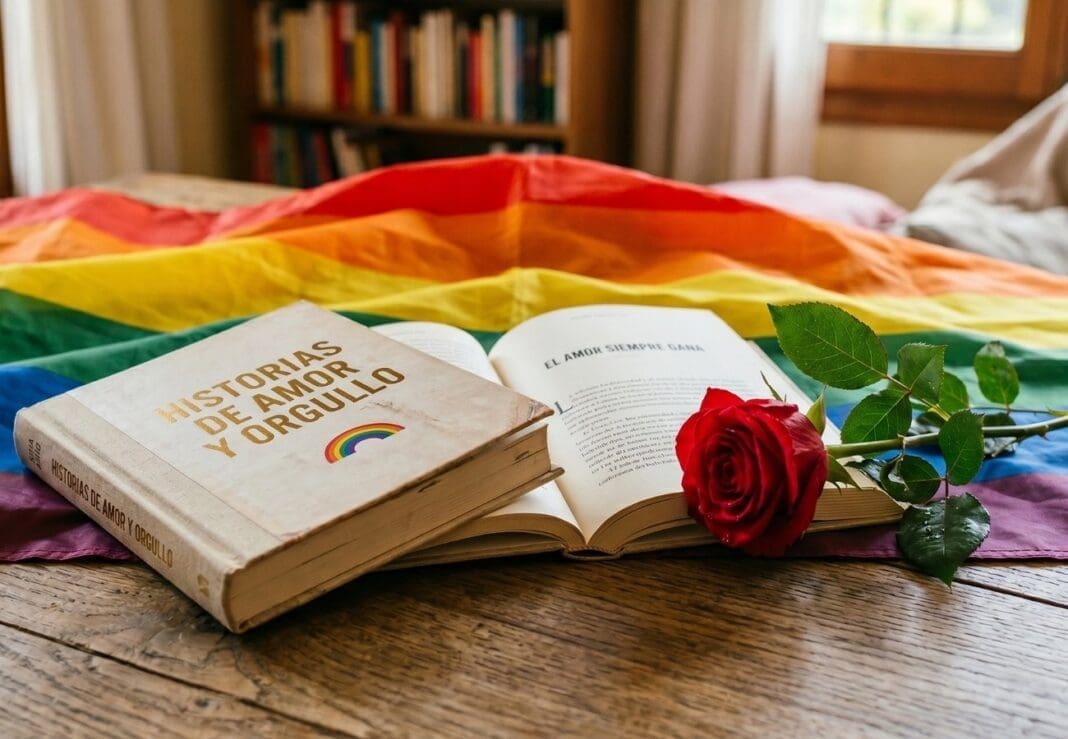
- The rose and the book are dyed rainbow on a day where trans, lesbian and gay visibility floods the bookstores.
- From the graphic novel to the political essay: we review the titles that are setting the pace in diverse narrative.
- We bring you our “chosen family” of readings so that you can be sure to get it right on this Book Day.
Sant Jordi is probably the most beautiful day of the year for those of us who love stories. The streets are filled with that smell of new books and fresh roses that fills everything. But this 2026, the LGTBIQ+ literature It’s not just a niche on a lost shelf; It is one of the great protagonists of the stops. Our literature has stopped being “clandestine” to become a driving force for sales and, above all, for social change.
Much more than love stories
LGTBIQ+ literature has experienced a true revolution in the last decade. We no longer just read stories about the trauma of coming out; Now our shelves are filled with science fiction plots, thrillers, activism memoirs, and poetry that celebrates our bodies. Reading diversity is an act of resistance and, in days like today, a way of saying that our lives deserve to be told with the same epic as any other.
5 LGTBIQ+ Recommendations for this Sant Jordi
If you’re going to wander between the stops and don’t know where to start, here’s our “Rainbow” selection to get you started:
1. For those looking for a new classic: The Bad Ones (Camila Sosa Villada)
If you haven’t read it yet, now is the time. A gem of trans literature that mixes the harshness of survival with a magical realism that breaks your heart and heals it at the same time.
It is a global phenomenon. Camila is an Argentine writer who narrates the life of a group of transvestites in the Sarmiento Park in Córdoba (Argentina). It’s raw, but it has a poetic beauty that blows your mind. He has won the Sor Juana Inés de la Cruz award.
2. To understand our present: The city of the living (Nicola Lagioia)
A literary true crime that dissects masculinity and the margins of society with fascinating rawness. Ideal for those looking for something intense and deep.
This is the only one that is not strictly “militant”, but rather a true crime based on a real murder that occurred in Rome. I have included it because it masterfully analyzes the shadows of masculinity and certain toxic gay environments.
3. To give (and give yourself) a graphic novel: Gender Queer (Maia Kobabe)
A book that has been censored in half the world and that today, in our free streets, must be a success. A perfect autobiographical guide to non-binary identity.
It is a graphic novel (a comic) that has become a symbol of the fight against censorship in the United States. It explains in a very didactic and personal way what it means to be non-binary and asexual.
4. National talent: The bad habit (Alana S. Portero)
Alana has established herself as one of the most powerful voices in our literature. His way of narrating trans childhood and youth in Madrid in the 80s is, simply, masterful.
It is, possibly, the most important LGTBIQ+ book written in Spain in recent years. Alana is a historian and activist from Madrid. The book tells the story of a trans girl trapped in a boy’s body in the San Blas neighborhood during the 80s and 90s. It is heartbreaking and brilliant.
5. Essay for reflection: The end of the closet (Bruno Bimbi)
A brilliant analysis of how we got here and the challenges that remain. Essential if you want to give a book that will generate debate at dinner tonight.
Bruno is a journalist who lived closely the fight for equal marriage in Argentina and Brazil. His book is a fundamental essay to understand where we come from and why we cannot let our guard down.
A rose, a book and a lot of pride
Sant Jordi is the festival of culture, and LGTBIQ+ culture is, today more than ever, culture for everyone. Giving a book on a diverse topic is not just a detail with someone from the group; is to open a window to new realities for any reader.
So today, whether on Las Ramblas or in your neighborhood bookstore, look for the rainbow between the pages. Because there is no dragon that can resist a good story and there is no knight (or princess, or non-binary person) who will not be moved by a book that talks about freedom. Happy Sant Jordi!