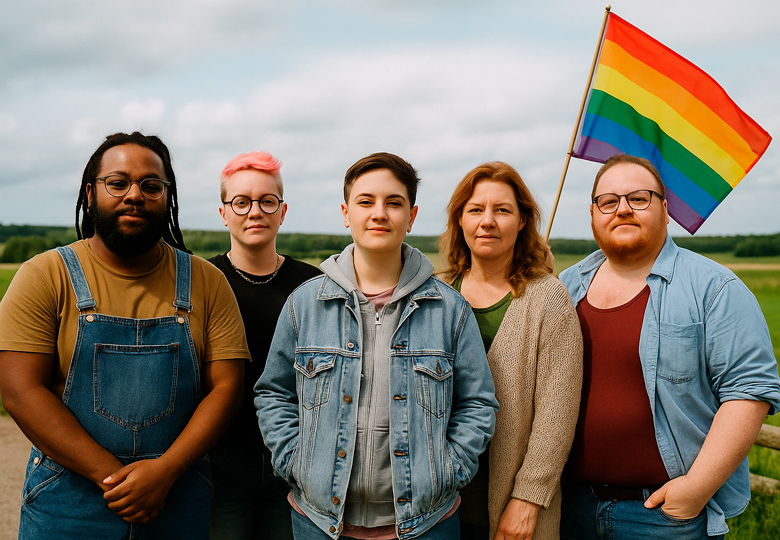

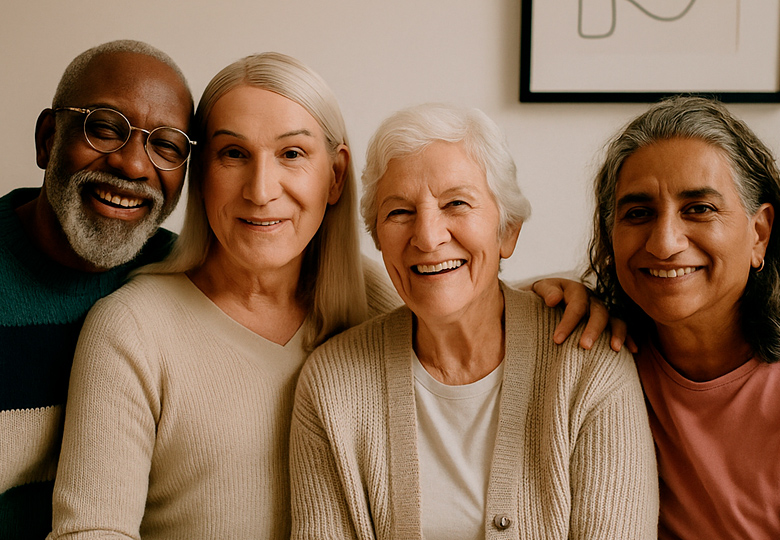
When we talk about diversity, we often forget a key stage of life: old age. What happens when the passage of time reaches those who are part of the LGTBIQ+ collective? Who takes care of queer seniors when the system doesn’t?
For decades, many have lived in hiding, rejected by their families or made invisible by society. And now, upon reaching old age, they face a doubly hard reality: that of growing old in a world that still does not understand them, and that of doing so often alone.
Why talk about queer care?
Queer care is not just a way to address physical or medical needs. It is a way of recognizing life trajectories marked by dissidence, exclusion and resistance. It is, at its core, a form of justice.

Older LGTBIQ+ people have been pioneers, silent activists or survivors of times where loving who you wanted or living how you felt was illegal, immoral or dangerous. Taking care of them today is also taking care of our collective memory.
Loneliness as a structural wound
One of the great challenges is the lack of traditional family networks. Many queer people have no direct descendants or contact with their families of origin. Some were expelled from home. Others simply never fit the mold.
This means that, when they reach old age, they find themselves without close support. Loneliness, more than a feeling, becomes a structural problem that affects your physical and emotional health.
In addition, facing residential centers that do not respect their identities, healthcare personnel without training in diversity, or LGTBIphobic roommates, multiplies the obstacles. Invisibility does not disappear with age; sometimes it is accentuated.
Chosen Families: The Strongest Refuge
In the face of all this, a powerful response appears: chosen families. Deep friendships, networks of affection, ex-partners who become caregivers, support groups created by affinity and affection beyond blood ties.
These networks function as an emotional and, many times, also economic or logistical support system. Shifts are organized, tasks are distributed, they are supported. It is no coincidence that, in the collective, the word “family” has such a broad and tender meaning at the same time.
Chosen families not only care; They also claim that there are other ways of aging, more dignified, more free, more ours.
Alternative care models that are changing the game
In recent years, initiatives have emerged that question the classic residence model. Here are some examples that deserve full visibility:
🏘️ Cohousing LGTBIQ+
Projects where several older queer people share a common space, with independence and autonomy, but also with company and mutual care. An example is the 55+ LGBT Housing project in Madrid, or the pioneering Barbary Lane in the United States.

🫶 Intergenerational communities
Spaces where people of different ages coexist within the group, promoting the exchange of experiences and mutual support. It is about avoiding the ghettoization of old age and promoting dialogue between generations.
🤝 Queer neighborhood support networks
Some groups are creating support groups, solidarity networks and time banks between people in the group, especially in urban neighborhoods. They are not formal structures, but they operate on the force of shared affection.
The importance of an intersectional perspective
Not all LGTBIQ+ older people experience the same difficulties. Those who are racialized, migrant, have disabilities, or come from rural contexts face even more barriers. That is why it is key to apply an intersectional perspective when thinking about care.
It is not just about taking into account gender orientation or identity, but all the layers that go through a life and that influence how one accesses care (or is expelled from it).
And what about the State?
Here comes the big question: where is the public system? Dependency care, health and residence policies are still far from considering sexual and gender diversity as a specific need.
There is a lack of professionals trained in diversity, adapted materials, safe spaces and staff who respect names, pronouns and trajectories. Meanwhile, the burden continues to fall on informal networks that, although brave, should not be the only ones responsible.
⚠️ A critical look: is the community model sustainable?
Although the model of community networks and care is beautiful and necessary, it also has its limitations. What happens when those networks are broken or do not exist? Are we idealizing self-management when in reality real public investment is needed?
We cannot forget that caring costs time, energy and money. And that, although affective activism saves lives, it should not replace rights guaranteed by law. Self-management is valuable, yes, but it cannot be an excuse for institutional inaction.
Caring is resisting, but it is also imagining
Thinking about queer care in old age is also imagining possible futures where growing old is not a sentence, but one more stage of the journey. A future where we can do it surrounded by those who understand us, without hiding who we were or who we are.
Maybe we don’t have all the answers. But we do know that a system that ignores its elders, especially the most vulnerable, is an incomplete system. Taking care of each other is just the first step. The rest is demanding that the world also takes care of us.