
When we talk about diversity, we often think of big cities. Places where there are associations, safe spaces, Pride events and a certain sense – albeit relative – of freedom. But what happens outside of that map? What happens in towns, in rural environments, where rainbow flags don’t fly so easily?
This article wants to give a voice to those who engage in LGTBIQ+ activism from the periphery. Because yes, there is also struggle, resistance and pride there.
The rural also exists… and resists
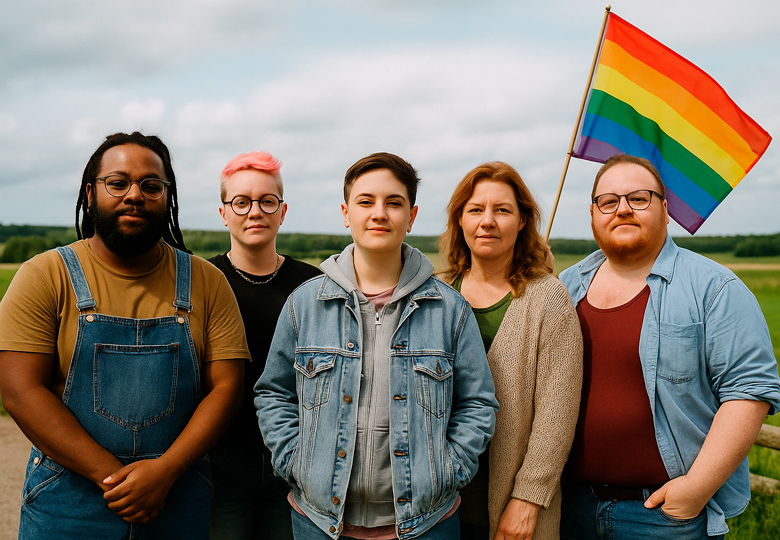
Although LGTBIQ+ visibility has historically been associated with urban contexts, many queer people live, love and resist in small towns, villages or agricultural environments. And they don’t always do it quietly.
There, activism takes different forms. Sometimes, there are no registered associations, but there are secret meetings, emotional networks, improvised workshops or handwritten banners for the first Regional Pride.
And that, believe us, is also activism. Even if it’s not on TV.
What does activism mean in a town?
Doing activism in rural areas is not the same as in the city. Here are some realities that give it its own character:
-
Greater personal exposure: In small towns, everyone knows everyone. Coming out or defending certain rights can lead to stares, comments or even retaliation.
-
Lack of anonymity: many people live in fear that their family, neighbors or boss will discover their orientation or identity.
-
Shortage of resources: there are no LGTBIQ+ houses, no specific safe spaces, nor specialized psychologists.
-
Constant travel: to participate in events or access services, you often have to travel kilometers.
- Advertisement - -
Activist loneliness: sometimes there is only one visible person in the entire town. Imagine what that weighs on his shoulders.
Still, many of those people are still there. Struggling. Enduring. Proposing new things. Imagining possible futures where today there is only silence.
Stories that break the mold
To better understand what it means to be an activist in rural areas, it is key to listen to those who live it. Here are some testimonies collected in different territories of the Spanish State:
Sara, 27 years old, Teruel:
“When I hung the first LGTBIQ+ flag on the façade of the cultural center, there were people who told me it was a provocation. But a week later, an older woman thanked me for ‘daring’. It turned out that her grandson was gay and had never told him about it in the town.”
Álex, 34 years old, Ourense:
“I am the ‘town faggot’, but I am also the one who organizes the diversity days at the rural school. At first they laughed, now they ask me when the next one is.”
Marina, 52 years old, Jaén:
“I have been a visible lesbian since the 90s. I was fired from work once. Now I have a bookstore where I sell queer literature. It is my way of continuing to be active.”
They are not big campaigns or big names. But they change lives, one conversation, one sign or one hug at a time.
Rural prides: small but brave
In recent years, rural Prides have emerged in places such as Aguilar de la Frontera, Zafra, Ponferrada or Banyoles. Many of them organized by grassroots groups, young people or even by feminist associations that integrate the LGTBIQ+ perspective.
They are simple events: talks, film forums, concerts, visibility walks. But they have a huge impact. In some cases, it is the first time that a person sees a trans flag flying in their region. Or the first time a grandmother asks what “non-binary” means.
What’s stopping them?
Although rural activism has enormous power, there are also obstacles that we cannot ignore:
-
Lack of financing: cultural budgets tend to focus on capitals.
-
Political pressures: in certain territories, there is a decline in rights promoted by conservative or far-right parties.
-
Religion and tradition: they still weigh heavily in public life and in the collective imagination.
-
Excessive self-demand: since there are not many visible people, those who are visible feel that they must “represent the entire group.”
Despite everything, they continue. And that’s what makes their work deeply valuable.
What can we do from the cities?
This is an important point. Many times, from urban environments, rural areas are viewed with condescension or paternalism. As if everything was “to be done.” And no, it’s not like that.
From the cities we can:
-
Listen without imposing.
-
Support with resources, without impersonating local processes.
-
Make visible without appropriating.
-
Make a network, not a hierarchy.
-
Report when rights are violated, without the need for there to be an official “headquarters”.
Because struggles do not only occur where there are big banners, but where someone dares to exist out loud.
❗A critical look: what if we romanticize rural struggle?
Sometimes, without meaning to, we fall into the trap of idealizing activism in towns as if it were purer or braver. And although it has its power, it can also be painful, exhausting and even dangerous.
There are activists who burn out, who leave, who abandon because they can’t take it anymore. Because they feel that everything depends on them. And that must also be told.
Urban support cannot be just symbolic. It has to be translated into real tools: training, media, alliances, institutional presence. Not everything is resolved with visibility.
Conclusion: let the periphery stop being so
LGTBIQ+ activism in rural areas is neither “less important” nor “less advanced.” It’s different. Sometimes lonelier, yes. But also more intimate, more resilient and deeply transformative.
It may not have as much press, but it has names, faces and memories that deserve to be told. And listened to.
So the next time you think about queer activism, don’t just imagine capitals or big cities. Also think about that small town where someone dared to speak… and changed the world of those who listened to them.