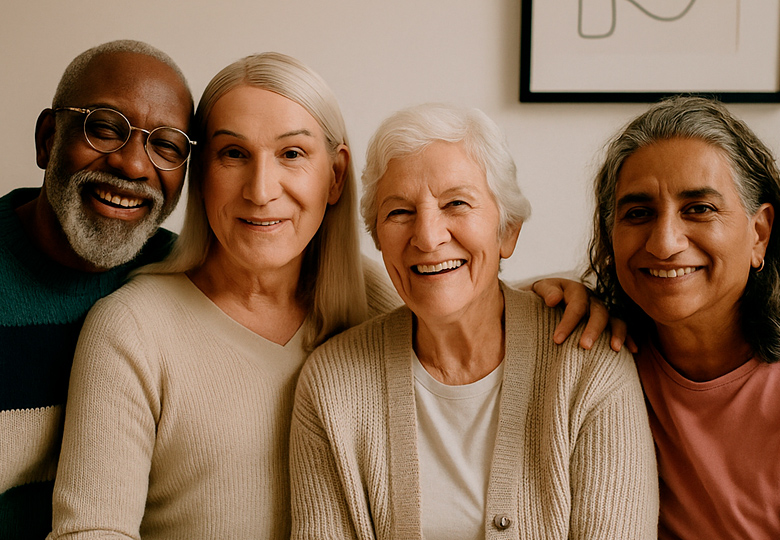


When we talk about family, most imagine a very specific model: mother, father, children, a house, maybe a dog. But for many within the LGTBIQ+ collective, the word “family” has another meaning. A deeper one. More real. More free.
In a world that often rejects us for being who we are, choosing each other is an act of radical love. And building new ways of being, caring and accompanying is also making history.
What is a chosen family?
A chosen family is not united by blood or paper. It is united by strong emotional ties, by mutual support, by commitment. It’s that group of people with whom you can be yourself without fear. Who hold you on the bad days, celebrate your achievements, and help you pick up the pieces when the world breaks.
It can be made up of friends, ex-partners, neighbors, roommates, older people in the group, people who met in therapy, in a drag workshop, at a demonstration. There are no rules. Real links only.
Why do chosen families arise?
For many LGTBIQ+ people, the traditional family unit has not been synonymous with protection. On the contrary: it has been a place of rejection, violence or incomprehension.
Coming out, transitioning, or simply existing visibly has broken relationships that seemed unconditional. And faced with this rupture, a part of the collective has had to build another network. A more honest one. More loving. Safer.
It also occurs in contexts where there is no explicit violence, but there is emotional distance. Phrases like “I accept you, but don’t show it”, “you don’t need to talk about it” or “it’s not a big deal” also leave wounds. And in those cracks, sometimes, a chosen family appears.
What does a chosen family offer that others don’t?
Every family is a world, that is clear. But the chosen families usually share some common characteristics:
-
Full acceptance: your identity is not negotiated. You are who you are, without having to explain yourself all the time.
-
Mutual care: from the emotional to the practical. Someone who accompanies you to the doctor. Who cooks for you when you can’t take it anymore. Who stays over if you need it.
- Advertisement - -
Unconditional support: in breakups, moves, moments of crisis or important decisions, they are there. They don’t ask why, they ask how to help you.
-
Celebration of diversity: in these families difference is not only tolerated, it is celebrated. It becomes a source of pride, not shame.
- Publicidad-
When choosing yourself is saving yourself
We are not exaggerating if we say that chosen families have saved lives. Literally.
For trans people, non-binary people, migrants, people with HIV, racialized people, people with disabilities… having a network that does not question you or abandon you can be the difference between sinking or sustaining yourself.
There are stories of people who have gone through family expulsions, shelters or institutional violence and have found the only real refuge in their queer friends, their transvestite sisters or their dyke community.
Examples of chosen families that inspire
-
In Barcelona, a group of migrant trans women call themselves “the aunts” and take care of other newcomers as if they were children.
-
In Seville, a self-managed queer house functions as a support network where young people expelled from their homes coexist.
-
In Galicia, an older gay couple takes care of a non-binary boy they met at a talk. “We are his network. He is our future,” they say.
These stories don’t appear in Christmas ads. But they are as much a family as any other. Or more.
What can we all learn from the chosen families?
Chosen families teach us that:
-
Love does not need imposed rules.
-
Care can be horizontal, shared, fluid.
-
The family can be a safe space, not a cage.
They remind us that there are other ways to accompany each other that do not depend on DNA or the signature of a notary. Sometimes the most important thing is to ask yourself: who do I feel free with?
And being part of a chosen family is not a plan B. It is a beautiful plan.
⚠️ A critical look: what if we romanticize too much?
While chosen families are powerful, they can also hurt. They are not free from conflicts, from hierarchies, from silences. Sometimes we idealize the idea so much that it is difficult for us to recognize when a dynamic is no longer healthy.
In addition, in the absence of institutional support, these networks take on tasks for which they are not always prepared: medical assistance, long-term care, complex emotional support… and that can be exhausting. Taking care of yourself also means being able to set limits within your chosen family.
The solution cannot be just emotional. It has to be structural.
What if we change the question?
Instead of asking “what is a family”, perhaps we could ask “who supports you”. And from there, rethink everything else.
Perhaps your family is your lesbian neighbor, your ex with whom you continue to share confidences, your group of trans friends who come together when everything goes wrong, your roommate with whom you share the groceries and the sorrows.
Perhaps your family is you, with your wounds, your choices and your bonds forged from real love. And that’s fine too.