
Because understanding who we are (and who others are) is an act of respect
Talking about gender identities and sexuality is not just a matter of labels. It’s talking about lives. Of unique experiences. Of paths that do not always fit into what we were taught as “normal.” Therefore, this article is not intended to give you a closed definition of each identity, but rather to open the door to an expanding universe.
We live in a world that, for centuries, has tried to divide everything into two: man or woman, gay or straight, male or female. But reality is much richer, fluid and complex. So if you’ve ever wondered what all those acronyms, colors or terms you see on networks or on Pride banners mean, stay, let’s explore it together.
Why is it important to talk about identities?
Because representation matters. Naming things gives power. When someone discovers that there is a word that defines what they feel, they often find relief. She realizes that she is not alone, that there are others like her. And also, because understanding these identities allows us to create safer and more respectful spaces.
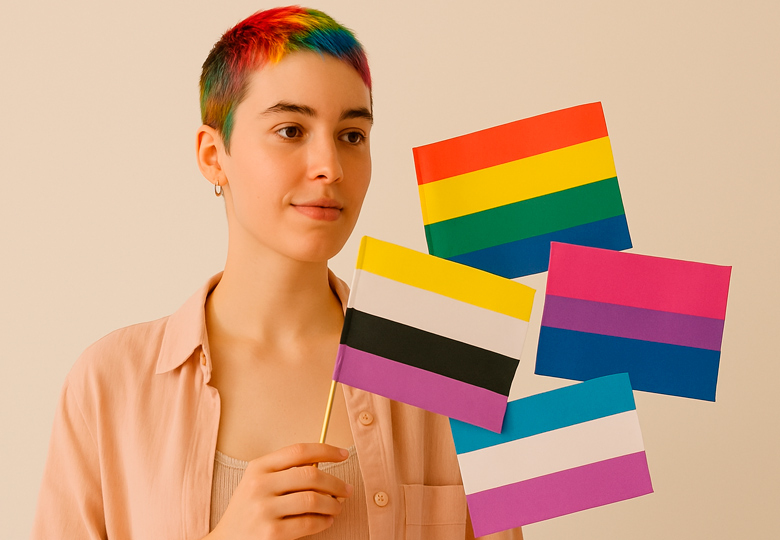
And yes, it may seem confusing at first. But it’s okay to not know everything. The key is to listen with curiosity, not judgment.
Sexual and gender identities: how are they different?
Before getting into the list, it is worth clarifying something:
-
Gender identity: it is how a person perceives themselves in terms of gender (man, woman, both, neither, something else…).
-
Sexual orientation: it is who we feel sexual, romantic or emotional attraction towards.
-
Gender expression: it is how we show our gender to the world (through clothing, the way we speak, gestures…).
-
Sex assigned at birth: this is the medical classification with which we are born (male, female or intersex), based on genitals and chromosomes.
And now, let’s go with diversity.
Gender identities and sexual orientations: a not-so-quick guide
Trans
A trans person is someone whose gender identity does not match the sex they were assigned at birth. It can be a man, a woman, non-binary, etc. Not all trans people medically transition, nor do they have to.
Non-binary
Gender identity that does not conform to the male-female binarism. They may feel somewhere in between, fluctuating, or completely outside that logic.

Agender
People who do not identify with any gender. They tend to feelneutral or disconnectedwith the idea of gender in general.
Gender fluid
Identities that change over time. A person may feel more masculine one day and more feminine another, or vary spontaneously.
Biggender
They identify with two genders simultaneously or at different times. For example, female and non-binary.
Intergender
Identity related to people who fall between or beyond traditional genders, sometimes with biological connection or intersexuality, but not always.
Neutrois
Non-binary identity defined as neutral or genderless, with a strong sense of not fitting into male/female.
Androgyny
Expression or identity that combines traits traditionally considered “masculine” and “feminine”. Some people identify as androgynous in terms of gender, others only in terms of aesthetics.
Genderqueer
Umbrella term for gender identities that challenge the norm. Non-conformist, disruptive, fluid. It can be used as a synonym for non-binary, but not always.
Two-Spirit
Indigenous identity of some indigenous peoples of North America. Designates people whoembody both masculine and feminine qualities, and who traditionally had a specific spiritual and cultural role.

Sexual, emotional and relational orientations
Gay
Man who is attracted to other men. It is also sometimes used generally for homosexual people, although many women prefer the term “lesbian.”
Lesbian
Woman who is attracted to other women. There are also non-binary women who identify as lesbians.
Bisexual
People who are attracted to more than one gender (not necessarily to the same extent). It is not a “phase”, nor confusion.
Pansexual
Attraction towards people regardless of their gender. It is sometimes confused with bisexuality, but it is not the same. The key is in the way that attraction is experienced.
Asexual
People who do not feel sexual attraction, or feel very little of it. It does not mean that they cannot have a partner, relationships or emotional desire.
Demisexual
People who only feel sexual attraction when there is a strong emotional bond. They are within the asexual spectrum.
Aromantic
People who do not feel romantic attraction or feel it differently than the norm. There is also the grey-aromantic spectrum.
Skoliosexual
Attraction to non-binary people or people outside the gender binary. It is a little-known but real orientation.
Other ways of experiencing diversity
Intersexual
People who are born with sexual characteristics (genitals, chromosomes, hormones) that do not fully fit into the binary classification. Being intersex does not imply a specific gender identity.
Polyamory
Relational model that involves having multiple romantic relationships (not just sexual), with the consent of all parties. It is not the same as open relationships or infidelity.
Leather
Subculture within the LGTBIQ+ collective linked to BDSM, leather and alternative sexual practices. It has its own flag and codes.
Bear
Large gay men, with hair and a more traditional “masculine” aesthetic. It is a cultural identity within the gay community, with a strong sense of community.
Drag Pride
Refers to the pride of people who explore and express identities through drag, as art and performance. It is not a gender identity, but it is a political way of challenging norms.
Progres Pride
It is not an identity, but an evolution of the Pride flag, which includes trans, racialized and intersex colors, for a broader and more inclusive representation.
Are so many labels helpful or confusing?
This is a question that comes up a lot. Some people feel that there are “too many labels” and that this can confuse more than help. But others defend that naming things allows them to exist with more security. Who decides how many labels are “too many”? Why does diversity bother us when it doesn’t directly affect us?
The important thing is to understand that no one is obliged to label themselves. You can use one, several or none. And that’s fine. What we shouldn’t do is invalidate words that other people have found useful in defining themselves.
What if I don’t fit in?
Well… nothing happens! Many people spend years wondering “what I am” and do not come to a definitive answer. That doesn’t make you less valid. Labels are there to help us, not to limit us. If one works for you, perfect. And if not, too.
The important thing is that you can live your identity freely, without fear and with respect.
Some keys to understanding and respecting diversity
-
Don’t assume anything based on someone’s appearance.
-
Ask respectfully if you are confident, but do not interrogate.
-
Use the language that person chooses for themselves.
-
Don’t correct someone who talks about their experience just because it doesn’t match what you know.
-
And remember: no one owes you a full explanation of their identity.
Why does this matter so much?
Because recognizing diversity saves lives. Because there are still people who live in fear, who feel alone, who can’t find references. Because ignorance generates prejudice, and prejudice generates violence.
And because, at the end of the day, naming, understanding and respecting ourselves is also a way of loving ourselves. To ourselves and to others.