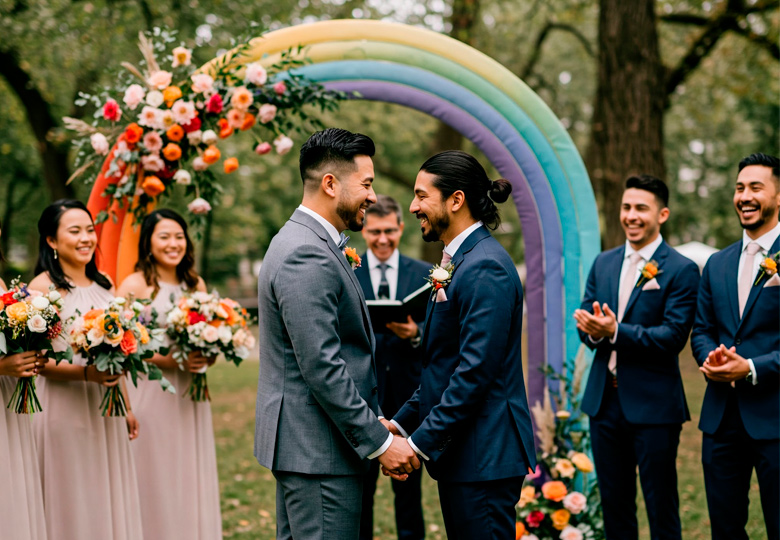


In the universe LGTBIQ+, there is a word that beats strongly: family. But we don’t always talk about blood family. Many times, we talk about the chosen family, that emotional support network that we build along the way. People who are there when the biological family can’t (or won’t) be there. Companions in life, in struggle and in celebration. Friends that become home.
What is a chosen family?
It may seem like a simple concept, but it contains a complex reality. The chosen family is that group of people—friends, couples, roommates, even exes—with whom we share affection, care, routines, existential crises, WhatsApp memes and good hugs. There are no contracts or legal ties. What unites is loyalty, empathy and, above all, the freedom to choose who accompanies you.
For many LGTBIQ+ people, this network is not just a pretty alternative. It’s a necessity.
When biological is not enough
Not everyone grows up in an environment where they can be who they are without fear. Family rejection, expulsions from home, emotional or physical violence, silences that hurt more than a scream. These realities are still present —although sometimes they are not seen as much in official statistics— and disproportionately affect queer people, especially trans, non-binary and racialized youth.
In that context, having a support network is literally a matter of survival. We are not exaggerating. According to several studies, emotional support in contexts of exclusion significantly improves mental health and reduces the risk of suicide. And in that network, many times, the first thread is a friendship.
More than colleagues: deep links
Queer friendships are not usually superficial. They are woven with an intensity that may sometimes seem exaggerated from the outside, but which responds to a real need to belong. It’s not uncommon for a queer friendship to last longer than many romantic relationships. Because there is something very powerful about sharing a common story of resistance, of shared learning, of healing together.
And yes, also about laughing at the bar, taking care of yourself when there is a breakup, helping yourself with a move or accompanying yourself to the doctor. Small everyday gestures that, added together, build a bond as strong as any traditional family bond. Sometimes even more.
Culture and community: from ballrooms to queer houses
If we look at history, we will see that this is not new. The “houses” of the ballroom movement (yes, as in Pose) are an iconic example of a chosen family. In the midst of the HIV crisis in the 80s and 90s, many trans and racialized people were rejected by their families of origin. This is how the houses were born: spaces of welcome, care and belonging, led by queer “mothers” and “fathers” who protected, taught and gave unconditional love.
Today, that tradition is still alive, although it takes new forms: from support groups to digital communities, to shared apartments that are more family than any Christmas dinner.
Not everything is rosy: conflicts also exist
Now, let’s not idealize. Chosen families can also have their shadows. Friendships are not always healthy. Sometimes we idealize these bonds so much that we ignore the limits. And what happens when there is emotional dependence? Or when a friendship breakup feels like a divorce?
In addition, in some cases, this support network cannot cover all the needs that a traditional institutional or family network would cover: economic support, stable housing, long-term care… It is not fair that queer people have to rebuild from scratch what others receive by default.
The chosen family is powerful, yes, but it should not be an excuse for society to ignore its responsibilities towards the LGTBIQ+ group.

What if we started to redefine the concept of family?
Perhaps it is time to question whether the family, as it has been traditionally conceived, is still the model that serves us. What if we stop understanding it as something biological and start seeing it as a constellation of affects? What if we accept that love, care and commitment can exist beyond the last name?
The chosen family is not only a refuge; It is also a form of resistance. That is to say: “even if the world does not recognize me, I decide who I walk with.”
A critical look: break with everything or integrate what is possible?
Although the idea of breaking away from one’s biological family can be liberating, it can also create internal dilemmas. Not everyone wants or can cut those ties. Sometimes there are attempts at reconciliation, middle paths, complex relationships that oscillate between love and pain. Idealizing the breakup as the only valid option can also be unfair. What happens when there are queer people who do find support in their biological families? Or when they don’t feel the need to “choose another”?
The key is to allow each unit to decide what type of network it needs, without judgments or closed molds.
Conclusion: choose yourself to survive, take care of yourself to live
Queer friendships, those that sometimes start with a knowing look in a bar or a match on an app, can end up being the closest thing to a real family. One that is not based on blood, but on something deeper: mutual care, honesty and support in difficult times.
Not everyone understands what it means to have to choose a family. But those who have done it know that, many times, that is where true freedom begins.