
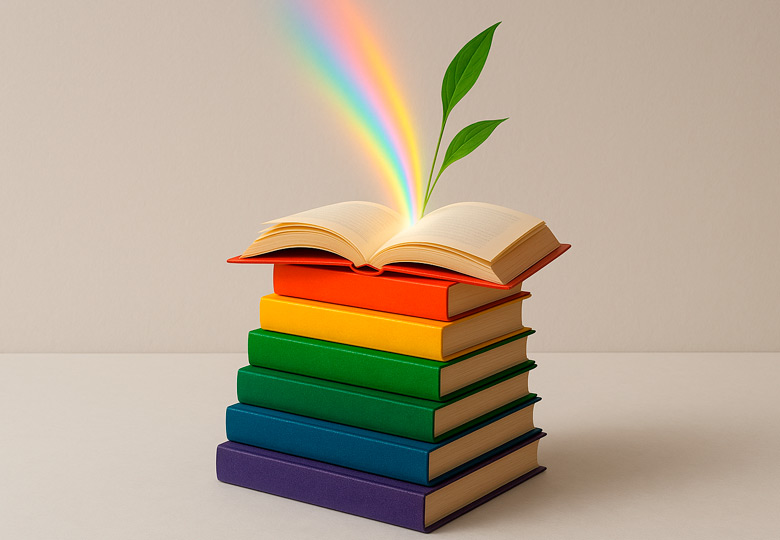
Have you ever read a book and felt like someone was finally telling your story? For many, LGTBIQ+ books are more than literature: they are mirrors, refuges and weapons. We are not exaggerating. When you come from a reality in which you rarely see yourself reflected, finding yourself between pages can be transformative. But… what really are LGTBIQ+ books and why do they have such an important—and necessary—place on today’s shelves?
What do we understand by LGTBIQ+ literature?
The label may seem broad, and it is. Broadly speaking, we are talking about works that address issues related to sexual, emotional and gender diversity. Sometimes their protagonists are queer people; other times, the plot revolves around conflicts, experiences or discoveries linked to the collective. They can be novels, poetry, essays, biographies, non-fiction stories… The range is enormous and continues to grow.
Of course, you have to be careful about simplifying. Not everything that includes queer characters is automatically an “LGTBIQ+ book” from a representative perspective. It also matters how it is told, who writes it and with what perspective the story is constructed.
A little history: from the forbidden to the celebrated
For a long time, LGTBIQ+ literature lived on the margins. Sometimes censored, other times silenced, and almost always ignored by the major editorial circuits. But even in the most hostile contexts, there were always those who wrote from dissent. Authors like Jean Genet, Audre Lorde and Reinaldo Arenas broke barriers and left their mark.
In recent decades, something has changed. Visibility grew, independent publishers began to support queer voices, and the reading public began to demand stories that reflected the plurality of lives that exist. Today, although there are still obstacles, we find LGTBIQ+ literature at fairs, awards, school libraries and even lists of bestsellers.
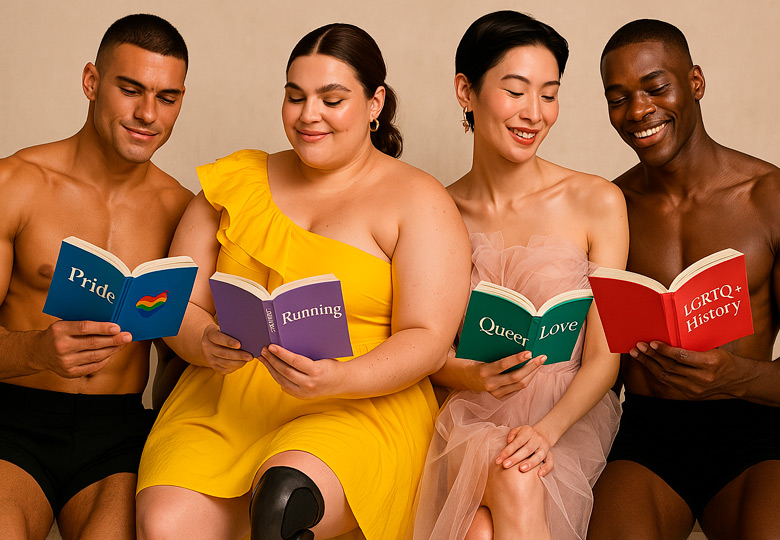
It’s not just about “visibility”
Representation is key, of course. But it is not enough to “see ourselves” in a story. We also want careful, complex narratives that do not fall into stereotypes. Because although stories of coming out or bullying are still necessary, we cannot stop there.
We need queer science fiction, romantic novels with trans people as protagonists, thrillers with non-binary characters that don’t die mid-plot. We want diversity within diversity. Why would an LGTBIQ+ story always have to be dramatic? Where are the comedies, the adventures, the dystopias with happy endings?
Authors who are leading the way
It is difficult to make a list without leaving many out, but here are some names that are making people talk (and read):
-
Andrea Abreu: although she does not define herself exclusively as a queer author, her way of portraying the affective and the corporal challenges norms from subtle and powerful places.
- Advertisement - -
Gabriela Wiener: mixes essay and autofiction to explore desire, polyamory, gender and identity from an intimate perspective.
-
Ocean Vuong: Vietnamese-American poet and novelist, whose work On Earth we are fleetingly great is pure queer lyricism.
- Publicidad-
-
Alana S. Portero: with The Bad Custom, she gives us a novel as honest as it is necessary about the childhood and adolescence of a trans woman on the margins of Madrid.
-
Kiko Amat, Elvira Sastre, Paul B. Preciado, Poppy Brite… Each unit, in its own way, adds unique voices to the map of diverse literature.
What are we looking for in these stories?
Whatever anyone. Emotion, beauty, truths, fiction. But also something else: the certainty that our lives deserve to be told. That there is room for our doubts, our desires, our contradictions. That we are not alone.
And many times, queer stories don’t just entertain or inform. They heal. They accompany. They teach. They open new worlds. Or they simply tell us: “what you feel, you are not making it up.”
You also have to look critically
Now, not all that glitters is gold. With the rise of diversity as a market value, there are editorials that include LGTBIQ+ characters to meet quota or ride the wave, without a true commitment to the group. What happens when a big company launches a “queer” collection only during Pride month? Or when a book that claims to talk about trans identity reinforces transphobic ideas?
Sometimes, even within activism, tensions arise: who has the right to tell which stories? Is it valid for a cishetero person to write about queer characters if they do so with respect? There are no easy answers. But these questions are worth asking. Reading with a critical eye is also a way of taking care of each other.
Recommendations to start (or continue)
If you are delving into LGTBIQ+ literature, here are some recommended works —very varied in tone, genre and origin:
-
Stone Butch Blues by Leslie Feinberg (a classic of trans and lesbian activism)
-
Cassandra by Lola Robles (science fiction with a non-binary perspective)
-
Call Me By Your Name by André Aciman (yes, the book before the movie)
-
Disobedient Mom by Esther Vivas (although it is not an LGTBIQ+ book as such, it reflects on dissident and inclusive motherhoods)
-
A summer with Mónica by Cristina Domenech (intimacy, love and discovery in a poetic key)
There are many more. The beautiful thing is that you can always discover a new author that stirs you inside.
The less pretty side of the matter
Although visibility has increased, there are still important challenges: censorship in school libraries, boycotts of queer authors, hate campaigns on networks… In some countries, even the possession of certain books can be grounds for arrest. And within the community itself, there are still debates about who has the microphone. Are we giving enough space to racialized voices, to non-binary people, to trans authors? Or are we repeating hierarchies within diversity?
The important thing: keep reading
We may not know everything. We may never achieve perfect representation, or literature without conflict. But that doesn’t mean we shouldn’t try. Read, share, recommend, write our own stories. Because every LGTBIQ+ book that takes up space in a bookstore or in a school backpack is a small victory. And we still have many to win.