
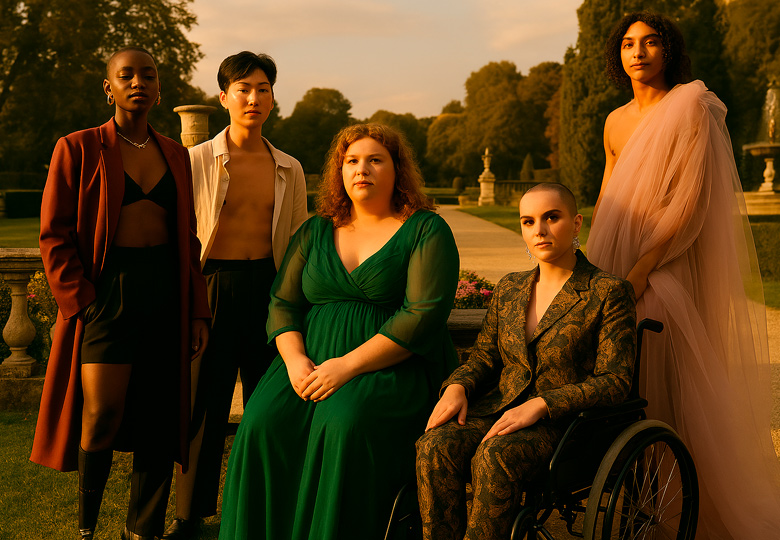
What happens when you are not only queer? What happens when you are also racialized, migrant, trans, functionally diverse or working class? The answer is: intersectionality. And yes, it is more important than it seems.
What is this intersectionality?
Okay, let’s start with the basics. Intersectionality is not a buzzword or a concept only for academic debates. It is, in reality, a tool to understand real life.
The term was coined by Kimberlé Crenshaw, an African-American jurist, to explain how different forms of discrimination (such as racism and sexism) intersect and intensify when they affect the same person. Today, it is also used to talk about the LGTBIQ+ experience when added to other inequalities.
In other words: not all people in the group experience discrimination in the same way. Being a middle-class white gay man in Madrid is not the same as being a migrant and undocumented trans woman.
When “pride” is not the same for everyone
Although pride celebrates diversity, there are realities within the group that remain invisible. There are bodies that remain unrepresented. Voices that cannot be heard. And lives that are lived from the margins, also within the collective itself.
Because yes, LGTBIQphobia exists. But there is also racism, ableism, fatphobia, transphobia within the group itself. And when all that is mixed… things get complicated. A lot.
Intersectionality allows us to see how these oppressions do not act separately, but rather intertwine, add up, and amplify each other.
What does it mean to live an intersectional identity?
For many, living from that intersection means facing:
-
Greater economic precariousness
-
Worse access to health and housing
- Advertisement - -
Lack of representation in media and public policies
-
Multiple violence (institutional, street, symbolic)
- Publicidad-
-
Blame and silence
And that wears out. It’s not just about “identity.” It’s about how that identity is read by the environment. And how that reading affects your opportunities, your well-being and your way of moving through the world.
Intersectionality in everyday life
Let’s talk about concrete examples:
-
A black queer person may be profiled by police and feel like they don’t fit into predominantly white LGTBIQ+ spaces.
-
A person with functional diversity may encounter physical barriers to access queer leisure spaces and suffer infantilization by society.
-
A non-white, migrant, and destitute trans person may face multiple levels of discrimination, labor exclusion, and medical violence.
And the list goes on. Because intersectionality is not a “ranking of oppressions”, but a complex network of intertwined realities.
What can we do from within the collective?
First: listen more and better. Not all LGTBIQ+ experiences are the same, and we shouldn’t aspire for them to be.
Second: check our own privileges. Can you walk down the street hand in hand with your partner without fear? Do you have access to affirmative LGTBIQ+ therapy? Can you change your name on documents without obstacles? If the answer is yes, you are in a position to do something for others.
Third: create truly inclusive spaces, not only in the symbolic (colors, words, hashtags), but in the concrete: accessibility, representation, resources, active participation of intersectional people.
The danger of not looking further
What if we only talk about intersectionality in theoretical terms, without grounding it in real actions? What if we use the concept to earn inclusion points, but we don’t really apply it in our spaces?
There is a risk of turning intersectionality into empty window dressing. Or worse: in an excuse to further fragment the group.
Therefore, the challenge is to look beyond our own experiencewithout feeling attacked, and understand that the fight is not only about what happens to us, but also about what we allow to happen to others.
A critical look: does intersectionality divide?
Some voices, even within the collective, question whether talking so much about intersections does not end up dividing more than it unites. They allege that we are fragmenting into increasingly specific identities and that this can dilute the strength of the movement. There are also those who think that focusing so much on identity overshadows other forms of political struggle, such as economic or environmental ones.
Although these criticisms deserve to be heard, intersectionality does not seek to divide, but rather make visible to transform. And recognizing that we don’t all start from the same place doesn’t weaken us. It makes us more honest, and therefore, stronger.
Now what?
There is no perfect recipe. But there is an invitation: look at the collective as an ecosystem of diverse realities, not as a uniform photo of “queerness.”
Maybe the real revolution is not just taking to the streets in Pride with a flag, but making sure that everyone—and when we say everyone, we are also talking about those on the margins—have a voice, have space and have real rights.
Let’s think about it this way: if queerness challenges the norm, it should also challenge the comfort of not seeing the other.
Intersectionality is not a fad or a term to fill discourses. It is an urgent and necessary way to understand how we live, resist and support each other within the LGTBIQ+ collective. Because being queer is not experienced the same when you are poor, racialized, trans, neurodivergent or migrant. And if we want a truly inclusive future, we will have to learn to look through more than just one lens.