
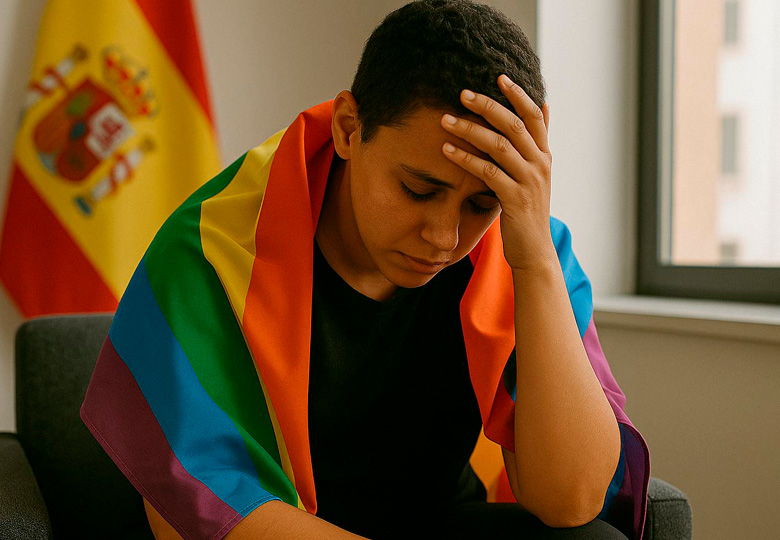
Spain has been, for years, one of the most notable destinations in Europe for LGTBIQ+ people looking for a safe place away from persecution. However, the path to obtaining asylum is not always as simple as it might seem.
What does it mean to ask for asylum as part of the LGTBIQ+ group?
When a person from the LGTBIQ+ group arrives in Spain fleeing their country of origin for fear of being persecuted, violated or criminalized for being who they are, they have the right to request international protection. This right is recognized both in Spanish legislation and in international human rights treaties.
In practical terms, it is about demonstrating that there is a real risk of persecution for reasons such as sexual orientation, gender identity or expression. It is not about a preference or a fashion: we are talking about survival.
Getting started: the application process
The asylum application can be submitted at a police station, in a detention center or even at the border. There is also the possibility of doing it once you are inside the country, although it is advisable not to delay too long. Once presented, the applicant enters an interview phase where they must tell their personal story, including details that, in many cases, are painful or traumatic.
This is where one of the biggest challenges begins: How do you demonstrate something as intimate as sexual orientation? How do you prove that a person is not safe in their country simply because they love or live differently?
Common obstacles in the process
One of the main problems is the lack of sensitivity or specific training of the staff in charge of conducting the interviews. Many times, applicants are faced with stigmatizing, prejudiced or downright offensive questions. Other times, they must deal with interpreters who do not know the right words for sexual or gender diversity issues.
In addition, there is a high burden of proof on the person applying for asylum. They are often expected to have openly lived out their orientation in their country of origin, which is ironic, since in many of these contexts coming out means literally risking one’s life.
Spain: a safe country for everyone?
Spain has made notable progress in LGTBIQ+ rights in recent years. Equal marriage, gender identity laws and, more recently, the Trans Law, position the country as a reference in Europe. But between theory and practice there is still room for improvement.
Several non-governmental organizations have denounced situations of institutional homophobia or unequal treatment within the asylum system. Despite legislative advances, the reality is that many people in the group feel invisible during the process or, in the worst case, have their request denied.
The role of social organizations
Luckily, there are support networks that work every day to make this path fairer. Organizations such as CEAR, UNHCR or Red Acoge provide legal, psychological and social assistance to LGTBIQ+ asylum seekers.
These entities help not only understand the legal steps, but also heal emotional wounds and build a new life in a freer environment. Without their work, many stories would be forgotten or would not come to fruition.
What could we improve?
Although the system has good intentions, there are still dark spots. It is urgent to improve the training of professionals involved in the process. It would also be necessary to review the evaluation criteria for applications, so that they are not measured with heteronormative standards or stereotypes.

Another key aspect is the streamlining of processes. Delays can last for years, leaving people in legal and emotional limbo. And while they wait, they often do so in environments that do not guarantee their safety or well-being.
A parenthesis to think
It doesn’t hurt to ask this question: is it really fair to force a person to relive their deepest traumas so that the system “believes” them? If the goal is to protect those fleeing hate, perhaps we should rethink the approach and look for more humane and empathetic ways to verify stories.
As a reflection
Spain has been, and continues to be, a beacon for many LGTBIQ+ people fleeing persecution. However, we cannot assume that this lighthouse shines the same for everyone. Important challenges remain that will only be resolved with political will, social awareness and institutional empathy.
Because welcoming is not only opening borders, it is also listening, believing and accompanying.