
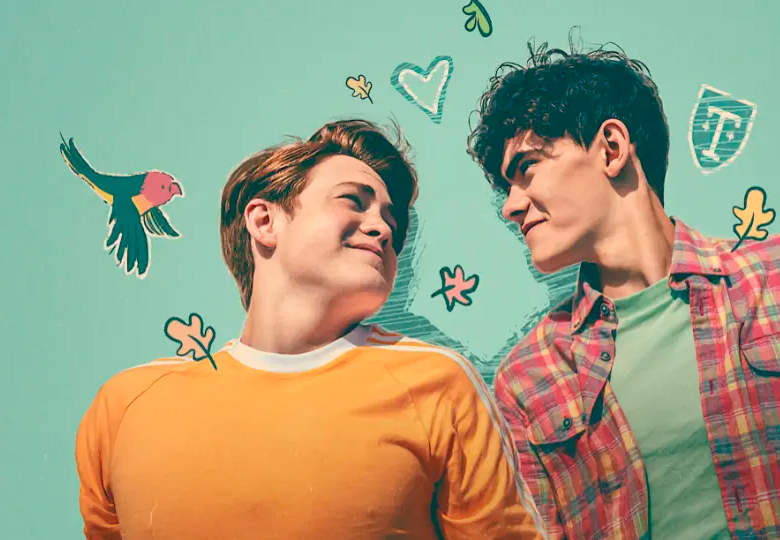
Netflix has surprised us with bittersweet news: Heartstopper, that series that stole our hearts in 2022, will come to an end… but it will do so in a big way, with a movie. Nick (Kit Connor) and Charlie (Joe Locke) will return one last time to tell us the closing of their story, based on the sixth volume of Alice Oseman’s comics (which, by the way, has not yet been released).
Heartstopper: From unexpected phenomenon to farewell announced
When Heartstopper landed on Netflix, almost without making a noise, no one imagined the phenomenon it would become. Fresh LGTBIQ+ representation, endearing characters and a love story that broke the mold. The series was quickly renewed for two more seasons, maintaining a very loyal fan community.
However, the third season was already showing signs of wear and tear. The audience dropped a bit, and although the affection did not disappear, something in the magic of the first episodes seemed to have been diluted. Was it inevitable?
The movie: a goodbye or a new beginning?
Netflix has confirmed that the story will conclude with a film adapting the final volume of Oseman’s comics. Alice will not only repeat as screenwriter, but will also be in charge of executive production. “I’m excited that we can tell the end of Heartstopper. Thank you to everyone who has made this possible, and to the fans for their patience and passion,” said the author.
Filming will begin in the summer of 2025, so if all goes well, we could see it on screen sometime in 2026. Yes, it’s a long way off, but it promises to be a “magical” ending, as Oseman describes it.
🍂💗🥹HELLO🍂💗🥹
The final chapter of ‘Heartstopper’ will be a film based on Alice Oseman’s upcoming volume six. pic.twitter.com/dpU4t7YFqC— Netflix Spain (@NetflixES) April 22, 2025
What will the end of Heartstopper be about?
The official synopsis already gives us some clues:
Nick and Charlie are inseparable, but as Nick prepares for college and Charlie explores her independence in high school, the distance begins to weigh on them. Can their love stand the test of time? Meanwhile, her friends will also face the ups and downs of growing up, loving, and moving on.
It seems that we are not only going to see the end of a couple, but also the growth of an entire group of characters that many of us have felt like our own.
The team behind the film
The chosen director is Wash Westmoreland, known for films such as Always Alice or Colette. The lead roles, played by Connor and Locke, will likely be joined by much-loved faces such as William Gao (Tao), Yasmin Finney (Elle), Tobie Donovan (Isaac), Corinna Brown (Tara), Kizzy Edgell (Darcy), Jonathan Bailey (Jack Maddox) and, of course, the wonderful Olivia Colman as Nick’s mother.
Is everything as perfect as it seems?
Although the news has been received with emotion, there are also those who raise some doubts. Wouldn’t it have been better to close the story with a well-constructed final season, rather than a quick movie? Is Netflix taking advantage of the commercial success of Heartstopper just when the phenomenon begins to cool down? And above all: can a movie condense all the emotional growth that we have followed during so many hours of the series? These are questions that, honestly, will only be answered when the long-awaited premiere arrives.
The impact of Heartstopper on the LGTBIQ+ community: more than just a series
When Heartstopper landed on Netflix in 2022, it could have gone unnoticed as just another youth series, amid a catalog packed with stories about high school, first loves, and teen dramas. But it wasn’t like that. For many, especially within the LGTBIQ+ community, Heartstopper was a direct blow to the heart. It wasn’t just entertainment: it was seeing yourself reflected on a screen in a luminous way, without harmful stereotypes or inevitable tragedies.
For those who grew up feeling out of place, for those who learned to hide their love out of fear or shame, Heartstopper was like finding a warm hug in the middle of a cold world. The story of Nick and Charlie did not scream, it did not seek to shock; it simply showed how love can flourish when given room to grow. And sometimes that’s enough to light a spark. To make someone feel, for the first time, that their story also deserves to be told, lived and celebrated.

Because yes, there are series that entertain… but from time to time a story comes along that changes you. That stays in your chest. That tells you, without bombastic words, that being who you are is not a mistake. That loving who you love doesn’t need an apology. Heartstopper was, for many, that moment of intimate revolution.
A love that does not ask permission
Until not so long ago, love stories between people of the same gender used to be marked by drama, pain or tragic endings. Heartstopper broke that narrative. Nick and Charlie showed us a tender, respectful and bright relationship. A story where LGTBIQ+ love was not a problem to solve, but rather something beautiful to celebrate.
And that, although it may seem obvious, is still revolutionary.
Real, diverse and necessary representation
In addition to Nick and Charlie, we saw trans characters like Elle (played by Yasmin Finney, a real trans actress), sincere friendships, complicated but loving families. Each character brought nuances. They were not caricatures or diversity trophies; They were young people dealing with real life. Like anyone.
This type of representation is essential. Because it’s not just about seeing yourself on the screen, but about understanding that we deserve love, respect and happy endings. That we exist, and that our stories matter.
A global (and very necessary) phenomenon
The impact of Heartstopper was immediate. All over the world, LGTBIQ+ young people and adults found refuge in the series. It was not unusual to see messages like: “Thanks to this series I dared to come out of the closet” or “I finally saw a story in which I didn’t feel like a monster”.
Many also began to question their identity, explore their orientation or understand their friends better. Because yes, representation also educates, although it does not do so explicitly.
And, in times where hate speech is once again gaining ground in some corners of the world, having positive references becomes more important than ever.
But was everything perfect?
Not everyone was satisfied. Some voices pointed out that the story of Heartstopper could seem “too idealized”, as if homophobic bullying or discrimination barely existed in its universe. Was it a faithful portrayal of reality or a comforting fantasy?
It is valid to ask. And perhaps that’s part of its power: showing us not only how things are, but also how they could be if love and acceptance were the norm, not the exception.