
For years, drag art has been classified as simple spectacle. An exaggerated, fun and provocative performance, yes, but seen as entertainment without more. However, drag has always been about much more than sequins and false eyelashes. It is politics, it is education, it is resistance.
And today, more than ever, it deserves to be understood as a pedagogical act that challenges norms, opens paths and transforms consciousness.
What exactly is drag?
Although many people associate it only with men who dress as women to perform, drag is a much broader art. It is a way of playing with gender, of taking it to the limit, of disarming it and reassembling it with humor, irony, pain or beauty.
It can be feminine, masculine, androgynous or something that has no name. It can be dance, poetry, singing, lip-sync, theater, makeup… or a mixture of everything. And, above all, it can be a mirror where society looks at itself… and doesn’t always like what it sees.
Drag as an educational tool
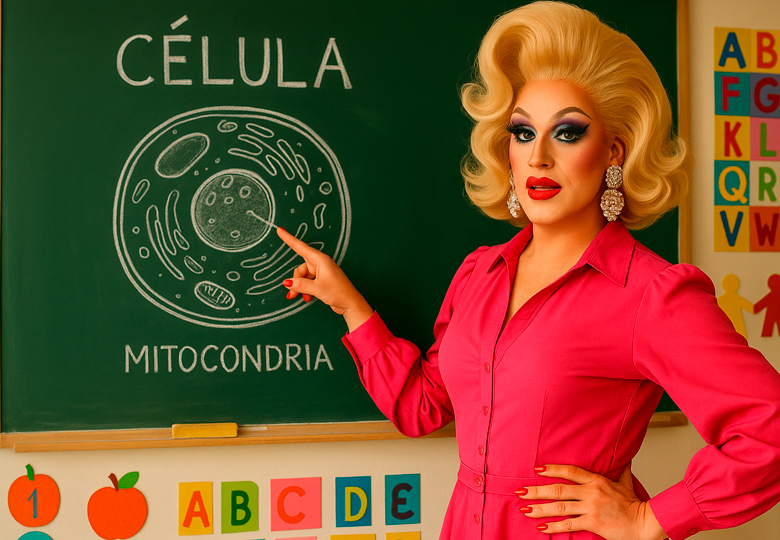
In recent years, we have seen drag move out of late-night bars and into libraries, schools, museums, and community centers. It’s not a coincidence. Drag has enormous pedagogical potential.
Here are some ways in which drag educates, questions and builds:
🧠 1. Teach about gender in an experiential way
Nothing like seeing a drag person breaking stereotypes to understand that gender is not something fixed or natural. That is built. What is learned? Which can be dismantled. And that there is no single “correct” way to be a man, a woman, or neither.
📚 2. Promotes reading and imagination
The “Drag Queen Story Hour” or “Drag Storytellers” have become popular in many countries, creating safe spaces where children listen to diverse stories, see non-normative representations and learn from a young age to respect what is different.
✊ 3. Claim LGTBIQ+ history
Many drag performers recover forgotten historical figures, perform political satire or denounce current injustices from the stage. His speech is not neutral: he has memory and he has intention. And that also educates.
🎨 4. Stimulates creativity and self-expression
Drag also teaches that the body is a canvas, and that there is no single way to show yourself to the world. It encourages experimentation, artistic freedom and connection with what feels beyond what is expected.
Projects that are already transforming
Some initiatives have taken this to another level. Here are some examples that demonstrate it:
-
Drag School (Barcelona): a workshop aimed at teenagers where, through drag, emotions, identity and body expression are explored.
- Publicidad-
-
La Venenolectura (Madrid): drag storytellers in public libraries that combine humor, tenderness and inclusive children’s literature.
-
La Escuelita Marica (Chile): self-managed space that uses drag and cabaret as forms of popular and decolonial pedagogy.
-
Drag artivism on networks: many creators use TikTok or Instagram not only to entertain, but to explain concepts of gender, queer history or mental health.
These examples remind us that drag is not just about “having a good time,” but also about learning, sharing, healing and fighting.
Why is it so annoying?
Perhaps one of the keys to drag is its ability to make people uncomfortable. And that, in a conservative society, can be very powerful… or very dangerous.
When a drag person appears reading stories to children, there are those who shout “indoctrination.” When a drag artist ironically talks about politics or religion, she is accused of going too far. And yet, why all the alarm over a little makeup and wigs?
Because drag destabilizes. It mocks what seemed untouchable. Play with the symbols of power. And he does it with laughter, which is one of the most subversive weapons that exist.
What drag awakens
Beyond the spectacle, drag awakens many things:
-
Curiosity in those who never dared to play with their gender expression.
-
Identification in young people who finally see someone like them on stage.
-
Debate in families, schools or neighborhoods where the normative seemed unquestionable.
-
Art, desire, reflection, memory.
All of that is valuable. All of that is transformative. All that is pedagogy.
⚠️ A critical look: is drag being commodified?
With the success of programs like RuPaul’s Drag Race, some voices from the collective itself have pointed out that drag runs the risk of becoming a product. That aesthetics are privileged over the message, that racialized, trans or non-binary drags are made invisible, or that certain stereotypes of “commercial” drag are perpetuated.
Not all drag is political, of course. But not everything commercial is superficial either. The key is not to forget its roots: those of the ballroom, the riots, the street, the need. Drag was not born on TV. It was born as a response. How I scream. Like survival.
Now what?
If drag teaches us anything, it is that there are many ways to teach, to learn and to be. That art can be a tool, the body can be a message and laughter can be a revolution.
Do you dare to look at the world from another prism?
Do you dare to disassemble yourself to put yourself back together with more pen, more voice and more truth?
So, maybe, you are doing drag too… even if you don’t know it yet.