
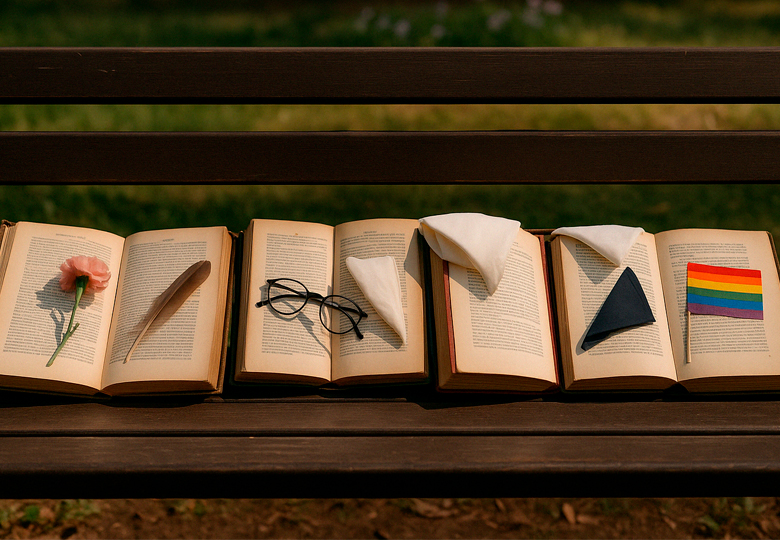
On Book Day we not only celebrate the stories that make us dream. It is also the perfect time to remember those who wrote from wounds, from desire, from rage and beauty. Because for many LGTBIQ+ authors, writing was not a luxury: it was an act of survival.
Today we want to pay tribute to six figures who, each uniting in their own way, broke patterns, challenged norms and opened paths with their words. They are not all there—they are never all there—but their voices continue to vibrate strongly. And yes, you may already know them, but have you read what they hide between the lines?
📚 Sappho of Lesbos: the first voice of female desire
We start at the beginning. Or at least, for one of them. Sappho lived on the island of Lesbos (Greece) in the 7th century BC. and wrote poems dedicated to love between women with a sensitivity that still shocks today. Her name gave rise to the term “sapphic” and the word “lesbian”, but reducing her to just that would be unfair. Sappho is one of the great poets of Antiquity, period.
Although much of his work has been lost—and what reaches us is sometimes mutilated—his verses survive as whispers loaded with eroticism, tenderness and passion. “Who should I persuade this time to come to you?” asks a voice that seems to travel centuries to touch us.
Was Sappho really a lesbian? Did you live in an exclusively female circle? How free were their loves? We don’t have clear answers, but his poetic legacy is undeniably queer.
🖋️ Federico García Lorca: the poet silenced for being who he was
Lorca is synonymous with duende, with metaphor, with intensity. But it is also synonymous with repression. The Granada poet was not only one of the pillars of the Generation of ’27, he was also a homosexual man in a deeply conservative Spain.
His poems and plays are full of symbols that spoke of what could not be said out loud: guilt, desire, social punishment. Works such as The Public or Sonnets of Dark Love (published posthumously) are testimony to an identity that sought space in a hostile world.
Federico was murdered at the beginning of the Civil War, in 1936. His voice was brutally silenced, but its echo remains as alive as ever. How would your work have evolved if you had lived longer? We will never know, but what he left behind is enough to move generations.
🧠 Virginia Woolf: between introspection and gender fluidity
Virginia Woolf wrote from the depths of mind and soul. His style, experimental and lyrical, broke with the traditional structures of narrative. But it also broke with the fixed categories of gender and sexuality, although not always explicitly.
In Orlando, for example, he gives us a character who lives for centuries and changes gender. A revolutionary work that turns normative ideas about the self upside down. Furthermore, his relationship with Vita Sackville-West—one of the most intense of his life—inspired much of his work.
Woolf did not identify with modern labels, but his queer sensitivity is present in his texts, in his letters, in his essays. And even today, many readers feel understood between its lines.
🖤 Audre Lorde: poetry as a tool of change
Poet, essayist, activist. Audre Lorde was many things, but above all, she was an essential voice for those who feel outside the margins. Black, lesbian, feminist, mother… her identities are intertwined in every word she wrote, without asking permission to exist.
Lorde spoke from intersectionality before the term became fashionable. She denounced racism within white feminism, classism, lesbophobia. And he did it from a writing that burns. He doesn’t ask, he demands. That does not decorate, it shakes.
Works like Sister Outsider or The Black Unicorn continue to be required reading to understand the struggle of many oppressed bodies. As she herself said: “Your silence will not protect you.”
🌈 Pedro Lemebel: chronicle, pen and queer revolution
If there is someone who transformed pain into uncomfortable beauty, it was Pedro Lemebel. Chronicler, performer, artist and dissident until the end. His pen—and his pen—were always political. In Pinochet’s Chile, being poor, queer and rebellious was not an easy option. But Lemebel did not ask permission.
His texts, compiled in works such as I’m afraid bullfighter or Loco afán, show us the lives of those who have always been left out of the official story: transvestites, whores, crazy women, migrants, bodies that the system wanted to erase.
Lemebel was not just a writer. It was a glitter slap to the dominant morality. A broken mirror where we can still look at ourselves, even if it hurts.
🌸 Ocean Vuong: queer tenderness from exile
Ocean Vuong represents a new generation of LGTBIQ+ authors who write from the intersection of multiple identities: migrant, Asian, gay, war orphan. His poetry and narrative are soaked in sensitivity, loss and beauty.
In his novel On Earth We Are Fleetingly Great, Vuong explores his relationship with his mother, inherited trauma, and queer identity in the context of Vietnamese exile in the United States. His voice is soft, but not fragile. It is sharp like a petal that cuts.
Ocean represents that queer literature that does not need to shout to move. That embraces from the wound. That transforms pain into something beautiful, although uncomfortable.
💭 What if being queer does not guarantee queer literature?
Okay, let’s stop for a second. Because it is also fair to ask this question: does being LGTBIQ+ automatically make a work queer? What happens when a dissident person writes from a normative point of view? What if there are voices that have been elevated by the publishing market only because of their identity, but without truly providing a critical or transformative vision?
Identity is not everything. What makes a literature queer is not only who writes it, but how the world is questioned from those words. And there, not everyone passes with flying colors.
🏳️🌈 Writing was, is and will be a political act
Literature has been a refuge, catharsis and barricade for many of us. These six names that we bring you today—from different eras, languages, and styles—have something in common: they wrote from a place of difference, and in many cases, despite the risk.
Their words continue to beat, and perhaps that is the true power of queer writing: reminding us that we are not alone. That someone, at some point, also felt like they didn’t fit in… and still, they wrote.