

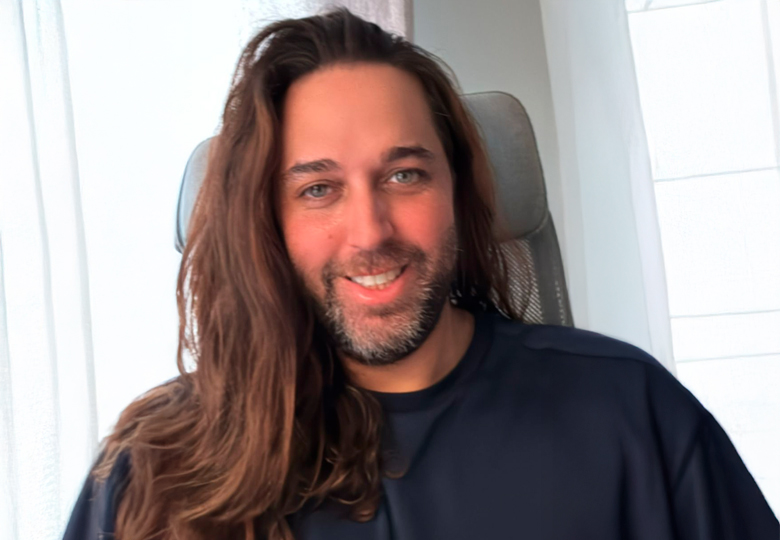
Rarely does an interview sound as intimate and as necessary as this one. Javier Kiniro, director of Rainbow Magazine, image consultant with an activist soul and author of books that embrace diversity through care, presents his most personal work to date: The reason why I’m still here. A guide written with tenderness and rebellion, which redefines the concept of ikigai from a queer, emotional and intersectional perspective. We spoke with him about purpose, freedom, memory, and what it means to be visible without breaking the bank in the attempt.
Javier, you just released “The reason I’m still here, a guide to finding ikigai while queer.” How did the need to write this book arise?

The idea was born from a personal wound and a collective intuition. For a long time I wondered why many LGTBIQ+ people find it difficult to find a purpose that is not crossed by pain, resistance or the need to prove something. I wanted to write a book that didn’t talk about success, but about meaning. That he did not look for standard answers, but rather his own paths. And to embrace chaos, fear, beauty and desire as part of the journey.
The concept of “ikigai” is usually linked to professional or productivity. What does your queer and emotional approach bring to this very popular idea?
Queer is disconcerting, and that is exactly what is needed. Ikigai cannot be reduced to an intersection of work, talent and market. For many LGTBIQ+ people, our “why” is not to produce more, but to live with dignity, to inhabit a body that respects us, to love without fear. In the book I propose a much more intimate, slowed down and honest look. Because sometimes our ikigai is not what the world expects of us… but what saves us.
You say in the book that “the world is not always prepared for our motives.” What have been yours to continue here?
My motives have always been more emotional than rational. I stay here for love: for art, for words, for people who still don’t know that they also deserve to be protagonists. I remain for those, like me, who have searched for years for a mirror where they do not feel like monsters. And also out of rebellion: because I refuse to accept that our lives only matter when there is suffering. I want there to also be joy, desire, memory… and yes, also a touch of scandal.
As an author, image consultant and queer activist, how do you connect your creative work with your social commitment?
For me one does not exist without the other. Writing, creating, accompanying, advising… everything is part of the same political act: caring. Taking care of bodies, taking care of words, taking care of spaces. From the aesthetic, from the symbolic, from the practical. Queer is not just an identity, it is a way of looking. And my work always tries to be a loving response to the world that violates us.
In a world where we are constantly asked to fit in, how do you find peace in not doing so?
With humor and memory. Laughing at other people’s expectations has saved me many times. And remember what so many people before me did so that today we can live outside the norm too. Not fitting in is uncomfortable, yes, but it is also deeply liberating. I do not find peace in conformity, but in coherence.
What role does intersectionality play in the way you write and run a magazine like Rainbow?
It is the central axis. Without intersectionality, activism is marketing. I am not interested in an LGTBIQ+ narrative that ignores racism, patriarchy, ableism, fatphobia, poverty, colonialism or neurodivergence. At Rainbow we work from a broad and conscious vision, with space for the multiple. My writing also starts from there: from knowing that we are many things at the same time, and that each story deserves to be told in all its complexity.
Many readers of Rainbow Magazine find refuge in its articles. What would you like them to find in the pages of this book?
A hug. One of those who do not judge, who do not give advice, who simply say: “I am here with you.” I would also like them to find words that give names to things that they have always felt, but that no one had explained to them before. And hopefully, also, a spark. A little light to help them turn on their own lighthouse.
What has been the most difficult thing about writing a book as intimate as this… and what has been the most healing?
The most difficult thing was not to censor myself. Sometimes, when you know that they are going to read you, the fear of not being liked appears, of seeming too sensitive, too contradictory, too much everything. But the healing thing was just the opposite: allowing myself to be. Writing without a filter, with tenderness towards my own chaos, and discovering that it can also help someone else.
From your experience, why do you think that many LGTBIQ+ people have a hard time finding their place in the world?
Because many times the world does not offer it to us. Because we grow without seeing ourselves represented, without references that tell us that what is ours is also worth it. Because we have learned to survive, but not always to live. And because we are too used to guilt. This book is, in part, a gesture of reparation. An invitation to imagine other possible places, starting from within.
If your book could change just one thing in whoever reads it, what would you like it to be?
Stop feeling like a mistake. Let them understand that they don’t have to fit in, that their way of existing is also valid. That you can search for your ikigai without asking permission. And that queer is not just a label, but a way of constructing meaning in this world as chaotic as it is beautiful.

Our RAINBOW questions 🌈
Who is your queer reference and why?
I would say Pedro Lemebel. For his bravery, for his sharp pen and his unwavering voice. Because he made the queer body a poetic trench. And because he showed that you can be combative and deeply tender at the same time.
If your life had an activist slogan embroidered on a t-shirt, what would it be?
“I didn’t come to be normal, I came to be unforgettable.”
When did you feel freer in your skin?
The first time I wrote to myself about my story, and I realized that I had not lived it alone, that it is a story shared by millions of people. I felt like my body no longer weighed me down. That everything lived had a meaning. It was like coming home.
Which everyday superpower of queer people do you prefer?
With our ability to reinvent ourselves again and again. To survive in style. Of making a family with strangers. Of dancing in the ruins with heels on.
Beyond his work as an author or director, Javier Kiniro reminds us that the important thing is not to fit in, but to inhabit. That meaning is not always found, sometimes it is created. And that being queer is not just about resisting: it is also about dreaming, healing, and dancing in the midst of chaos. The reason I am still here is not just a book, it is a pending conversation, an embrace of words, and a declaration of intentions. And as he himself says: “I didn’t come to be normal, I came to be unforgettable.”