


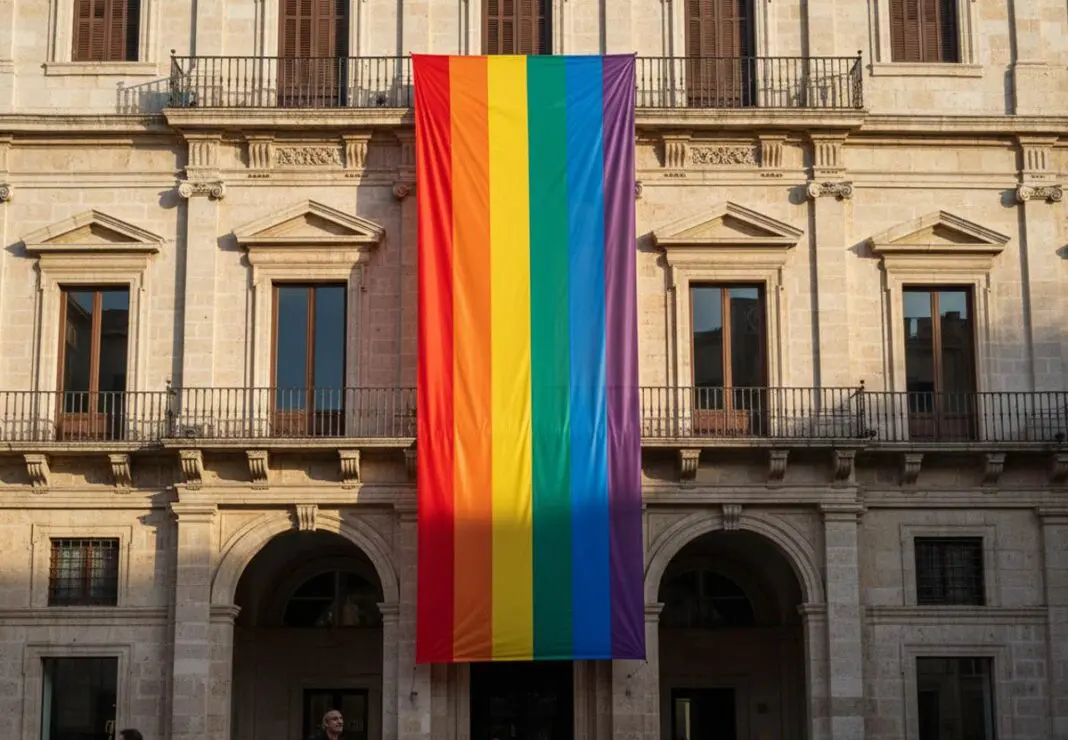

Today we delve into news of great significance for the LGTBIQ+ community and the legal framework in Spain. Recently, the Contentious-Administrative Chamber of the Supreme Court has set a significant precedent by issuing a ruling that endorses the placement of the flag that represents our group on the facades of Public Administration buildings.
This ruling occurs as a result of an appeal that challenged the act of the Government Delegation in Valencia, which on June 28, 2023, within the framework of the National LGTBIQ+ Pride Day, decided to raise an unofficial flag of the group. Who filed the initial complaint? The Christian Lawyers Association.
Institutional Neutrality or Positive Action? The Central Debate
The core of the controversy revolved around the principle of objectivity and institutional neutrality that the Constitution, in its article 103.1, imposes on the Public Administration. The plaintiff, Abogados Cristianos, argued that the placement of this banner represented an excess and a “de facto way”, since no formal administrative procedure was followed nor a prior resolution was issued.
But the High Court has a different reading, and it is crucial to understand the future of these demonstrations in public spaces: it considers it a “positive action.”
What does this legal concept imply?
The Administration, by choosing to make support for the LGTBIQ+ group visible on such an important date, is implementing a measure that seeks to favor and protect a historically discriminated group, in accordance with applicable regulations. For the Supreme Court, this gesture does not conflict with the obligatory neutrality, but rather complements it by promoting equality.
The court thus reaffirms the line of thought already applied in at least three other previous rulings, once again dismissing the association’s appeal and maintaining consistency in its jurisprudence. This legal path invites us to deep reflection: where does neutrality end and the duty of an administration to be active in defending the rights of all its citizens begin?
Beyond the Flag: The Situation of l’Armari de la Mòria
Although the news from the Supreme Court is progress, it is important to remember that the fight for rights is still underway on other fronts. In this context of visibility and memory, the entity Lambda, col·lectiu LGTBIQ+, has filed a complaint with the Ombudsman about the situation faced by the public service l’Armari de la Mòria.
This service, which depends on the Generalitat, is essential for the recovery and preservation of the LGTBIQ+ historical memory in the Valencian Community. His complaint underlines the importance of institutions not only taking symbolic steps such as raising a flag, but also ensuring the viability and support of public services that sustain and honor the trajectory of our group.
We ask you, reader: How do you think the Public Administration can better balance symbolic gestures, such as the placing of the flag, with effective and sustained support for services such as l’Armari de la Mòria? What else does the LGTBIQ+ community need to feel fully represented and supported by institutions? It’s a conversation we all need to have.