
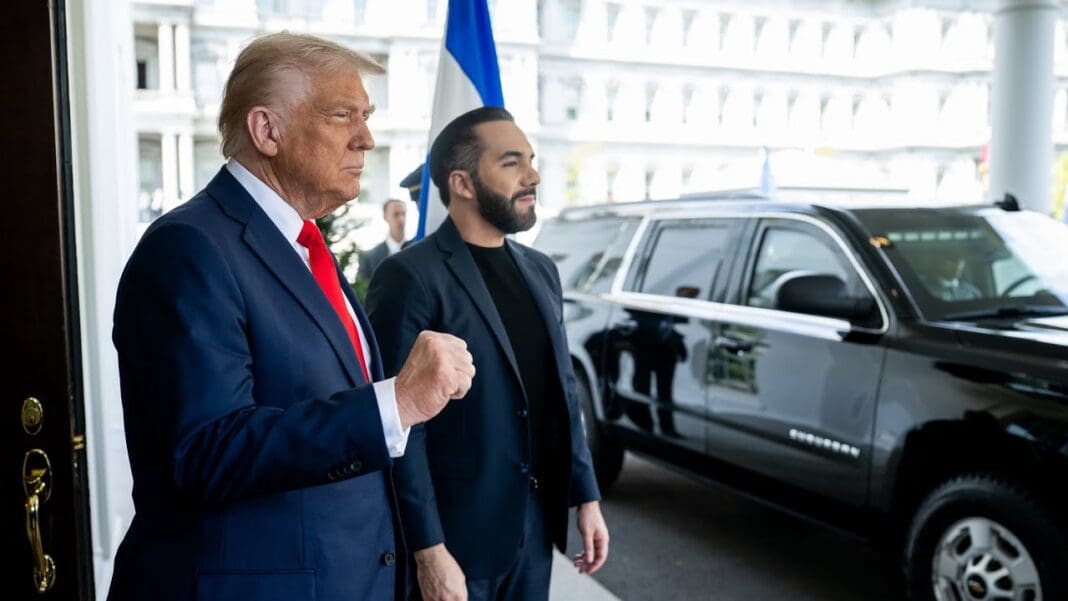
During a recent meeting at the White House, the president of the United States, Donald Trump, and the Salvadoran president, Nayib Bukele, shared opinions that have once again ignited the international debate on the inclusion of trans people in women’s sports categories.
The exchange, captured on video and quickly viral, began when Trump asked Bukele if El Salvador allows “men to compete in women’s sports” or “box against women.” The Salvadoran president’s response was forceful: “That is violence.” From there, both leaders agreed in their criticism of trans inclusion policies in sport, describing them as “abusive” and as a supposed threat to women’s rights.
Trump: “Do they allow men to participate in women’s sports? Do they allow men to box their wives?”
Bukele: “That is violence.”
Trump: “That’s abuse of women… but we have people who fight to the death because they believe men should be able to play in… pic.twitter.com/j4occmsKcj
— Wall Street Wolverine (@wallstwolverine) April 14, 2025
Backward or forward?
Bukele argued that allowing the participation of trans people in spaces traditionally reserved for women could “reverse” historical achievements in the fight against gender violence. According to the president, laws that enable this type of inclusion would not only be incoherent, but could facilitate forms of abuse that had already been attempted to eradicate.
Trump reinforced this position, suggesting that there are movements that “fight to the death” to defend transmasculine or transfeminine people from participating in sports that, in their view, do not belong to them.
What they didn’t say: the complexity behind the debate
What both leaders omit in their statement is that the debate on the participation of trans people in sport is much broader and more complex. There are international sports organizations that have developed specific regulations to address this issue, based on criteria such as hormonal levels or transition time. There are also voices within feminism and LGTBIQ+ activism that point out that systematically excluding trans people violates fundamental human rights.
Where then is the balance between protecting fairness in competition and guaranteeing the right of everyone to participate fully in society?
Criticisms, conflicts and necessary reflections
The position of Bukele and Trump has been celebrated by conservative sectors, but has also received criticism from activists and human rights organizations who denounce a politicized and simplistic use of the issue.
Can a discourse that denies the identity of trans people really protect women? Or is it, deep down, reinforcing stereotypes that have precisely been the driving force behind much violence?
Reducing the debate to a dichotomy of “men versus women” makes invisible the experience of those who do not fit into that binary, and can perpetuate unfair exclusions. Wouldn’t it be fairer to design solutions on a case-by-case basis, based on evidence and in dialogue with the communities involved?