
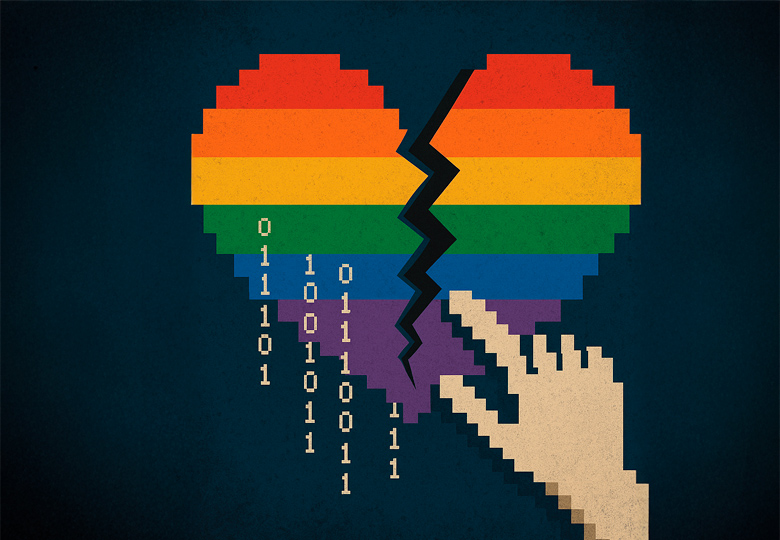
It’s not new. But it is becoming more and more evident. The digital hatred towards the LGTBIQ+ community has ceased to be a one-time phenomenon and has become a structural problem that runs through networks, forums, online video games and even news comments.
In an increasingly connected world, violence has also mutated. It is no longer necessary to meet someone on the street to suffer an attack: it is enough to have a public profile, give your opinion, exist online being who you are. Who protects LGTBIQ+ people from digital harassment? What responsibilities do platforms have? And us as users?
What is digital violence?
Digital violence is not just an insult on Twitter (X). It is much broader. We are talking about systematic harassment, threats, doxxing (publishing private data), hate speech, image manipulation, blackmail with intimate content, forced outing (taking someone out of the closet without their consent), among other forms.
And yes, this is also violence. Even if it doesn’t leave physical marks, it can leave deep emotional scars.
According to data from Amnesty International, LGTBIQ+ people—especially young, trans and non-binary people—are among the most vulnerable groups on the internet. Because? Because its mere visibility already challenges imposed norms. Because being visible, in certain spaces, becomes a political act that makes people uncomfortable.
How does this violence manifest itself?
The variety of attacks is as wide as it is creative. Below are some of the most common cases:
-
Offensive comments or mockery every time someone publishes LGTBIQ+ content on networks.
-
Coordinated hate campaigns (organized trolls, bots, attack threads).
-
Repeated harassment of visible activists or influencers of the group.
-
Dissemination of transphobic speeches disguised as “personal opinion”.
- Advertisement - -
Physical or sexual threats received through direct messages.
-
Exposure of gender identity or sexual orientation without consent, sometimes even to family members or in the work environment.
- Publicidad-
All of this may seem intangible, but it has very real effects. Constant stress, anxiety, self-censorship, digital isolation or even depression are common consequences.
A problem with multiple layers
There is an obvious layer: the aggressors. Individuals who, from anonymity or even with public profiles, feel they have the right to insult, question or ridicule the existence of other people.
But there is also the structural layer: platforms that do not moderate well, algorithms that reward morbidity and controversy, and a general lack of digital and affective-sexual education.
Because, let’s be honest: how many times have we seen transphobic comments without anyone reporting them? How many times is homophobic “humor” normalized in viral memes?
And then, there is the silence. Sometimes silence hurts too.
Who suffers from it the most?
Not everyone within the LGTBIQ+ group receives the same type (or level) of violence. Trans and non-binary people, especially racialized ones, suffer a lethal combination of transphobia, racism and misogyny online. Lesbian and bisexual women are also targets of hypersexualization and verbal violence.
Studies indicate that LGTBIQ+ adolescents are an especially high risk group. Many, even without coming out in their physical environment, live their identity through the online world, where they seek community, representation and refuge. What happens when that refuge becomes a hostile place?
And what do the platforms do?
This is where things get complicated. Because big technology companies talk a lot about diversity, but their moderation policies are not always up to par.
For example:
-
Educational content on diversity is censored, while hate speech is allowed under the guise of “freedom of expression.”
-
LGTBIQ+ profiles are punished for “sexual content” when what they share are emotional images that would have no problem if they were heterosexual.
-
Complaints of harassment are ignored, or take days to act.
Social networks have created global spaces of connection… but they have also replicated (and sometimes amplified) the violence of the real world. And that requires reflection: are they really designed to take care of us?
What can be done?
There are no magic solutions, but there are important steps:
-
Always report. Although it may seem useless, accumulating complaints helps to make patterns visible.
-
Actively support people in the group when they are attacked online.
-
Train ourselves in the ethical use of networks and inclusive language.
-
Pressure the platforms to improve their moderation systems and work with entities specialized in diversity.
-
Do not share hate speech, even if it is to criticize it: that only amplifies it.
At an institutional level, it is key to develop specific laws on digital violence, as some countries are already doing, and to recognize this violence as a real form of aggression with legal consequences.
What if the problem is not just digital?
Here is an uncomfortable but necessary idea: perhaps digital is not the problem… but rather the reflection. The Internet does not create hate out of thin air. It amplifies it, makes it visible, allows it.
If we see transphobia on networks, it is because it exists outside. If there is homophobia in comments, it is because it was planted long before.
Focusing only on technology would be to simplify a profound, cultural, educational problem. Perhaps the question we should ask ourselves is not “how do we solve hate on the internet?”, but “what society are we building outside of it?”
A reflection…
Now, there are also voices that warn about the risks of over-regulating. Some people suggest that content control can lead to censorship, especially when algorithms do not understand nuances. Where does hate speech end and valid criticism begin? Who decides what is moderated and what is not?
In addition, there are those who believe that exaggerating the effects of digital violence could have negative consequences, such as fostering a culture of permanent victimization. It is not about minimizing damage, but about maintaining the balance between protection and autonomy.
It is a complex debate, which deserves to remain open.
How to take better care of ourselves?
Digital violence against the LGTBIQ+ community is not an isolated phenomenon. It is part of a broader system that still needs transformation. Making it visible is a first step, but it is not enough.
We need secure networks, yes. But also safe physical spaces, emotional education, positive references, public policies that protectand communities that embrace.
Because the freedom to be yourself—online or offline—should be a right. Not a constant fight.