
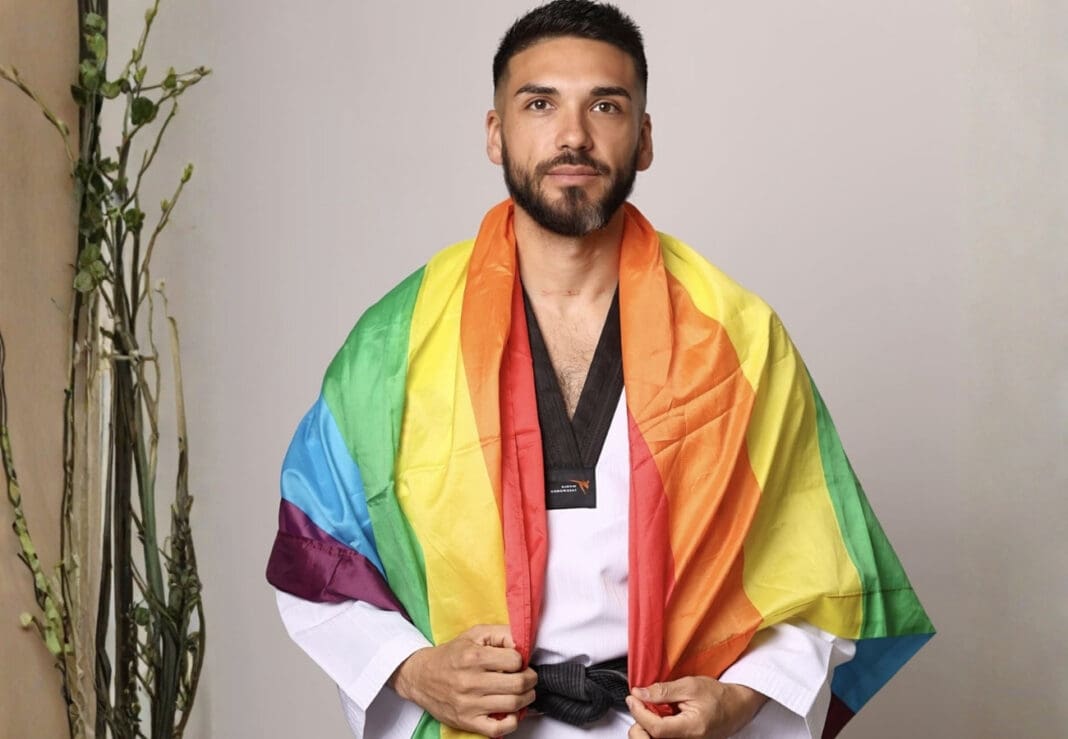
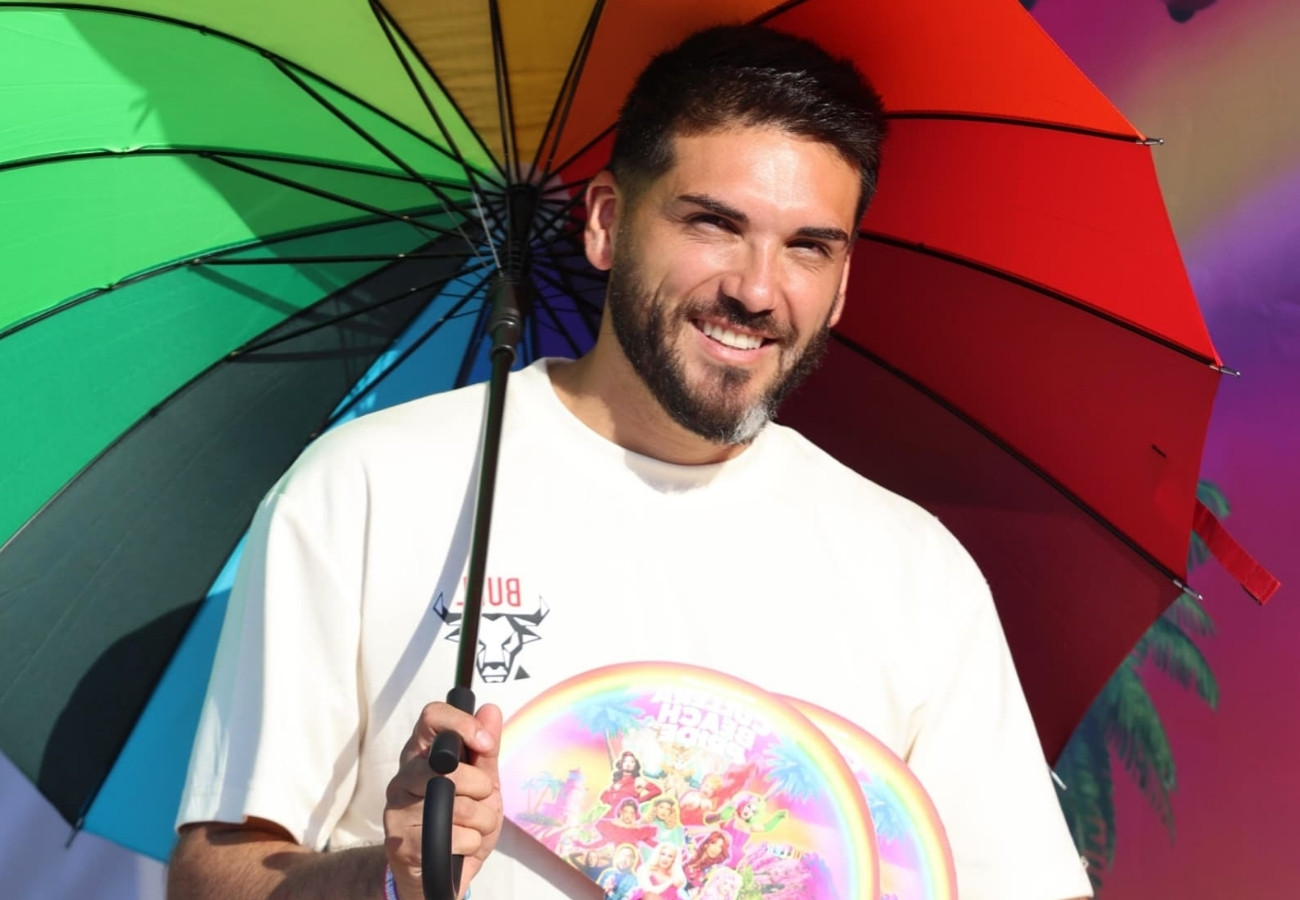
Damián López, LGTBI secretary of the Socialist Party of the Valencian Country, is not one of those who remains silent out of commitment. High-level taekwondo player and one of the strongest voices of the PSPV-PSOE in Valencia, has learned the hard way—inside and outside of sport—that freedom is not begged for, it is exercised. In this talk with Magazine Rainbow, Damián tells us how the discipline of sport has given him the necessary skills to not give in to hate speech and to understand that, in politics as in life, no one wins alone: either we save ourselves as a community or there is no match that counts.
We speak without filters about the controversy of Gay Games 2026 and that “pinkwashing” that stings so much in the Valencian associative fabric. Damián is clear that he has not come to the institutions to be a “lapel activist” or a photogenic adornment; his is a rebellion with a cause that seeks to shake up the board and recover in 2027 a Government that does not compare diversity with diseases. A necessary interview to understand why, sometimes, the greatest victory is not hanging a medal, but knowing when to stand up.
Rainbow: As a high-level taekwondo player, discipline is your daily basis. How does that “combat” mentality and strategy influence your way of understanding political activism?
I think that, to begin with, it is essential to recognize that people are political beings by nature. We inhabit: we live together, we make decisions, we uphold values and we build community. In that sense, sport is also political. Not because it necessarily responds to parties or ideologies, but because it transmits values, organizes links, establishes rules of the game and defines which behaviors we promote and which we reject. Values are politics in action.
For me, sport is an ethical school. In each training session, discipline, respect, teamwork, resilience and the ability to recognize one’s own and others’ limits are put into play. All of this contrasts deeply with the violence that we see today installed in certain public discourses, especially in the most ultra sectors, where disqualification, fear and the logic of the enemy predominate.
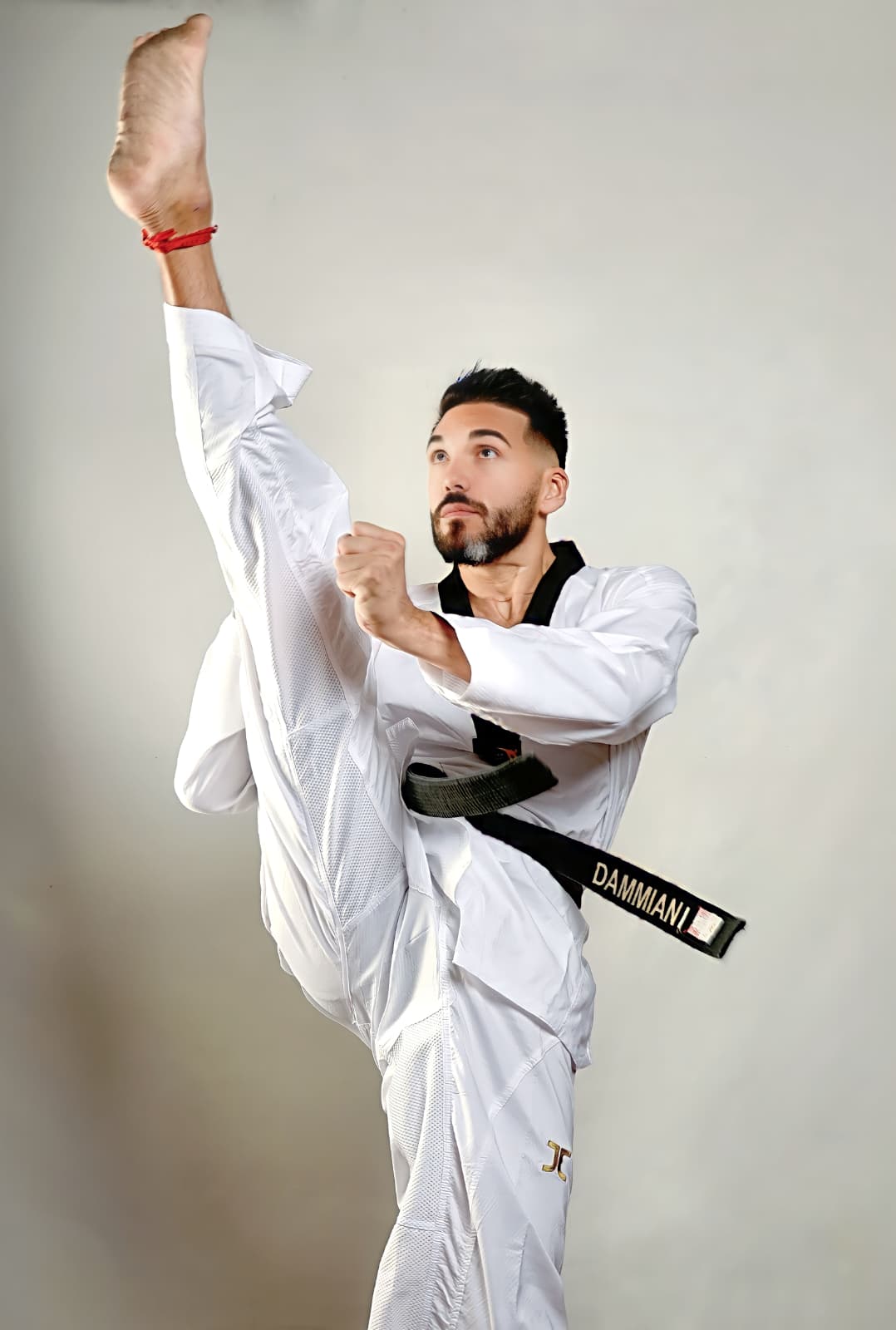
What sport gives me in this context is, above all, mental clarity and emotional strength. It helps me to organize my head, not to react from the immediate anger and to hold convictions without falling into aggression. Training is also an exercise in temperance: learning that processes are long, that setbacks exist and that perseverance is more transformative than fits and starts.
In times where a reactionary, classist and denigrating wave is advancing, sport reminds me that real changes are not built from hatred, but from coherence and community. Just as in a competition no one wins alone, in public life there are no individual transformations either: we need networks, solidarity and shared objectives.
My activism, then, is not born from empty confrontation, but from a deep conviction in certain values: dignity, equality and respect. And sport is the space that trains me—literally and symbolically—to hold those values firmly, even when the social climate seems to push in the opposite direction.
Rainbow: Elite sport is usually an environment of very strict hierarchies. Has taekwondo been a refuge or an extra challenge when it comes to making your identity and political commitment visible?
Taekwondo has been much more than a sport in my life; It has been my refuge. Throughout my story I have had to go through very difficult experiences: a migration that forced me to start from scratch, an illness like cancer that tested my strength, moments of absolute poverty, deep wounds such as abuse, loneliness and the challenge of growing up in a dysfunctional family.
In the midst of all that, Taekwondo was my space for balance. There I found discipline when everything seemed chaos, respect when I felt broken, and resilience when life demanded I get back up. It was the place where I was able to transform pain into strength, uncertainty into focus, and fear into determination.
More than teaching me how to fight, Taekwondo taught me to resist, to rebuild myself and to believe in myself even in the darkest moments.
Rainbow: Headlines have been published in various media outlets stating that “The LGTBI secretary of the PSOE of Valencia asks to ban right-wing gays”. What did you really want to convey about political coherence within the collective? As an advisor and political official, how do you manage that your phrases are used to create a narrative of confrontation instead of debate of ideas?
I think we are facing one of the most aggressive and self-conscious ultra-rights in recent times. It is not a rhetorical exaggeration: it is a political and cultural statement. They are sectors capable of instrumentalizing any phrase, decontextualizing any reflection and turning nuance into a weapon. Their strategy is not to debate ideas, but to erode legitimacies. That is why our battle is not only electoral or institutional: it is, above all, cultural.
When I point this out, I do so not from victimhood, but from responsibility. As LGBTI people we cannot afford to look the other way when rights are in question in exchange for a false sense of privilege or acceptance. History has taught us that no right won is irreversible, and that each setback begins by normalizing discourses that seemed unthinkable.
This is a deep debate, even uncomfortable, because it touches sensitive chords such as belonging, identity and mental health. There is a human need to be accepted, to be part of something. But we must ask ourselves: at what price? There are spaces that do not recognize us as equals, that question our dignity, and yet need to display us as an alibi to legitimize their setbacks. This dynamic is not integration: it is instrumentalization.
The rights of the collective would not be under discussion today if there were not a deliberate strategy of dividing us and using LGTBI voices as symbolic endorsement for policies that, ultimately, erode our own protection. That is not ideological diversity; It is political functionality at the service of those who have never defended our equality.
I am not moved by fear. I have nothing to lose when it comes to defending human dignity and rights, and everything to fight for. I am not going to dedicate my energy to amplifying attacks that seek precisely that: to distract, to wear down, to intimidate. My focus is on building, strengthening awareness and remembering that freedom cannot be negotiated or begged for. It is exercised and defended.
Rainbow: To what do you attribute the alarmism and the virulent reaction of certain sectors and right-wing parties to your approaches about spaces for activism?
I think your concern is not personal, it is symbolic. They are concerned that my voice represents that humble part of society that rarely has a loudspeaker: a boy who comes from below, who did not inherit power or privileges, and who has still managed to open a public debate about something as essential as the expansion of rights and freedoms for all.
What is uncomfortable is not my story, but what it demonstrates: that it is not necessary to belong to the elites to question the established order; that someone of simple origin can challenge power and point out its contradictions; that the discourse of equality is not an empty slogan, but a lived experience. When those who have historically been invisible take the floor and turn it into collective consciousness, that disorients those who need everything to remain the same.
Furthermore, my speech is not about gratuitous confrontation, but about progress. And precisely for this reason it is uncomfortable: because it states that rights are not a zero-sum game, that expanding freedoms does not take anything away from anyone, and that a fairer society strengthens the whole. In the face of those who live by sowing fear or resentment, talking about dignity and shared progress disarms their narrative.
As I said before, we are facing a cultural battle. And it will not be punctual or ephemeral. In the next elections—and probably in those to come—we will see how the confrontation intensifies, how the tone becomes more aggressive. Because when they cannot refute the substance, they attack the form; When they cannot stop ideas, they try to discredit the person who utters them.
That is why this fight is not only political, it is also a question of democratic survival. It is about deciding whether we move back towards an exclusive model or move towards one where no one has to ask permission to exist fully. And that is where I will continue to be: not from fear, but from the conviction that social progress has always inconvenienced those who benefit from stagnation.
Rainbow: Do you feel that certain political sectors are trying to “protect” what an LGTBIQ+ activist should be like so that it suits their interests?
Today the term activist has become almost a campaign accessory. Everyone puts it on their lapel when it suits them. I have even heard leaders of the Popular Party define themselves as activists. And yes, it is ironic. Because activism is not an aesthetic label or a rhetorical resource: it is assuming personal costs for defending rights that bother those in power. Managing what exists is not the same as challenging it.
We have so trivialized the words that anyone gives a categorical opinion about realities that they have not lived or studied. And when everything is “activism”, nothing is. Activism is born from discomfort, from conflict with what is established, from pointing out what many would prefer not to look at. That’s why it bothers. That’s why they try to domesticate it.
Within political parties there is a constant temptation: to protect the activist, mark the perimeter, remind him how far he can go. Turn him into a docile spokesperson instead of critical conscience. Because there are debates that make people uncomfortable, that alter the planned agenda, that force us to review privileges and strategies.
And in politics, the uncomfortable is often labeled as “unnecessary.”
But we have not come to be comfortable. We have come to question everything. To review even what we think we do well. To push the limits, not to manage them. If activism stops making people uncomfortable, it stops transforming.
In LGTBI matters—as in so many others—the agendas are not written by themselves: they are set by the people behind each organization, their courage or their fear, their autonomy or their dependence. And I was not born to be an ornament or an alibi. I’m a rebel. And rebellion, when it is at the service of human rights, is not a problem: it is a democratic guarantee.
Our absence was not a betrayal of sport or diversity. It was an act of political coherence and collective dignity.
Rainbow: València is the venue for the Gay Games 2026, but the main LGTBI entities (such as Lambda) have withdrawn from the organizing committee. How do you value, as an athlete and politician, that the social fabric turns its back on the event?
Sorry to correct you, but the associative fabric and LGTBI activism did not turn our backs on the Gay Games. It was the Gay Games who turned their back on the community by complacently associating themselves with the extreme right that governs Valencia.
We are activists. We do activism. And under no circumstances are we going to become servants of those who have historically violated our rights, have questioned our dignity and have fueled hate speech against our lives.
The mayor of València, María José Catalá, has come to compare LGTBI people with diseases such as ALS. Given that, what were we supposed to do? Look away and applaud?
If there is something that I feel deeply proud of, it is the Spanish associative fabric and its activism: independent, combative and coherent. We are not going to legitimize a blatant and obscene pinkwashing exercise while whitewashing those who attack our rights.
Our absence was not a betrayal of sport or diversity. It was an act of political coherence and collective dignity.
Rainbow: There is talk of institutional “pinkwashing”. Do you think it is possible to hold Gay Games with a protest essence under the current management of the City Council and the Generalitat?
I don’t believe it. There will be visibility, yes—because many tourists will arrive: men, gays, whites, with money, ready to enjoy the beach, sun and paella with a wristband. But visibility is not the same as transformation.
I doubt that anything historical or really relevant will emerge from this. The privileges travel in business, stay in front of the sea and applaud diversity as long as it does not make the afternoon cocktail too uncomfortable. Inclusion will be celebrated as long as it is photogenic, sponsored, and perfectly timed between competitions.
The truly interesting thing will not be in the ceremony or the medals, but in what we do those days. In how we point out – clearly and without asking permission – that participating is also taking a position. Coming to celebrate rights in a context of inequality without questioning it has a name: complicity.
If there is activism, it will not be what comes in the official event kit. It will be the one that bothers you. Whoever remembers that not all bodies travel with the same privileges, nor do all dissidence fit in a sponsored photo.
Rainbow: What specific measures does the PSPV propose so that Valencia does not lose its prestige as a diverse and safe city in the face of this climate of institutional breakdown?
In 2027 we will recover light, dignity and pride for the LGTBI community in Valencia. From the PSPV we are clear: the first step is to change the government that governs us today with regression and indifference. We need to put institutions back at the service of rights, and we are going to achieve that next year with Pilar Bernabé at the helm.
Pilar Bernabé is not only a committed person, she is a firm ally of the LGTBI collective, someone who understands that rights are not curtailed, they are not negotiated and they are not questioned. With it, political courage, sensitivity and determination to move forward will return.
And we are going to resume, with more force than ever, all the policies that were paralyzed in 2023. We are going to promote diversity education in the classrooms to combat hate from the roots. We are going to reinforce visibility and training in all areas, from administration to the business community. And we are going to guarantee resources and real support to the LGTBI associative fabric, because it is the entities that support, accompany and defend our group every day.
We are not going to allow even one step back. Faced with hate, more rights. In the face of silence, more pride. In the face of fear, more community.
In 2027 we recover the government to restore hope, equality and a future to the LGTBI community.
Rainbow: The closet in men’s sports continues to be a difficult wall to break down. What would you say to a young athlete who today is afraid that his political or personal visibility will cut short his sports career?
The first thing I would tell a young athlete is to not be afraid to ask for help from the beginning. Having a strong support network not only protects physical and mental health, but also strengthens athletic performance. Because behind every athlete there is a complete person, with emotions, challenges and realities that are not always seen on the track or in competition.
But beyond individual athletes, I want to address a call to the federations: we need to start talking about all the realities that those who practice sports go through. We are people before we are athletes, and our differences—gender, culture, orientation, abilities or experiences—deserve recognition and respect.
From the Taekwondo Federation of the Valencian Community we actively assume this responsibility. We continue to create training content that protects and promotes all diversities. We are currently working on a diversity training manual, which will be mandatory for all clubs and coaches in our federation. We want each sports space to be a safe, inclusive place and aware that true strength is not only measured in technique or medals, but in respect, equity and mutual care.