
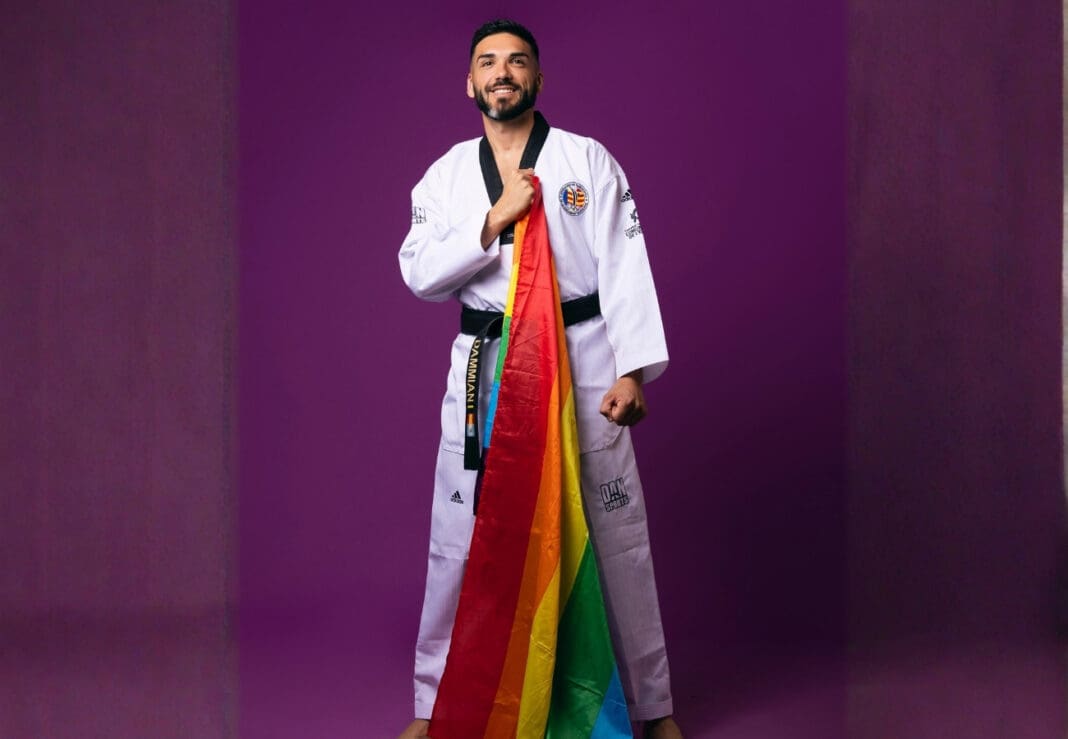
I think I’ve been an activist since I was born.
Not because one day I decided to join an organization or participate in a demonstration, but because all my life I have had to claim my right to exist. I have had to do it to survive poverty, to report sexual abuse, to defend my dignity when I began to understand that I was homosexual and to face a world that constantly reminded me that there was something in me that I had to hide, correct or justify.
I have been doing LGTBI activism on the streets, in associations and within the sports field for more than twenty years. And if years, experience, and many hours of therapy have taught me anything, it is that the struggle is never exclusively individual. We like to think that we are autonomous people who advance on our own merit, but the reality is that our rights have always been collective achievements. None of the spaces we occupy today were given to us. They were conquered by people who organized themselves, who rebelled and who took risks so that subsequent generations could live a little better.
That is why it is impossible for me to understand the discourse that insists that LGTBI people must be apolitical or non-partisan.
LGTBI people do politics for the mere fact of existing.
Our existence questions structures that have historically marginalized us. We engage in politics when we demand equality before the law, when we demand protection against hate crimes, when we defend diversity education, when we ask for decent health care or when we denounce employment discrimination. We engage in politics because we have understood that the system has not always protected us and that the only way to transform it is by organizing ourselves together with other people who share our experiences and our demands.
However, in recent years a new trend of pseudo-activism has emerged, built from the comfort of certain privileges. An activism of showcase, photography, marketing and social networks. An activism that often speaks more about individual visibility than collective transformation.
It is the activism of those who have never had to face social exclusion, precariousness, family violence or structural discrimination. Of those who can afford to present equality as a goal achieved because they never had to fight for it to survive.
From these privileged spaces, it is constantly questioned which activism is legitimate and which is not. It is accused of “politicizing” our demands, as if human rights were a neutral issue. Moderation is requested from those who still experience discrimination firsthand. Silence is demanded from those who remain vulnerable.
And meanwhile, those who most need to be heard are once again left behind.
Trans people. Racialized people. The impoverished people. Lesbian and bisexual women. Migrants. The older people of the group.
All those identities that continue to endure multiple layers of discrimination while observing how certain sectors try to turn activism into an aesthetic issue, devoid of conflict and demands.

When that happens, public space is once again occupied by those who historically already had a voice: men, white, cisgender, normative and with access to positions of power. And then a deeply unfair paradox occurs: those who have suffered the least the consequences of exclusion end up questioning the experiences and needs of those who continue to fight every day to be recognized.
That’s why I insist: LGTBI people cannot afford to be apolitical.
Because our existence is political. Because our rights are political. Because the speeches that seek to limit us are political. Because the laws that protect us or unprotect us are political. Because every advance we have achieved has been the result of political decisions. And because every setback we suffer is also a setback.
The Valencian Community is an obvious example of this reality. We are seeing how certain political forces turn our lives into an ideological battlefield. How democratic consensuses that seemed consolidated are questioned. How equality policies, spaces for diversity and protection tools against discrimination are attacked.
Our land has become a laboratory where the extreme right measures how far it can advance in the erosion of rights and freedoms. They do not seek to debate our existence. They seek to condition our lives. They seek to reduce our spaces of representation. They seek to expel us from the places where critical thinking and citizenship are built.
Faced with that, neutrality does not exist. Neither does silence. Because when human rights come into question, standing aside is not a neutral position: it is a way of allowing others to decide for you.
We cannot let them take away from us what makes us real, visible and worthy: the word, collective organization and political participation.
And yes, we must also recognize those who came before. To those who laid the body when doing so meant losing their job, family or even their lives. To those who conquered rights that today some enjoy while affirming that it is no longer necessary to fight.
Don’t think we’re naive. Don’t underestimate us.
We know perfectly well where we come from and we also know how to identify who has been on the side of our demands and who has worked to stop them.
Because memory is also political. And because the freedom we enjoy today was not born from indifference, but from the collective struggle and political parties that have accompanied us.
It would be advisable to reflect on this.