




A space of freedom or a digital trap?
Social networks came with the promise of connecting, making visible and giving a voice to those who had never had one before. For many people LGTBIQ+, platforms like Instagram, TikTok or X (formerly Twitter) have been a window to the world. A refuge to express yourself, to find community, to say “here I am.”
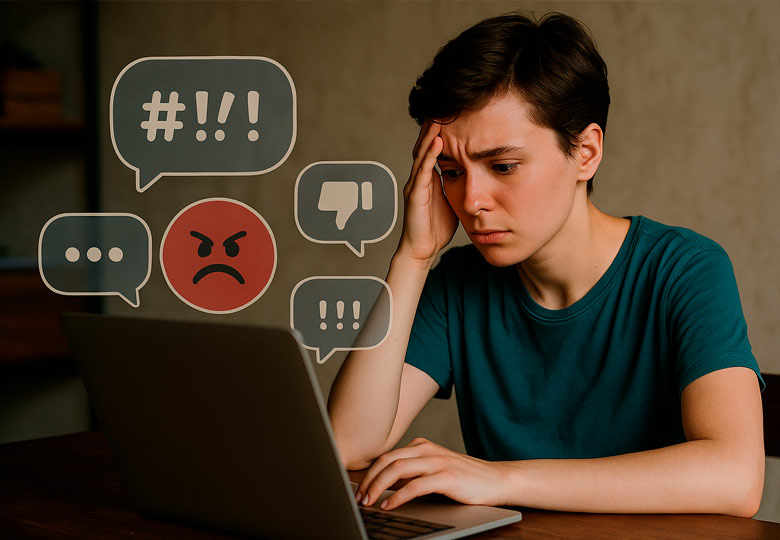
But along with the likes and rainbows came hate comments, anonymous messages, mass reports and the shadows of the algorithm. To what extent are these networks still safe for the community?
From the verbal to the viral: hate also adapts
What was once an insult in the school hallway now multiplies into threads, memes, and fake accounts. Hate has learned to speak the language of the Internet. And LGTBIQ+phobia is no exception.

In networks, the attack can come in the form of mockery disguised as humor, organized harassment, transphobic comments or denial of identities. Many times, those who exercise it are not even aware of the damage they cause. Or worse yet: they do it knowing that there will be no real consequences.
Because the truth is that moderation systems fail. And while a nipple or a word out of context can block your account, hate speech is rampant.
The algorithm problem
And here a key word comes into play: algorithm. That invisible creature that decides what we see, who we follow, what goes viral and what gets buried.
In theory, the algorithm rewards content that generates interaction. In practice, LGTBIQ+ content is often penalized without explanation.
Trans creators who see their videos mysteriously disappear. Queer activists whose posts are labeled “sensitive content.” Queer love stories censored while the dissemination of homophobic or misogynistic content is allowed. What is happening?
Algorithms, like any system, are not neutral. They feed on human biases. And if the training data comes from an unequal society, the result will be unequal too.
Who moderates the moderators?
Content moderation is a dark universe. There is talk of automatic systems, human reviews, internal policies. But the reality is that no one is entirely clear about how it is decided what is deleted and what is not.
In addition, many networks do not have enough staff (or adequately trained) to manage complaints of LGTBIQ+phobic content from an intersectional perspective. What happens when an insult has cultural nuances? Or when a word resignified within the collective is misinterpreted by an automatic system?
The lack of transparency of the platforms does not help. And in the meantime, those who experience online violence must navigate forms, automated responses, and closed doors.

Real consequences for digital bodies
Digital is not just digital. Violence in networks has concrete and serious consequences in real life.
Anxiety, fear, self-exclusion, abandonment of public spaces, and even suicide attempts. This is not an exaggeration: it is the daily life of many LGTBIQ+ people who try to simply exist on the Internet.
Some choose to create secondary accounts. Or for stopping showing up with your partner. Or to avoid certain topics. What was supposed to be a space of freedom becomes a place of self-censorship.
And that, in a world where much of activism and visibility happens through networks, is a silent form of exclusion.
What is being done? And what’s left to do?
There are important initiatives. Organizations such as It Gets Better, GLSEN or FELGTBI+ actively work against cyberbullying. Some platforms have incorporated tools to filter offensive comments or block toxic accounts.
But it is not enough. We need more than patches. Here are some key urgent demands:
- Algorithmic transparency: knowing how it is decided which content is hidden or promoted.
- Moderation with an LGTBIQ+ approach: diverse teams with specific training.
- Effective sanctions on accounts that promote systematic hatred.
- Active protection for creators of the collective, not only in June.
- Human and accessible appeal spaces, not just automatic responses.
What if the problem is not just the networks?
It is also fair to ask whether we are expecting too much from platforms that, at their core, are private, for-profit companies. Their priority is not social justice, but user retention.
Can we demand ethics from those who live off constant attention, even if it is toxic?
Some voices criticize that entrusting the visibility of the collective to these digital environments makes us vulnerable. What happens if tomorrow it is decided to censor all mention of queerness due to external pressures or economic interests?
Are we prepared to sustain our communities outside of likes and retweets?
A space to recover, not to abandon
Not everything is dark. The networks have also been a space of love, art, resistance and memory. Thanks to them we have met, we have cried together, we have learned and we have shouted with pride.
What we need is not to leave, but transform those spaces from within, demand changes, take care of ourselves more and occupy every corner with our voices.
Because every story shared, every meme that represents us, every thread of support, every video of a trans person dancing without fear… is a victory.
And although the algorithm does not always understand us, we do.


