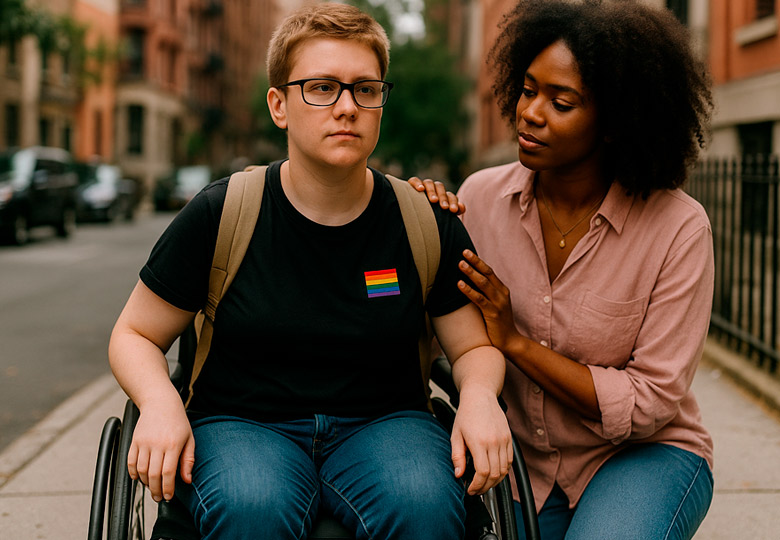


A place that should be safe
In theory, school should be a safe space. An environment where everyone—regardless of sexual orientation, gender identity, or expression—can learn, grow, and feel free. In practice, for many LGTBIQ+ students, the classroom is just the opposite: a silent battlefield where every look, mockery or push leaves a mark.
bullying due to LGTBIQ+phobia is not something new, but it is still something silenced. In many cases, it is not even named. It is camouflaged under the label of “kids’ things” or minimized with phrases like “it was just a joke”. But it is no joke that LGTBIQ+ adolescents present higher rates of anxiety, depression or dropping out of school. And it is not anecdotal that many think twice before being themselves in class.
Data that should not exist
According to the most recent report from the LGTBI+ State Federation, 6 out of every 10 minors in the group have suffered bullying at school related to their identity or orientation. That’s a lot of hallways, a lot of recesses, a lot of failing classrooms.
The forms of harassment change: insults, isolation, cyberbullying, physical attacks. Sometimes they are comments from teachers that reinforce stereotypes. Others, knowing glances that look away. And although legal advances have been made—such as Law 4/2023 for LGTBIQ+ equality—, cultural change within the centers is still slow.
Not all teachers know how to act. Not all protocols work. And not all students feel confident to report.
How is fear perpetuated?
One of the keys is in silence. The majority of LGTBIQ+ young people who suffer bullying do not tell it at home or to teachers. Sometimes for fear of not being believed, other times for not having come out of the closet. There are even those who have not even named themselves, but they already receive violence for how they walk, for their way of speaking or for having a pen.
The message is clear: you don’t have to “be” something to be punished for breaking the norm. It’s enough to look like it. And that, in the middle of adolescence, when identity is being built, can hurt three times as much.
And the teachers? Where is it?
Here is not about pointing the finger at anyone, but about saying what is happening. There are committed, sensitive teachers who stand up and transform their classroom into a space of freedom. And there are others who still prefer not to get involved, because “they are delicate topics”. The problem is that, by not taking a position, the system does: it positions itself on the side of the attacker.
Training in emotional-sexual and gender diversity continues to be optional in many communities. And although protocols exist, they are often applied late, poorly or not at all. Are we training teachers to manage these realities? Or do we continue to pretend that “education is neutral”?
What can be done?
Although the outlook may seem bleak, there are concrete steps that can be taken. And some are already happening. Here are some examples that can make a difference:
-
Mandatory training in LGTBIQ+ diversity for all educational staff.
-
Clear and visible action protocols, not just filed in a document.
- Publicidad-
-
Safe spaces within the center, such as support groups or tutoring with an inclusive approach.
-
Include LGTBIQ+ references in the school curriculum, not only during Pride month.
-
Involve families, especially in the early educational stages, to prevent hate speech from home.
It is not necessary for every teacher to be an activist, but they do need to know how to look with perspective. Because neutrality, when it comes to human rights, is not an option.
What no one wants to tell
There is a topic that is often avoided: teenage suicide. Data hurts, but it is also necessary. Young LGTBIQ+ people have between 4 and 5 times greater risk of attempting suicide than their cishetero peers. Not because of her identity, but because of how society treats her.
The educational system, when it does not act, not only perpetuates bullying: sometimes, it also perpetuates emotional abandonment. And there, the difference between intervening or not can be a matter of life or death.
Is the law working?
Since the approval of Law 4/2023, specific measures have been established against harassment due to LGTBIQ+phobia in the educational field. The law says the right thing. The paper is fine. But reality is still not entirely with her.
Many autonomous communities have their own more advanced regulations, while others have barely begun to implement them. This generates inequalities that directly affect students. What if you live in a region where your identity is not protected the same? Is it fair that your right not to be attacked depends on your zip code?
A necessary critical vision
There are also critical voices that point out the limits of this strategy. Is there any point in filling schools with rainbow posters if inclusion is not worked transversally? To what extent are we including non-binary, intersex or students with less visible identities? Don’t we run the risk of making diversity just another “issue” instead of a comprehensive view that goes through everything?
Even within the collective, there are pending debates about which bodies, which voices and which experiences are prioritized in educational discourse. Diversity is not just a flag, it is a complex, living, sometimes uncomfortable process. And precisely for that reason, so necessary.
Dreaming of a different classroom
Imagining a school without LGTBIQ+phobia is not a utopia, it is a realistic and urgent objective. But she won’t get there alone. It requires will, resources, training and the desire to listen. Really.
Because it is not only about protecting those who have already been attacked, but about preventing them from being so. To build spaces where each person can be who they are, without fear. Where the strange thing is not being different, but rejecting the difference.
Maybe we don’t know how to get there yet. But knowing that we are not there is already a good starting point.