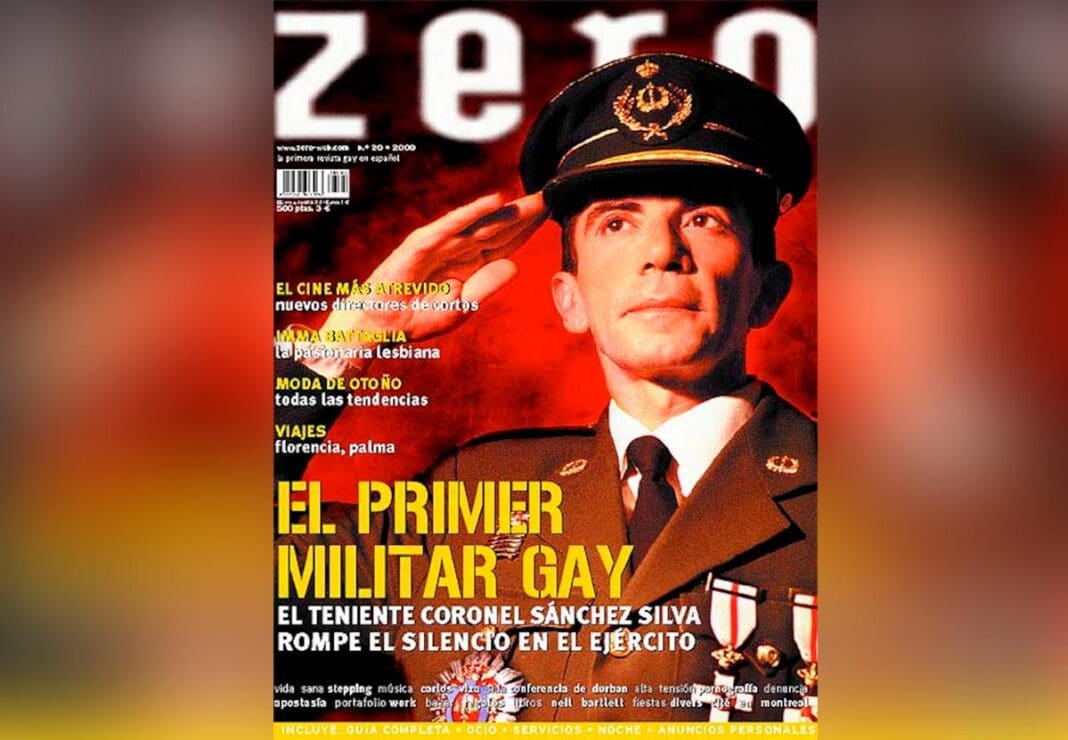
Lieutenant Colonel José María Sánchez Silva has died at the age of 74 in a military residence in Guadarrama. His name is written in history as that of the first military commander who, in September 2000, decided to publicly reveal his homosexuality. He did it on the cover of Zero magazine and in an interview with El País. That gesture, simple in appearance but revolutionary in its context, opened a crack in the wall of silence that existed within the Spanish army.
A cover that changed mentalities
The image of Sánchez Silva in the magazine Zero with the headline “The first gay soldier” marked a before and after. Until then, homosexuality in the Armed Forces was a taboo subject, surrounded by prejudice and discrimination. His testimony was an act of civil courage that forced the military institution – then directed by Federico Trillo, Minister of Defense of the PP – to look in the mirror.
That decision didn’t come out of nowhere. According to Mili Hernández, founder of the Berkana bookstore in Chueca, it was he himself who came forward to tell his story, convinced that the time had come to take a step forward. “For the LGTBIQ+ community, for politics, for what happened next, this is the most important cover that a magazine has had in decades,” Hernández recalled in the documentary Zero, the magazine that brought a country out of the closet (2023).

The price of visibility
Sánchez Silva’s coming out had a huge media impact, but also a personal cost. He himself recognized that, although there were direct homophobic attacks, it was common for discrimination to occur disguised as apparently neutral norms. After the interview, he suffered threats, insults and even had to take a colleague to court for insults in 2003. Justice was not on his side and he ended up requesting voluntary reservation.
Years later, he summarized his experience with a phrase that continues to resonate: “If someone has hated me, let them know, from now on, that they have not managed to make the hate reciprocal.”.
A discreet life after the storm
After leaving the army, his life became much calmer. Between Chamberí and Chueca, he divided his days between readings in Berkana, meals at El Yate or coffees at the now-defunct Figueroa. He never kept a uniform or medals; The only thing he retained was the conviction that he had done the right thing. He died asking that his ashes rest next to those of his parents, in Cabo Enderrocat (Mallorca), and with a funeral in a military church, despite having apostatized years before.
Pending recognition
Although his gesture opened doors that today allow many soldiers to live their sexual orientation with greater freedom, Sánchez Silva complained that the LGTBIQ+ community and associations had barely valued his contribution in life. Perhaps now, after his death, is the time to recognize his rightful place in the history of the rights of our collective.
However, it is worth asking: why did pioneering figures like Sánchez Silva not receive the support they deserved during their lifetime? Was it the fear of stigma, the discomfort of remembering darker times, or the lack of collective memory? The invisibility of leaders within the community itself shows a challenge that is still pending: it is not enough to achieve rights, we must also care for and recognize those who risked their professional and personal lives to pave the way.