
The word may sound distant. But the phenomenon is much closer than we think.
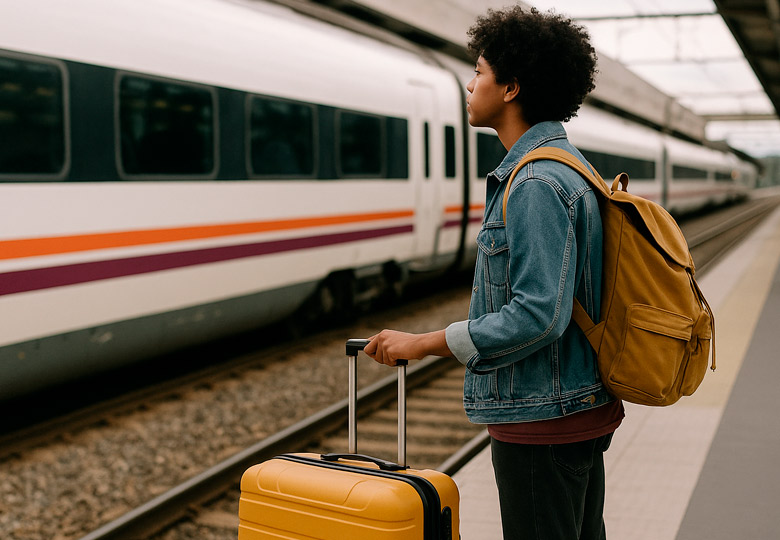
Sexile does not occur only between countries. In Spain, thousands of LGTBIQ+ people migrate every year from towns or rural areas to larger cities looking for something as basic as being able to live their sexuality freely.
They don’t always do it on a whim or for work. They do it because they need to breathe. Because they want to come out of the closet without being singled out. Because they want to love, dress, fuck or exist without having to explain themselves.
And that, in many parts of the territory, is still not possible.
🌍 What is sexile?
The term sexile was coined in the 90s to refer to those people who, for reasons related to their sexuality or gender identity, are forced to migrate.
There has been a lot of talk about international sexile: young queer people leaving countries where being LGTBIQ+ is illegal, persecuted or punished, seeking safety in Europe or North America.
But internal sexile also exists. And in Spain, it has a name, face and map.
🧭 Where do they come from and where do they go?
Although there are no official figures, the patterns are clear:
📍 From where:
- Small towns, especially in rural areas of Castilla-La Mancha, Castilla y León, Galicia, Aragón, Murcia or Extremadura.
- Medium cities with a strong religious or conservative presence.
- Family or school environments with social pressure, harassment or denial of identity.
🏳️🌈 Where:
- Madrid (Chueca, Lavapiés, Malasaña…)
- Barcelona (Eixample, Raval, Gràcia…)
- Valencia, Seville, Bilbao or Palma
- Coastal municipalities with a more open culture, such as Sitges or Torremolinos
The vast majority look for spaces with a greater LGTBIQ+ presence, support networks, anonymity and real possibilities to explore their identity.
🧠 Why are they leaving? (And what they leave behind)
The motivations for internal sexile are varied, but usually revolve around:
🔒 Escape from repression
Living in a town where you can’t walk hand in hand with your partner, use correct pronouns, or simply dress how you want without fear takes a toll. And it exhausts.
🏳️🌈 Search community
Emotional isolation is real. Many LGTBIQ+ people grow up without references, without friends, without safe spaces. Migration is also a journey towards the tribe.

❤️ Being able to love without hiding
For many, the first freely lived relationship only comes after sex. This is when they can explore emotional or sexual ties without guilt or double lives.
💼 Job opportunities
Although it is not always the main reason, many people take advantage of moving to a big city to reinvent themselves professionally in more open or creative sectors.
But all this has a price: the family that is left behind, the roots that are cut, the identity that is fragmented.
💬 Voices from sexile
“I left Albacete when I was 19. It’s not that I couldn’t be gay. It’s that I couldn’t even talk about it.” — Miguel, 29 years old, lives in Lavapiés
“In my town I wasn’t trans. I was ‘the weird one’. In Barcelona I was myself for the first time.” — Rita, 25 years old, now lives in Raval
“I went back to town for Christmas with my partner. They looked at us as if we were aliens. I had never felt so foreign in my own home.” — Leo, 32 years old, non-binary
Critical perspective: what if there is also elitism in sexile?
Migrating is not easy. But not everyone can do it.
It requires money, contacts, independence and a minimal safety net.
Trans, racialized, disabled, migrant or working class people have it even more difficult. And many times they are trapped in hostile places, with no option to leave.
Therefore, romanticizing sexile as “liberation” without considering its material conditions can make very complex realities invisible.
What can we do so that no one has to leave to be who they are?
1. Create safe spaces in all territories
Libraries, cultural centers, associations, institutes… visibility cannot only be urban. Rural Pride also exists and needs support.
2. Schools with real affective-sexual education
Many sexile stories begin in the classroom. Preventing queerphobic bullying saves lives.
3. Diversity training in health, work and social environments
Being respected at the clinic, at work or at the town bar should not depend on your zip code.
4. Public aid for LGTBIQ+ people expelled from their homes
There are young queer people who remain on the streets after coming out of the closet. We are not talking about choice. We talk about emergency.
❤️ The return (or not) after the sexile
Some people come back years later. Others, never.
Returning to town with your partner, with another body, with another name… can be an act of power.
Or a painful experience.
Can that bridge be rebuilt? Can a conservative family learn to hug? Can a town change?
The answer is not unique. But we do know this: those who left did not do so to flee, but to live.
✨ Conclusion: migrating because you are you is also political
Sexile is real. Silent. Daily. Not always dramatic, but almost always profound.
It is an internal migration that tells us about the fractures between center and periphery, between freedom and imposition, between visibility and survival.
And although there may be more safe spaces in cities, that is no excuse to forget about those who still cannot go out. Not even those who dream of returning without hiding.
Because true Pride will be complete when we don’t have to leave to be able to love each other.