

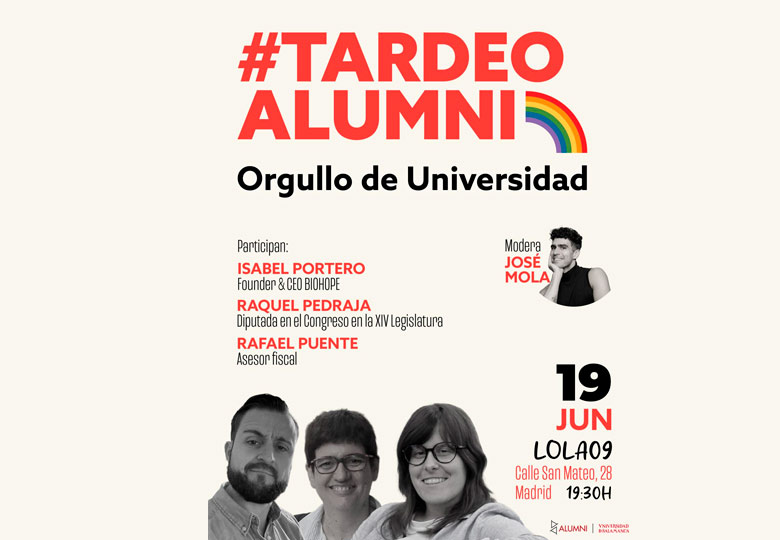
Next Thursday, June 19, Madrid will be the scene of an event that unites reflection, celebration and community: the event #TardeoAlumni, organized by Alumni – University of Salamanca, lands in the capital with a title that has already It says everything: “University Pride”.
It will be at 7:30 p.m. at Lola09 (Calle San Mateo, 28), one of those spaces where conversation flows, ideas intersect and people meet. A perfect place to give voice to those who have made and continue to make the path from the USAL classrooms towards more inclusive and committed realities.
What does it mean to feel university pride today?
The event wants to be more than just a meeting between alumni. It wants to open a space where diverse experiences, personal and professional trajectories that were born at the university and expanded beyond its walls can be heard.
Among the guests, names that do not go unnoticed:
- Isabel Portero, founder and CEO of BIOHOPE, one of those figures that combines science, leadership and vision of the future.
- Raquel Pedraja, deputy in Congress during the XIV Legislature, who brings with her the political and social view from within the institutions.
- Rafael Puente, tax advisor, with a more technical approach but no less necessary to understand how the world we inhabit is structured.
- And as moderator, José Mola, journalist, writer and LGTBIQ+ activist, who will provide his close, critical and, why not, provocative tone.
An event with prior registration (and limited capacity)
Entry will be free for Alumni members, while non-members must pay €5 to participate. Of course, it is essential to prior registration, since capacity is limited and the experience promises to be close and enriching.
You can register by clicking here
Why go?
Because we need more spaces to share differences. Because every story adds up and because sometimes, the academic and the personal are not as separated as we think. And because meeting others who have also gone through the classrooms—and the same challenges—can be a way of recognizing oneself.
What conversations do we need to continue having?
In an era where labels matter, where polarized discourses gain space, what place does the university occupy as an engine of free and diverse thought? Can we talk about pride without talking about memory, struggle and vindication? Perhaps there are no closed answers, but these meetings serve to open up those questions. And that is already a lot.