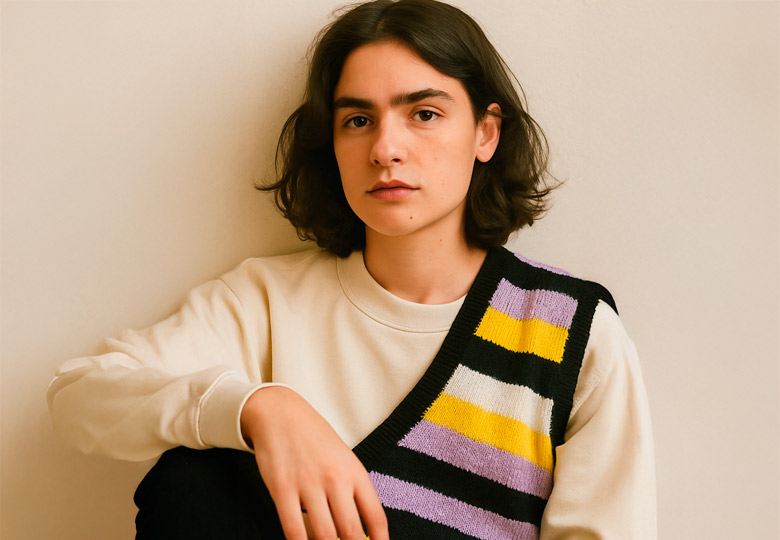

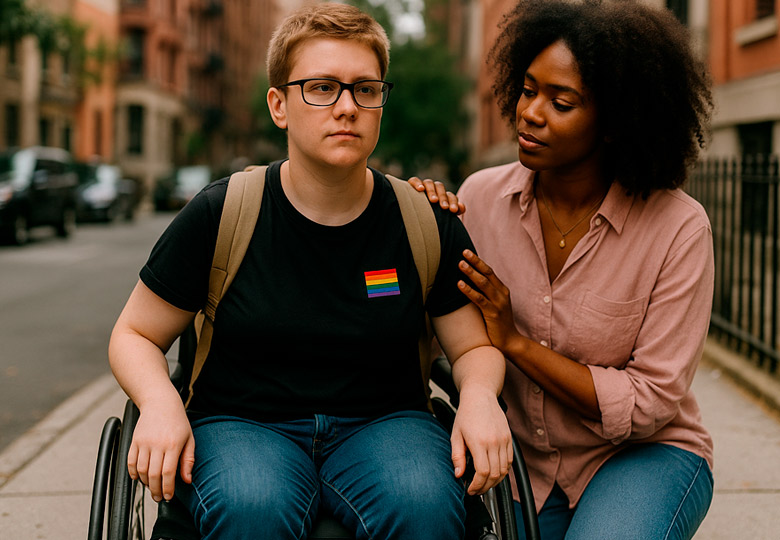
Coming out of the closet is never easy. But if you are also a person with a disability, the path can become even more complex.
We are talking about double invisibility. One that silences desire. And another that infantilizes the body.
In this article we put on the table a reality that is not yet mentioned enough: living as LGTBIQ+ and with a disability.
Because yes, we exist. And we also want to be seen, desired, heard and free.
🌈 When your body is read as “asexual by default”
We live in a society that continues to associate disability with dependence, weakness or lack of agency.
And in that collective imagination, desire disappears. The idea that someone with a disability can have a diverse sexual identity, or a full emotional life, simply does not fit into the script.
Therefore, coming out as a person with functional diversity is not just talking about your orientation or your gender identity.
It is also breaking with the ableist gaze that denies you as a desiring subject.
🚪 How do you experience this process of “coming out”?
Each story is different, but there are patterns that repeat. Here are some common elements:
1. Fear of not being believed
“But do you have a partner?” “And how do you do that?” “Isn’t it too much for you?”
The questions are not just invasive: they start from disbelief. As if your LGTBIQ+ identity needs to be “proven” more than other people’s.
2. Invisibility on both sides
In spaces of disability, sexual and gender diversity is often not named. In LGTBIQ+ spaces, disability is not contemplated.
And that leaves many in no man’s land.
3. Fear of losing care or support
Coming out can pose a real risk if you are emotionally or financially dependent on those who do not accept your identity.
This is even more serious when we talk about people with intellectual or psychosocial disabilities or in a situation of guardianship.
4. Communicative or accessibility barrier
If the person also cannot speak, needs visual aids, does not understand the normative structure of language or lives in an institution, the difficulty in expressing their identity is multiplied.
✊🏼 Silent bravery: the stories we don’t see
There are many ways to be brave. Sometimes it’s raising a flag. Others, it means for the first time that you like someone. Or choose a different pronoun. Or simply, don’t laugh at a homophobic joke in your therapy group.
Coming out as disabled involves deep inner work. An emotional process that does not always receive the recognition it deserves.
Because we are not talking about a symbolic gesture. We are talking about an act of resistance.
🤝 How to accompany with respect
If you are a professional, family member, teacher, friend or caregiver, these are some ideas to accompany without invalidating:
✅ Don’t assume anything
Nor is he heterosexual. Nor is he asexual. Nor that he has no interest in exploring. Ask respectfully. Listen carefully. Believe what he tells you.
✅ Create accessible spaces
It is not enough to accept. You have to create real conditions so that the person can express themselves, explore and build community.
✅ Talk about desire and relationships
Desire is not a taboo subject. And if it is, ask yourself why.
Talking about sexuality, affections, bonds, consent and pleasure is also caring.
✅ Use clear, direct and adapted language
If a person needs pictograms, easy reading, sign language or alternative communication, it is your responsibility to adapt. It is not “something extra”. It is part of your right to express yourself.
🧠 What if the environment is LGTBIQ+ but not accessible?
Therein lies the painful contradiction. Many queer spaces proclaim themselves inclusive, but they continue without a ramp, without an interpreter, without easy reading, without subtitles, without sensory rest.
Inclusion is not just theory. It’s practical.
And accessibility is not a “detail”, it is a condition to exist.
❗Critical perspective: inclusion or condescension?
Be careful. Because sometimes, in the attempt to “include”, we fall into infantilization or paternalism.
We don’t need to be treated like brave heroes or like fragile people. We just want the right to live our lives on our own terms.
Have you considered whether, in the name of support, you are making decisions for others? Does your way of caring leave space for that person to express themselves freely?
🌟 Testimonials that inspire (but do not romanticize)
-
Marina, 27 years old, deaf and bisexual: “No one spoke to me about sexual orientation in sign language. I discovered it alone. Today I proudly sign who I am.”
-
Kevin, 34 years old, wheelchair user and non-binary: “The most difficult thing was coming out of the closet within the disability group. There are prejudices there too.”
-
Isa, 19 years old, with autism and lesbian: “I knew it since I was little. But they told me it was confusion. Why would I confuse something as clear as loving a girl?”
🌱 Pride also has supports, crutches, canes and subtitles
Being LGTBIQ+ and with a disability is not a double problem. It is a rich, powerful and transformative double identity.
But for it to flourish, it needs fertile soil: acceptance, accessibility, listening and community.
Coming out as a disabled person should not require more courage than in other cases.
But, for now, it requires it.
And for that reason, those who do it deserve all the applause, all the spaces and all the respect.