

In a country that prides itself on its diversity and openness, a painful and often invisible reality continues to push thousands of people to leave their homes: sexilio. This phenomenon, which involves the forced displacement of LGTBIQ+ people for reasons of sexual orientation, identity or gender expression, is not an echo of the past, but rather a current and persistent experience in Spain. A pioneering report, “State of LGTBI+ Hate: Sexile”, prepared by the LGTBI+ State Federation in collaboration with the University of Salamanca, sheds light on this harsh reality, offering us an x-ray of the impact of discrimination and the lack of safe environments.
A Reality Encrypted in Displacements and Considerations
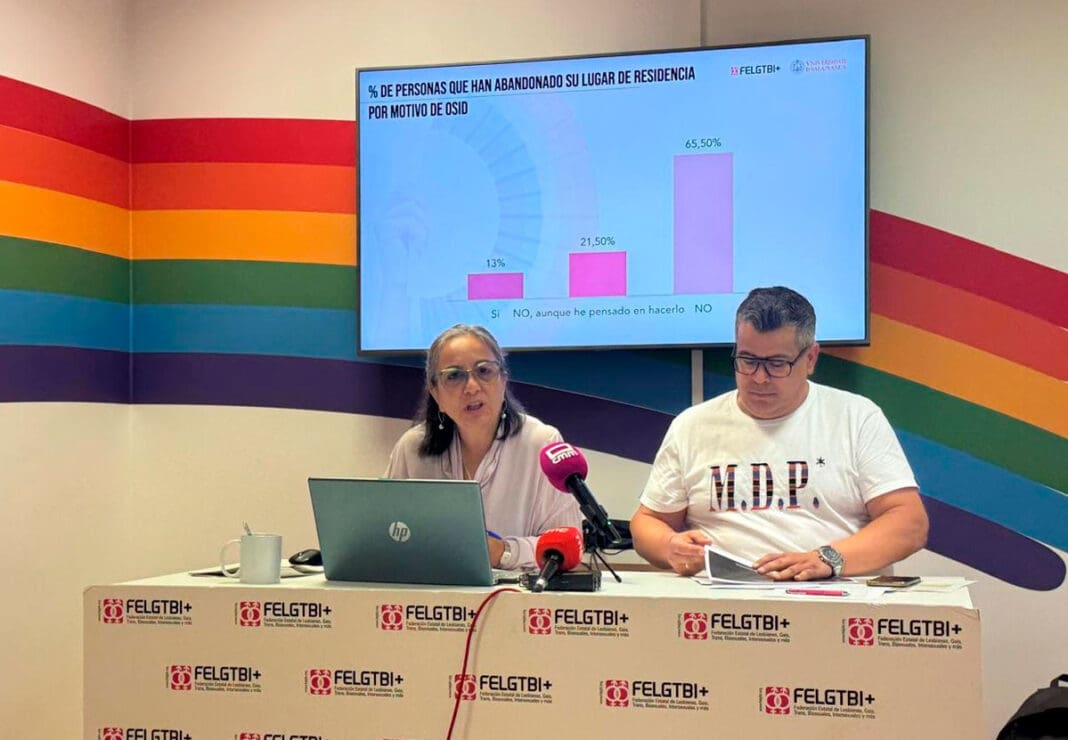
The data is conclusive: one in three LGTBIQ+ people in Spain has had to become sexiled or has considered it throughout their life. The research, based on a representative sample of 800 interviews, reveals that 13% of the LGTBIQ+ community has changed residence for these reasons, while 21.5% have seriously considered it. This means that more than a third have experienced or contemplated displacement as the only way to be who they are, without the constant fear of rejection.
The lack of safe spaces, the fear of violence and the proliferation of hate speech not only slow down the vital development of these people, but push them to leave their municipalities, their families and their support networks behind. We are not talking about a voluntary election, but rather a forced expulsion that operates silently and systematically in numerous corners of our country. Have you stopped to think about what it means to have to flee your own home to be yourself?

Sexile Does Not Understand Borders: Unequal Impact and Resistance Strategies
The report highlights that sexile impacts the entire spectrum of the LGTBIQ+ community, but with a particular intensity on trans and racialized people, whose displacement rates are even higher. This confirms that discrimination is intertwined with other inequalities—territorial, social and economic—turning migration into an obligation rather than an option.
Contrary to the preconceived image of an exodus from the countryside to the city, the data surprises us: 43.4% of displaced people came from large cities, 26.9% from abroad and only 13.5% from rural environments. More than half of those who sexile choose a regional capital or another large city as their destination. This shows us that sexile is an urban, transnational and multi-causal phenomenon, intrinsically linked to the search for security, equal opportunities and the possibility of full development.
The motivations to migrate are clear: the need to live without hiding, escape discrimination, violence or family rejection, and find references and support networks. However, displacement is not always synonymous with a better life, nor does it guarantee a residential solution. 17.3% of sexiled people have lived on the streets (compared to 5.5% of the LGTBIQ+ population in general), and 22.1% have lived in inadequate housing. The emotional burden is undeniable: 11.5% live in constant fear and 8.7% suffer continuous depression, figures significantly higher than among those who have not experienced sexile.
LGTBIQ+ Youth Facing Sexile: A Fight for Visibility and Freedom
Sexile takes on special relevance among youth. According to CIS study 3501 (January 2025), 25.8% of young people under 30 years of age identify as part of the LGTBIQ+ community. However, many cannot exercise their rights on equal terms. The “LGTBI+ State 2025” survey reveals that 16.3% of LGTBIQ+ young people have changed residence for reasons related to their sexual orientation, identity or gender expression, and 23.7% have seriously considered it. In total, an alarming 40% have experienced or contemplated forced displacement as the only way to be who they are without fear of rejection.
The majority of young people leave towns or small cities, where only 8.2% of LGTBIQ+ youth live, compared to the 91.8% who live in medium or large cities, evidencing a clear territorial fracture. This displacement, beyond being a response to violence, becomes a strategy of resistance and life construction: 38.3% move to express themselves freely, 31.9% to develop life projects with real expectations (partner, work, studies), and 29.8% in search of support networks, friendships or visible references. As María Rodríguez, head of research at the LGTBI+ State Federation, explains, “this analysis allows us to identify sociodemographic, territorial and risk patterns associated with sexile, as well as its implications for well-being and fundamental rights.”
An Urgent Call for Inclusive and Decentralized Public Policies
“Sexile is not an election, it is a silent expulsion that continues to operate in our country. Thousands of people have had to leave their homes behind to be able to live without hiding. We are talking about human rights that should be guaranteed in any corner of Spain,” says Jesús A. Muñoz, member of the Executive Commission of the LGTBI+ State Federation. Sexile shows us how discrimination intersects with other inequalities, making “paper” laws not enough. We need public policies with a territorial and intersectional approach that ensure that no one has to flee their town, their neighborhood or their country to exercise their rights and be who they are.
In this sense, Muñoz has announced that the Federation will work with the General Directorate of Policies against Depopulation of the Ministry of Ecological Transition and Demographic Challenge in the design of public policies to address sexile and reinforce research in this area. The objective is to guarantee a dignified life for LGTBIQ+ people in rural areas and small cities.
Sexile is a complex, multi-causal and inconspicuous phenomenon, which combines experiences of violence with the search for freedom and opportunities for personal development. For this reason, the LGTBIQ+ State Federation demands inclusive and decentralized public policies, specific measures for trans, racialized and people in situations of greater vulnerability, as well as support networks that prevent sexile from leading to social exclusion or loss of rights. “The place of residence can no longer determine the degree of freedom and dignity with which an LGTBIQ+ person lives in Spain. Migrating must be a free decision, never an obligation imposed by hatred, violence or lack of opportunities,” concludes Muñoz.
What can we do, as a society, to ensure that every LGTBIQ+ person can live freely in their own home, without fear of being who they are? Reflection and action are urgent.