
Hair loss can be an unexpected blow to self-esteem. Sometimes it starts out subtle, with entrances that peek out timidly. Others, more abruptly, as if time said “that’s it.” And although many people wear it with pride, for others it is not so easy. What happens when looking in the mirror stops being comfortable? A resource that is becoming increasingly louder enters the scene: hair prostheses.
What is a hair prosthesis and why is it in fashion?
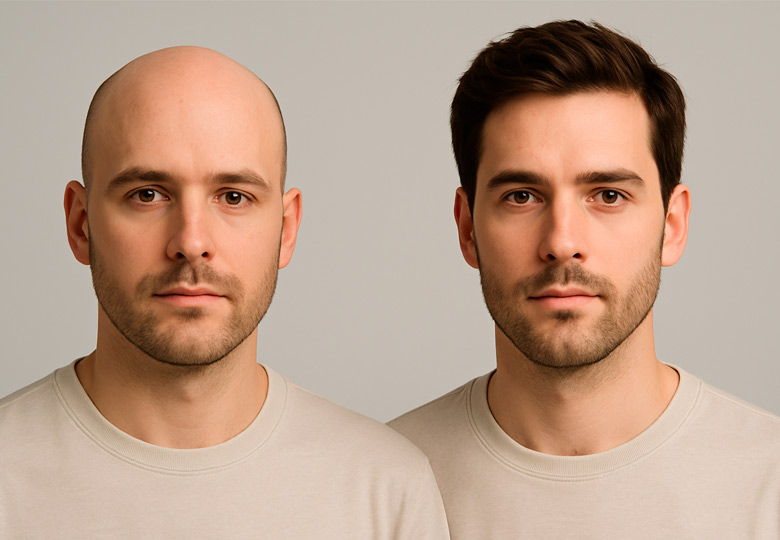
Let’s speak clearly. A hair prosthesis is not just any wig. Nothing to do with carnival costumes or those pieces that fall off with a little wind. It is a personalized solution, made with natural or synthetic hair, that adapts to your scalp as if it were part of you.
It can cover small or large areas, depending on the degree of alopecia. It is glued with special adhesives, and the idea is that no one notices that it is not your hair. And yes, you can swim, play sports and even sleep with it. You have to be careful, of course, but the important thing is that it gives you the freedom to live without thinking about your bald head all day long.
Who uses hair prostheses?
Although the traditional market was mainly aimed at straight cis men with advanced baldness, today prostheses are opening up to more audiences. More and more young people, trans and non-binary people are looking for these types of solutions. Because hair is not just something aesthetic, it can also have an emotional, identity, and even gender burden.
Imagine being in transition and wanting to see yourself in the mirror with a hairstyle that reflects how you feel. Or simply want to recover that security that you lost over the years. There is no single valid reason. Every story is unique.
How much does a hair prosthesis cost?
Spoiler: it’s not cheap. Depending on the type of hair, the application technique and the duration, prices can range from 300 euros to more than 1,500. Add to that the monthly maintenance, which is around 50-100 euros, if you want to keep it impeccable.
But before you put your hands on your head (literally), think about this: there are those who spend the same on treatments, miracle shampoos or supplements that promise to stop hair loss. In many cases without visible results. The prosthesis gives you immediate, visible and real results. That has a value.
Benefits that go beyond aesthetics
Let’s talk about self-esteem. Security. How a prosthesis can change the way you move through the world. It’s not an exaggeration. Several people say that they felt reborn when they put it on for the first time. That they went out again, to flirt, to look at each other with affection.
Shallow? Could be. But also very human. Because the physical matters, especially when it interferes with how we feel inside.
In addition, today there are very advanced options: prostheses based on polyurethane or tulle, European, Asian or Latin American hair, techniques that allow a real scalp appearance. If they are well made and placed, they are practically undetectable.
Types of hair prostheses: not all are the same
When you hear “hair prosthesis,” you may imagine something generic. But the reality is that there are many different types, and each one adapts to different needs: from the degree of hair loss, to your lifestyle, your budget or simply how you like to feel your hair.
Choosing well can make the difference between feeling like yourself or wearing something that doesn’t quite convince you. So, if you are thinking of trying one, here is a basic guide to understanding the world of meshes, bases and materials.
1. Polyurethane (PU) base: ultra realistic appearance

Polyurethane is a type of thin, transparent sheet that imitates the scalp. It is flexible, adapts well to the shape of your head and allows the hair to be “injected” into the base without knots, which creates a very natural visual effect. At first glance, it looks like the hair is coming straight out of your skin.
Advantages:
- Hyper-realistic finish.
- Ideal for invisible frontal lines.
- Easy to clean and maintain.
Disadvantages:
- It can be hot, especially in summer.
- Less breathable.
- Requires more care to make it last.
Recommended if you are looking for maximum realism and you don’t mind that the base is a little less comfortable on hot days.
2. Mesh or lace base: lightness and freshness
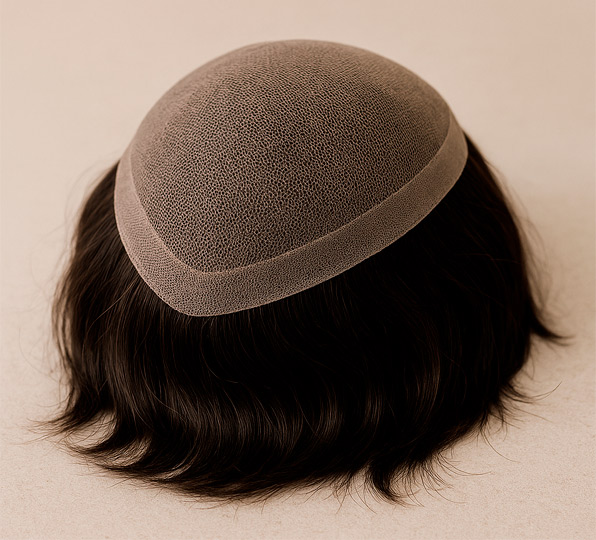
Mesh, also called lace, is a very thin and breathable base. There are several variants, but the most common are French lace (more resistant) and Swiss lace (finer and more natural, but also more delicate).
In this type of prosthesis, the hair is hand-knotted in the mesh, which gives it a fairly natural fall.
Advantages:
- Very light and comfortable.
- Lets air pass through, ideal for hot climates.
- Good balance between naturalness and breathability.
Disadvantages:
- More fragile than other bases.
- Requires more frequent maintenance.
- The knot may loosen over time.
Perfect if you play sports, live in a hot area or are looking for something that feels cool and comfortable.
3. Combined or hybrid foundation: the best of each world

This type of prosthesis mixes several materials to take advantage of the best of each one. The most common is a mesh front part (more natural), with polyurethane sides and back area (for a firmer hold and easier to put on).
Advantages:
- Good breathability.
- Solid fixation.
- Balanced appearance.
Disadvantages:
- May be more expensive.
- Maintenance is somewhat more complex.
Recommended if you are looking for versatility, careful aesthetics and durability.
4. How do you place your hair? Knotted vs. injected
Not only the base matters, but also how the hair is placed.
-
Injected hair: the hair is introduced directly into the polyurethane base, without knots, which creates a very real visual appearance. It’s ideal if you’re worried about being noticed.
-
Knotted hair: It is knotted manually on the base (usually mesh). It is more resistant and allows for greater density, although the finish may be slightly less natural if it is not done well.
If you prioritize realism, you may like the injected one more. If you are looking for durability, knotting wins points.
Hair: natural or synthetic?
Prostheses can be made with:
-
100% human hair: the most natural, it can be combed, straightened, dyed… It looks and feels like your own hair. More expensive, but also more durable.
-
Synthetic hair: Cheaper, but with a different texture. It cannot be molded with heat. Ideal for tight budgets or specific uses.
-
Mixtures: some combine both types to achieve good value for money.
What is the best hair prosthesis for you?
There is no single valid answer. It all depends on what you are looking for and how you live your day to day:
-
Do you go to the gym or sweat a lot?
-
Do you move in hot environments?
-
Are you interested in an ultra-natural look or do you care more about being resistant?
-
Do you prefer something easy to maintain or are you willing to invest time?
Ideally, you can try different materials, touch, compare, ask questions without fear. Some hair centers offer samples or trial sessions. Take advantage of that. And remember: if the first option doesn’t convince you, nothing happens. You can change until you find what really fits you.
And maintenance?
Not everything is glamour. Like any other system, prostheses require constant care. Cleaning, touch-ups, adhesives that do not irritate the skin, visits to the hair center. It’s not just “put it on and go.”
Some last 4-6 weeks before needing maintenance. Others, cheaper, last less. But if you’re a detail-oriented person, you’ll probably enjoy it. There are those who say that this time becomes ritual: a kind of self-care that is also comforting.
Criticism and doubts that we cannot ignore
Now, not everyone is convinced. There are critical voices that question whether these solutions reinforce oppressive beauty standards. Are we promoting that there is only one “correct” way to look? What about accepting baldness as part of body diversity?
There are also those who point out conflicts of interest. Some hair centers sell aggressive treatments to prevent hair loss and, at the same time, offer prostheses as a “last resort.” Isn’t it convenient for them if other methods fail?
And be careful with the emotional: if a prosthesis becomes a kind of mask that you cannot take off even in front of your loved ones, perhaps it is time to review what is behind it.
Alternatives: what else is there?
If you feel that a prosthesis is not for you, there are other options. Some more expensive (like hair implants) and others more natural, like letting baldness flow. On TikTok and Instagram there is an interesting movement of people documenting their transition to a shaved head with pride. It is another path, and also valid.
There are also hair fiber powders, hair tattoos (micropigmentation), and of course, traditional strategic hairstyles. Nothing is final. The key is to choose what makes you feel best, without external pressures.
Fad or new normal?
The rise of hair prostheses for men is not coincidental. It occurs in a context where masculine aesthetics are redefined, where personal care is no longer taboo, and where hair—that great symbol of youth, strength and desire—takes on a new dimension.
Will it be a passing fad or are we facing a new way of understanding male beauty? Hard to say. Maybe both. Maybe everyone makes their own path between the social, the emotional and the practical.
The important thing, in the end, is not whether or not you use a prosthesis, but that you make the decision freely, with information and without guilt.
In summary: The good, the bad and what remains in the air
Main advantages:
- Immediate and visible results.
- High customization.
- Increased self-esteem.
- Suitable for different types of people and lifestyles.
Disadvantages:
- High (and ongoing) cost.
- Frequent maintenance.
- Possible allergic reactions to adhesives.
- Risk of emotional dependence.
Conclusion? As with everything that has to do with the body, there is no single truth. The important thing is to be able to choose, be informed and, above all, feel good about yourself.