
What is internalized homophobia?
Hatred does not always come from outside. Sometimes, we carry it inside without wanting to. Internalized homophobia is that voice that whispers that loving who you love is wrong. That forces you to hide, to pretend, to adapt to molds that were not made for you. In simple words: it is the set of prejudices, beliefs and negative attitudes towards one’s own sexual orientation or gender identity that an LGTBIQ+ person may have absorbed throughout their life.
Yes, even though it hurts, we may have grown up with speeches that taught us that being different was dangerous. And that leaves a mark. These are not personal faults, but social structures that pass through us, even without realizing it.
How does it manifest?
Internalized homophobia is not always evident. Sometimes it is disguised as “common sense.” Others, it sneaks into small details of everyday life:
- Feeling ashamed when showing affection in public.
- Reject cultural aspects associated with queerness.
- Constantly seek heteronormative approval.
- Having relationships loaded with guilt or emotional self-boycott.
- Thinking that we don’t deserve love or visibility.
- Criticizing others within the group for “being too much.”
Even in safe spaces, these dynamics can remain active. Because? Because we have grown up in a world that, for a long time, taught us that being LGTBIQ+ was a problem that should be corrected, hidden or healed.
Where does this load come from?
The root of internalized homophobia lies in socialization. Since childhood, we hear messages that reinforce heterosexual couple models, normative aesthetics, rigid gender roles and a whole battery of stereotypes. Even when there is no direct aggression, silence, invisibility and subtle contempt also educate.
This is reinforced through the family, school, the media, religion… It is not about pointing out individual culprits, but rather understanding that we live in a society that has historically marginalized everything that does not fit into the cishetero norm.
And of course, after years of living with that backpack, it is not strange that we end up believing that something is wrong with us.
The emotional impact: beyond the individual
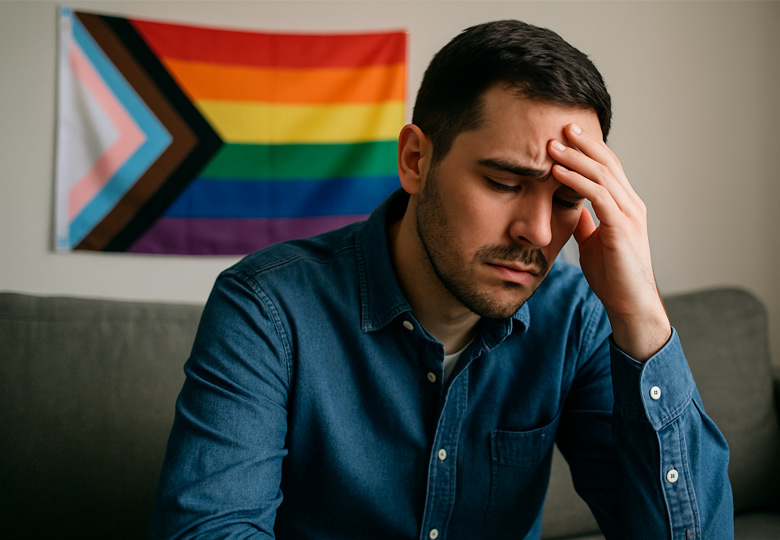
Is it just a personal thing? Not at all. Internalized homophobia can seriously affect mental health. Anxiety, depression, low self-esteem, social isolation or difficulties establishing emotional bonds are just some of the most common consequences.
In addition, not all of us experience this reality in the same way. Trans, non-binary, racialized or functionally diverse people often face multiple forms of discrimination simultaneously, which can intensify the internalization of rejection.
Therefore, talking about internalized homophobia is also talking about intersectionality. How different oppressions intersect and generate unique experiences that deserve to be made visible.
Can it be unlearned?
The good news is yes. Internalized homophobia is not a sentence. It can be dismantled, little by little. As? Here are some ideas, although there are no magic formulas:
-
Recognize it: the first step is to name it. Admit that it is there, without blaming yourself for it.
- Publicidad-
-
Search for references: surround yourself with narratives and people that affirm and celebrate diversity.
-
Taking care of mental health: therapy with LGTBIQ+ friendly professionals can make a difference.
-
Connect with the community: Finding spaces where you don’t have to explain who you are is healing.
-
Questioning commands: asking where certain ideas that seem “natural” come from can open new paths.
It is not about becoming an activist from one day to the next, but about giving yourself permission to be. To live without fear, with all the lights and shadows that this implies.
The personal is political (and also collective)
Overcoming internalized homophobia is not just an intimate victory. It is also a political act. Because every time we dare to show ourselves without filters, we are challenging a system that would prefer to see us silent, hidden, scared.
And although the process can be painful, it is also full of beautiful discoveries. It is, in many cases, a second coming out of the closet. This time, not to tell the world who you are, but to tell yourself that it’s okay to be who you are. That you don’t have to fit in, or hide, or ask permission.
What if everything is not so clear?
Now, we also have to admit something: not everyone agrees with the concept of internalized homophobia. Some critical voices inside and outside the group point out that it can be used as a way to blame LGTBIQ+ people for their fears or insecurities. Or what is sometimes labeled as “internalization” is actually a survival strategy in a hostile environment. Is it really fair to call “internalized homophobia” the fact of not showing yourself openly in a job where you could be discriminated against?
These questions do not have simple answers, but they deserve to be heard.
Why talk about this now?
Because although we have made a lot of progress in rights and visibility, there are still open wounds. Violence is not always visible, nor does it always come from outside. And as long as there are people who feel they must hide to be accepted, there is work to be done.
Let’s talk about internalized homophobia not to point the finger at us, but to give us tools. To hug each other better. To understand that healing is also a form of resistance.
Internalized homophobia is a complex, silent and very present reality in the lives of many LGTBIQ+ people. But it is also something that can be transformed. Recognizing it is a step towards self-love, community and freedom.
Have you stopped to think if you too have carried that voice? What would you do today to start silencing her?