
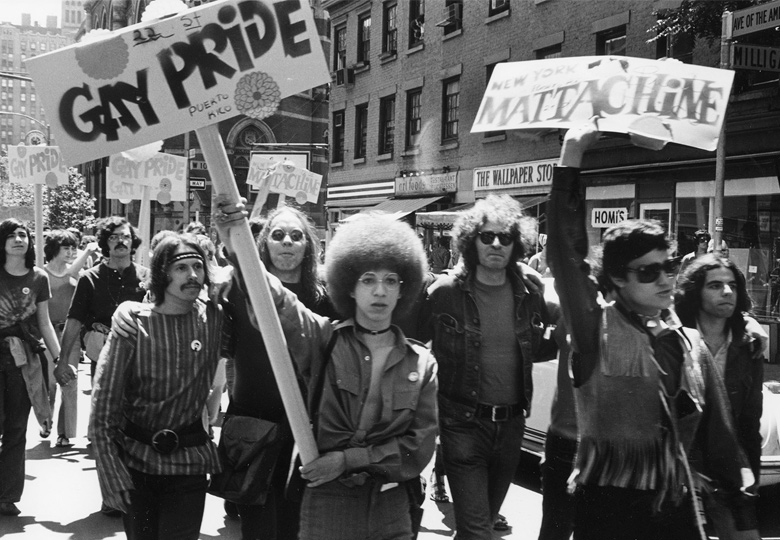
It all began on a warm morning on June 28, 1969, in a small bar in the New York neighborhood of Greenwich Village: the Stonewall Inn. It was not a glamorous place nor was it legally accepted. In fact, it was one of the few spaces where people from the LGTBIQ+ community could meet without (too much) fear of being persecuted. That night, like so many others, the police raided. But, unlike previous times, people did not remain silent. This time, they responded.
Why was Stonewall different?
In the 1960s, homosexuality was criminalized in much of the world. Raids were common and occurred with total impunity. Those who did not fit into the heteronorm – trans people, non-binary people, lesbians, gays, sex workers or simply those who challenged gender stereotypes – were marginalized, violated or directly ignored by society.
Stonewall was not the first revolt. In the US, demonstrations had already taken place in Philadelphia or San Francisco. But what happened in New York that night was different. It lasted several days. The pent up anger overflowed. Not only for that moment, but for everything that came after it: years of humiliation, of repression, of invisibility. The community said “enough.”
Who was in charge
Although official history has tended to whitewash or simplify the facts, the truth is that it was primarily racialized trans people who led the response. Figures like Marsha P. Johnson and Sylvia Rivera, both trans and racialized activists, played a key role. They were not comfortable figures for the press or the most assimilationist movements of the time, but their courage has marked generations.
Stonewall was not an isolated episode: it was a spark. One that ignited a global movement. A year later, in 1970, the first Pride March was held in New York, Chicago and Los Angeles. And since then, every June it is commemorated in hundreds of cities around the world.
From protest to global Pride
Today, more than five decades later, many cities celebrate LGTBIQ+ Pride with massive parades, floats, music and demands. But the path has not been easy, nor is it free of contradictions.
Stonewall symbolizes a before and after. We went from hiding to visibility, from fear to activism, from shame to pride. But it also forces us to remember. Because Pride was not born as a party, but as a revolt against the system.
And, above all, it was and is a reminder that the fight continues. In many countries, LGTBIQ+ people continue to face discriminatory laws, systematic violence or lack of basic rights. Even in contexts where legislative progress has been made, transphobia, biphobia and social homophobia continue to be very present.
What remains of the spirit of Stonewall today?
It’s easy to think that Stonewall belongs to the past. That today, with advances such as equal marriage, gender identity laws or visibility in the media, everything is done. But is it really like that?
Many voices within the group question the direction of Pride. There is talk of “pinkwashing“, of how big brands use the rainbow flag to sell products without really committing to the rights of the group. There are also internal tensions: Who is left out of the story? What happens to LGTBIQ+ seniors? And with migrants, racialized people or people in poverty?
It is important not to forget that Pride is – or should be – a political space. A moment to celebrate, yes, but also to demand, to make visible, to make uncomfortable if necessary.
A living memory
Talking about Stonewall is talking about living history. Of a story that continues to be written every day. Not only in New York, but also in Madrid, Mexico City, Buenos Aires or Kampala. Wherever there is someone who resists, who loves freely, who demands respect, there is the legacy of Stonewall.

But it is also a fragmented, incomplete story, often told from a single perspective. That is why it is essential to listen to all voices. Those who were on the front lines, those who have been silenced, those who come now with new ways of understanding activism.
What if Pride also excludes?
It seems like a contradiction, but it is not. Some people in the collective feel that the current Pride does not represent them. That has lost its transformative charge. That has become superficial, elitist, white, cis, commercial. Where is the radicalism that promoted Stonewall? And what happens when the institutions that previously repressed now join the party without taking into account their own past?
There are no simple answers. But there are many necessary questions. Because Pride, like any social movement, must be reviewed, adapted, questioned. Only then will it continue to make sense.
Stonewall today: a symbol that challenges
Every time we remember Stonewall, we are not doing archaeology. We are making present. Because the right to exist, to love, to express oneself freely, is still not guaranteed for everyone. And although the form of activism has changed, its essence remains alive: resist to exist.
Maybe that’s why Stonewall hurts, but it also inspires. It wasn’t a perfect story. It wasn’t a miracle. It was a night of rage, of fatigue, of courage. It was a turning point. And that spirit continues to beat in every march, in every banner, in every kiss stolen from fear.