
The violence that occurs within LGTBIQ+ sexual-affective relationships is a reality, often invisible, that requires a specialized response. With this objective, the LGTBI Center of Barcelona has just launched the Intra+ project, a pioneering initiative that seeks to design a comprehensive approach model, anchored in the feminist, queer and intersectional perspective.
This project was born to give shape to a void. For a long time, the understanding and attention to this violence, commonly called intragender, has been insufficient. Intra+ is presented as a space for participatory analysis, where the experiences and needs of the collective itself will be the core to build a specialized support model.
Beyond the term ‘Intragender Violence’
Before delving into the project, it is essential to stop at the language. The term “intragender violence” has traditionally been used to talk about violence between people of the same gender. However, is it a truly inclusive term?
From the perspective of the Intra+ project, this concept can be limiting. The reality of the LGTBIQ+ community is diverse and includes relationships with trans, non-binary, queer or asexual people, among others, who fall outside the binary definition of “same gender.”
Although these violences share structural roots with gender violence – such as patriarchy, machismo or heteronorm -, they also have their own specificities. Addressing them implies recognizing these particularities, understanding that they are not alien to the patriarchal system, but that they often replicate it even from non-normative bodies and sexualities.
What is Intra+ doing to transform care?
The project has a double aspect. On the one hand, it focuses on strengthening the technical capabilities of the social intervention area of the Centro LGTBI de Barcelona. On the other hand, it seeks to create a networking structure with other equipment to ensure intersectional professional coverage in the detection, support and referral of cases.
Part of this effort is materializing in:
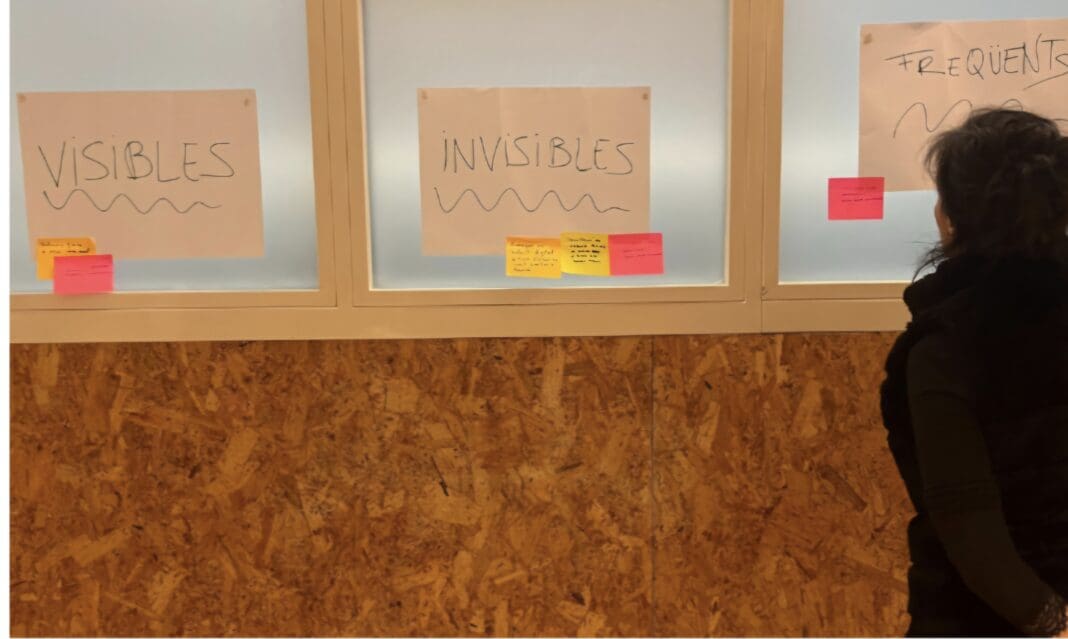
- Analysis and conceptualization: Focus groups are being organized with social intervention professionals who work with LGTBIQ+ people. In these meetings, vital topics such as:
- The key concepts and persistent myths around intragender violence.
- The manifestations of visible and invisible violence in various contexts.
- The frequency and patterns that are being detected.
- The current types of approaches and the challenges they present.
- Reference material: Intra+ will develop a practical guide and other supporting materials. These resources are designed to consolidate the care model and serve as an essential reference for professionals and services throughout the territory that serve the LGTBIQ+ community.
The increase in cases: Greater violence or more visibility?
The LGTBI Center of Barcelona has registered a significant increase in cases treated for violence in sexual relationships. The figures are eloquent: from 12 cases in 2023, they went to 22 in 2024, and 2025 closed with more than thirty cases.
However, the team of professionals highlights an important reading: this increase is not a linear increase in the frequency of violence, but rather a reflection of a greater capacity for detection and access to services.
- Specialized services: The consolidation of specific LGTBI resources and better coordination with sexist violence circuits have broken down historical barriers.
- Legal and social framework: Regulatory advances in Catalonia and the growing social visibility of LGBTIphobic violence have legitimized the demand for help.
- Feminist impact: The feminist struggle, by challenging the myths of romantic love and making power dynamics visible, has been key. This critical framework has allowed more LGTBIQ+ people to identify psychological, emotional or economic violence that was previously normalized.
This visibility process is, in itself, an achievement.
Intersectionality as a central axis
One of the strongest criticisms that the LGTBI Center observes is how existing services often maintain a heteronormative perspective, reproducing LGTBIphobic stereotypes or racist prejudices.
Therefore, the intersectional feminist perspective is essential for Intra+. It allows you to address the complexity of oppressions. When a person is crossed by multiple axes of discrimination (for example, being a trans person in an irregular administrative situation), their vulnerability to violence in any area (partnership, work, institutional, health) skyrockets.

Readers reflect: Do we recognize the way in which racism, transphobia or economic precariousness increase the risk of exposure to violence within our own relationships? Are we demanding services to accompany us from a structural perspective that recognizes all our inequalities?
The model that will be designed with Intra+ seeks precisely to rethink and redefine professional intervention methodologies to guarantee structural support. This work is promoted by the LGTBI Center of Barcelona, with the expert collaboration of psychologists Miriam Vázquez de Santiago and Marta Mariñas López, who contribute their feminist, queer and intersectional vision in trauma care.
The ambition is clear: to contribute to the eradication of violence within the LGTBIQ+ group through training, coordination and a care model that is as diverse and complex as the group it seeks to protect.