
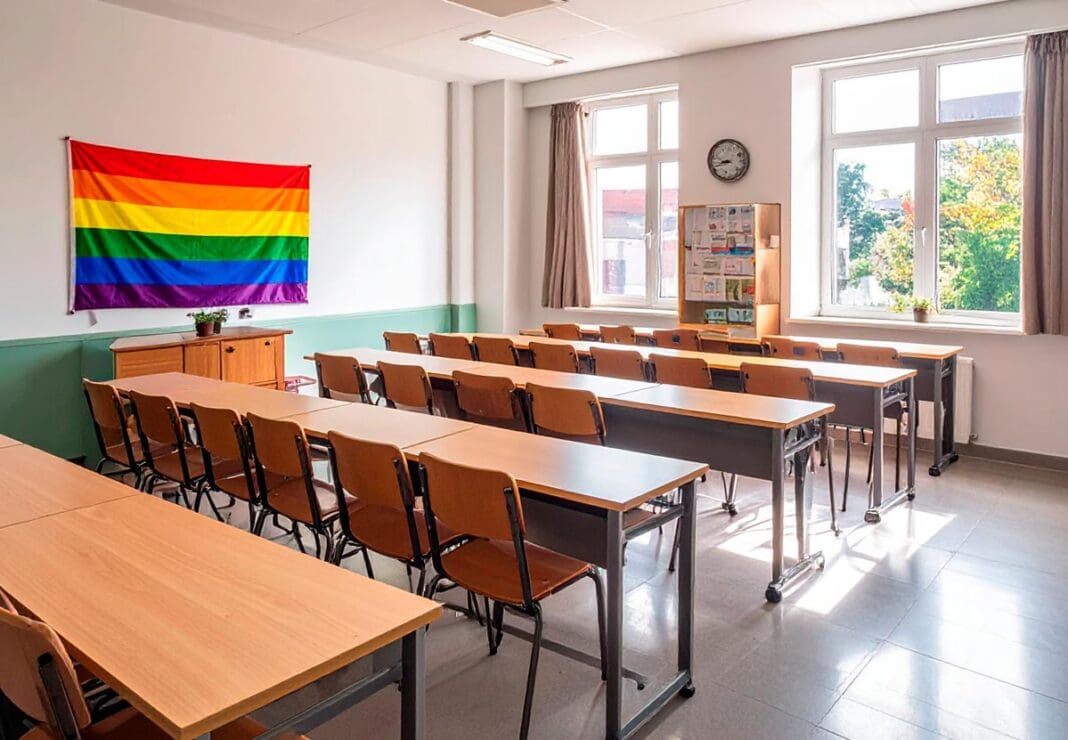
Despite the important legislative advances in recent years, the inclusion of LGTBIQ+ diversity in the educational field continues to be a pending task in Spain. A recent investigation, the result of collaboration between the LGTBI+ State Federation and the University of Salamanca, brings this complex reality to light. Its report, titled “Radiography of education in LGTBI+ diversity“, offers an exhaustive analysis of how affective-sexual, gender, bodily and family diversity is being integrated in our educational centers, as well as the deployment of inclusive public policies in each autonomous community.
This study acquires particular relevance after the approval of Law 4/2023, the well-known Trans Law and LGTBI+, which promised a solid regulatory framework to promote inclusion in the classrooms. However, as the report itself clearly warns, the promulgation of a law is not, in itself, a guarantee of its effective application. What good is a legal framework if it is not translated into concrete measures, from anti-discrimination protocols to teacher training or awareness campaigns aimed at students and their families? This is where the real challenge lies and where the autonomous communities show an unequal panorama.
The gap between paper and practice: A palpable reality
The report reveals that, although the majority of autonomous communities have laws or protocols to protect LGTBIQ+ students, their application is, in practice, very disparate. We find a paradox: a society that is advancing in the recognition of rights, but where educational barriers persist for certain groups of the group.
The data from the ‘LGTBI+ State 2025’ Survey are revealing regarding the educational level achieved by LGTBIQ+ people. Although a large majority has accessed university studies (41.9%), and others have completed Baccalaureate or higher vocational training (25.09%) or secondary school (23.71%), there are worrying inequalities within the group. For example, almost 6% of non-binary people have not completed their studies, and 21% of trans men did not complete primary education.
As María Rodríguez, head of research at the LGTBI+ State Federation, emphasizes, these data show that “despite progress, significant educational barriers persist for certain groups within the LGTBI+ collective, especially for trans and non-binary people”. Are we, as a society, guaranteeing the same educational opportunities for all? It is a question that forces us to reflect deeply.Visibility, harassment and the role of educational institutions
Visibility in the educational environment continues to be a critical point. Although more than 60% of young LGTBIQ+ people feel comfortable being visible with their close friends, this figure drops drastically to 25% in high school and 21% in college.
What do these percentages tell us about the environment of safety and acceptance in our centers?
Even more alarming is the impact of violence and harassment. 21.2% of incidents of hate and discrimination towards the LGTBIQ+ group occur in the educational field. Furthermore, more than half of young people have suffered harassment, humiliating treatment or cyberbullying during secondary education. “The family continues to be the main detector of these situations, while educational institutions still do not respond sufficiently,” adds Paula Iglesias, president of the LGTBI+ State Federation. This statement invites us to question: Are our educational centers equipped and sensitized to detect and act effectively against these attacks?
An autonomous map of lights and shadows
The territorial analysis of the report shows a fragmented and, at times, contradictory panorama. If in 2020 a previous study (“Reality of trans students in the educational system“) placed communities such as Aragón or Catalonia at the head of the recognition of rights, and others such as Castilla y León or Cantabria in the last positions, five years later the scenario has changed.
While some regions that were previously in the queue, such as Castilla-La Mancha, have experienced significant progress, others, such as the Community of Madrid or the Region of Murcia, have suffered setbacks in the application of their own laws. This is often conditioned by political discourses that go against equality and diversity.
This territorial disparity is a clear indicator that progress not only depends on the existence of regulatory frameworks, but on the political will, the investment of resources and the real capacity of each autonomous community to transform the law into tangible measures. “Legal frameworks are necessary, but insufficient. What is at stake is not only having written protocols, but also guaranteeing that in each educational center LGTBIQ+ students can feel safe, respected and visible”, warns Paula Iglesias.
The report also points out common problems at the national level, such as the lack of systematic teacher training, the absence of evaluation of results and an excessive dependence on individual initiatives or associations. Awareness programs, although abundant, are often dispersed, generating very diverse educational experiences between centers and communities.
“Diversity education cannot remain in good intentions or documents. We need each educational center to apply concrete measures, for teaching teams to be prepared and for LGTBIQ+ students to feel safe and accompanied every day,” Iglesias emphasizes. “It is essential that the autonomous communities move from theory to practice and that there is real monitoring of the protocols, because without evaluation there is no possible improvement. Educational equality requires institutional commitment, resources and shared responsibility.”.

The path to educational equality: From protocols to action
Among the most urgent recommendations of the study, the need to: is emphasized
- Comprehensive inclusive education plans.
- Clear and effective protocols against bullying.
- Continuing training programs for teachers and families.
We have made a lot of progress in the legislative field, it is true. But true educational equality will only be achieved when each regulation is translated into effective practices in every classroom, in every playground, on every university campus. This report is not just an x-ray; It is a wake-up call, an urgency for us to move from protocols to real and, above all, evaluable action. Are we really willing to make that commitment? The future of LGTBIQ+ diversity education depends on it.