

Why is talking about this so important?
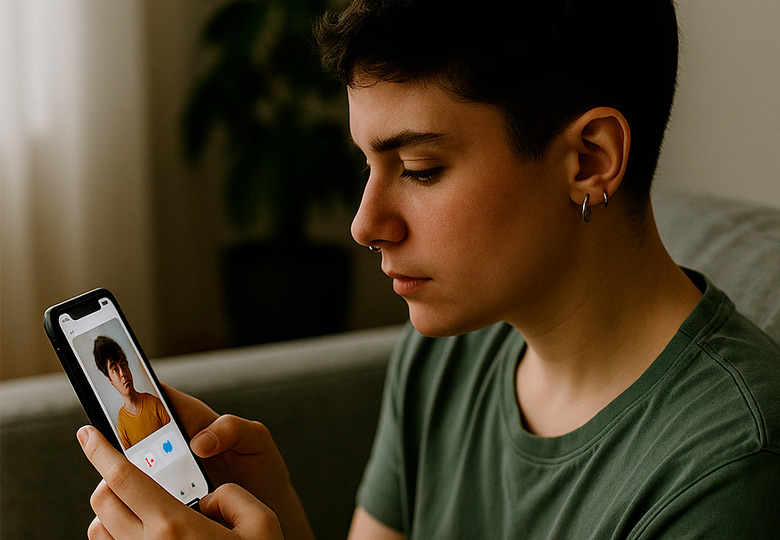
Flirting apps are part of our daily lives. From Tinder to Grindr, passing through OkCupid or Her, they are spaces where we look for flirting, sex, a partner, friendship or simply feeling desired. However, for many trans or non-binary people, entering these apps can be a field full of traps: transphobia, discrimination, violence or simply invisibility.
Today we want to speak to you directly, from empathy and respect, to share practical advice on how to use these platforms with greater security and confidence. And, above all, to remind you that you don’t have to endure violence to find connection.
1. Choose the app carefully: not all are equally safe
Although it may seem obvious, not all apps offer inclusive options. Some allow you to mark identities outside the binary or add your pronouns, while others remain anchored in the “man/woman” without further ado.
🔍 Apps that usually include trans and non-binary options:
- OkCupid (allows multiple identities and pronouns)
- Her (aimed at women and non-binary people)
- Lex (more text and queer community)
- Taimi (focused on LGTBIQ+ diversity in general)
Before creating your profile, check what gender and orientation options it allows. This will save you disappointment and awkward moments.
2. Take care of security from the beginning
We know that it can be tiring to have to think about security every time, but your well-being comes first. Here are some practical tips:
✅ Do not share your exact address or photos of easily identifiable places in your neighborhood.
✅ If you meet someone, let someone know. Send location and name of the person.
✅ Trust your hunches. If you don’t like something, it’s okay to cancel.
✅ Use a different name if you don’t want to be found on personal networks.
✅ Have a list of emergency contacts or dating safety apps ready (for example, Circle of 6 or Tinder’s safety feature).
3. When and how to talk about your identity?
There are no fixed rules here. Some people prefer to indicate it in their profile, others wait to build trust. Both options are valid.

💭 What to ask yourself before deciding?
- Do you feel safer saying it before meeting?
- Do you prefer to avoid people who may react badly and filter them from the beginning?
- Or do you don’t care and decide to tell it only if a deeper conversation arises?
No answer is wrong. Do what makes you feel peace. Your safety and mental health are more important than external validation.
4. Learn to detect red flags
Unfortunately, there are people who seek out trans or non-binary people just to fetishize or mock them. These are some warning signs:
🚩 Messages sexualizing your identity without knowing you (“I always wanted to try with a trans”)
🚩 Invasive questions about your body before knowing your name
🚩 Insistence on seeing you immediately, without respecting your limits
🚩 Comments like “you don’t look trans” or “no one would notice” as supposed flattery
If you see any of these attitudes, consider whether you want to dedicate your time and energy to someone who does not respect you as a person.
5. Protect your mental health: it’s not your fault
Remember that transphobia and discrimination in apps are not your fault. Sometimes, after receiving transphobic rejection, we can feel that something is wrong with us. But not. That reaction only speaks about the other person, not your value.
If you feel overwhelmed, take a break from apps. Talk to your support circle. Look for safe spaces, such as LGTBIQ+ groups in your city or online communities, to share your experiences without judgment.
6. Reflect: is dating on apps always the best option for you?
Here comes the big question. Apps are just another medium. It is not mandatory to use them. Sometimes we think that they are the only way to flirt or find company, but there are also in-person spaces where the connection can be more natural and less invasive: LGTBIQ+ associations, workshops, activist groups or even queer leisure activities.
7. Critical perspective: apps that promise inclusion, but…
Although more and more apps include diverse gender options, is it really inclusion or marketing? Some platforms add non-binary or trans identities to appear progressive, but they do not act against the transphobia of their users or improve security filters.
It is of little use to be able to choose “gender fluid” if your complaint for transphobic insults is then ignored. Real inclusion needs effective moderation, trained teams and clear sanctions. Without that, it’s just another pretty button.
8. Final tips for a safe and happy relationship
❤️ Be clear with your limits from the beginning.
❤️ Remember that you don’t have to answer invasive questions.
❤️ Scroll until you find people who respect you as you are.
❤️ Celebrate your matches, but don’t put your value in how many you receive.
❤️ You deserve love, desire, care and respect. Always.