

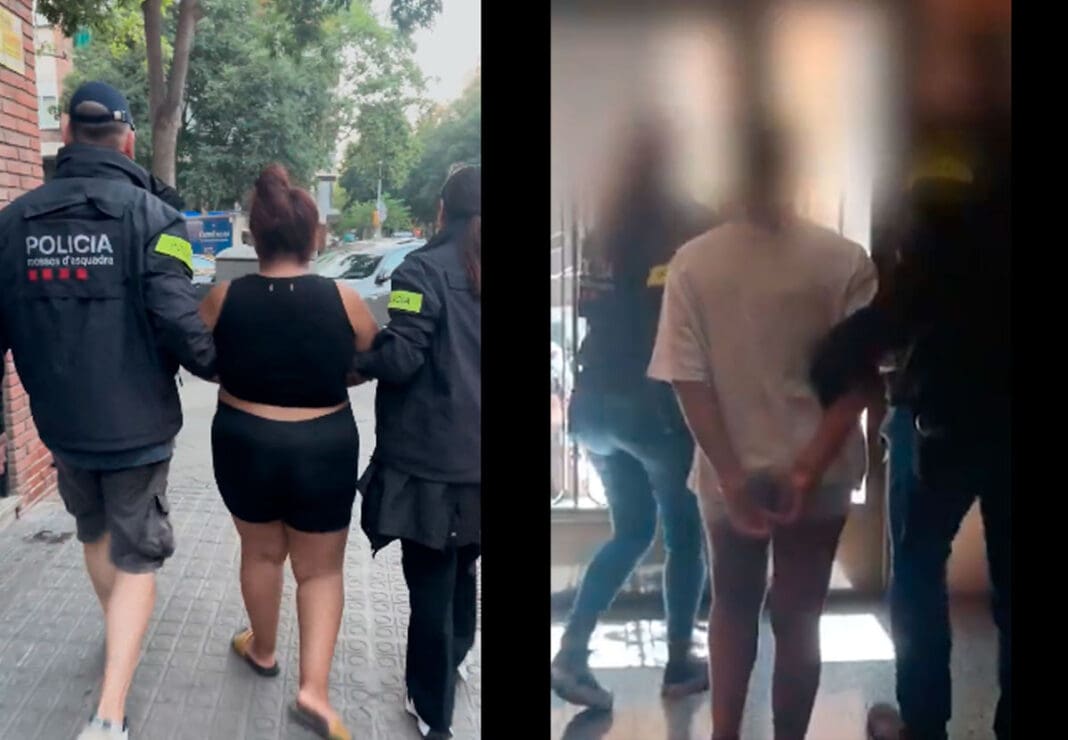
On June 25, the Sant Antoni neighborhood in Barcelona was the scene of a brutal transphobic attack. Five people – three women and two men, aged between 20 and 34 – were arrested by the Mossos d’Esquadra as alleged perpetrators of a crime against the fundamental rights of a trans person.
The most alarming thing is that the attack was not an isolated impulse, but an organized and premeditated action. The victim had met one of the aggressors, whom he previously knew. Shortly afterwards, four other people appeared and joined in the violent act: hitting, kicking, insulting, pulling hair… And everything, recorded with mobile phones.
Five people arrested for a transphobic attack in Barcelona
Fem follow-up and accompaniment to the victim, who suffers a serious emotional situation and requires continuous psychological support, activating the Protocol of the Victim Care Group pic.twitter.com/KUbIlMvdWz
— Mossos (@mossos) July 22, 2025
Aggression as a digital spectacle
According to the police investigation, two of the attackers recorded the scene with the clear intention of disseminating the images on social networks. It was not only about humiliating and physically attacking, but also about publicly exposing the victim, making his identity as a trans person evident.
A fact that adds another layer of complexity to the case: both the victim and the attackers have hearing disabilities, so the Mossos activated the service of sign language interpreters to guarantee adequate attention throughout the process.
Investigation and arrests
The Central Hate Crimes and Discrimination Unit acted quickly. Thanks to the evidence collected, on July 16 the arrests were made in Barcelona, Sabadell and Ripollet. The next day, the detainees were brought to justice. Meanwhile, the Victim Care Group protocol was activated, which includes psychological and legal support.
The victim, who had already been attacked previously by the same attackers, is going through a delicate emotional situation. He currently receives continued psychological support, although the effects of this type of violence do not disappear easily.
Transphobic violence: a deeper symptom?
This case raises many questions that are still on the table. What mechanisms failed so that a victim suffered repeated attacks by the same people? Why is it still so common that attacks against the LGTBIQ+ community are recorded and broadcast as if they were entertainment? And, perhaps most disturbing: to what extent are social networks normalizing this type of violence?
Beyond police forcefulness, a social, educational and political response is needed that is up to the task. Transphobic violence does not start with beatings. It begins with the look that points, with the comment that ridicules, with the lack of empathy towards realities that are still considered “alien.”
A critical perspective that we cannot ignore
Although the arrests are a step in the right direction, we cannot help but question some points. What guarantees are there that the victim will really be protected in the future? Are there sufficiently solid protocols to act in contexts where there is hearing impairment and hate violence? Furthermore, the fact that the attackers previously knew the victim suggests a dimension of sustained violence that is not always addressed in official reports. Nor can we forget the use of social networks as a tool of revictimization, a worrying trend that still lacks effective responses.