What happens when those who flee because of who they are encounter a system that doesn’t know how to listen to them?
The Spanish Commission for Refugee Assistance (CEAR) has focused on this question with its report “International protection for LGTBI people: access to the right to international protection for reasons of sexual orientation and gender identity”.
In it, CEAR issues a clear warning: the Spanish asilo system still carries practices that make invisible and violate the rights of the LGTBIQ+ collective. From country of origin reports to in-person interviews, the reality is that many applicants face obstacles that go beyond the bureaucratic. They are structural, cultural, and often deeply emotional barriers.

Stories that outweigh the facts
To obtain international protection in Spain, LGTBIQ+ people must demonstrate that they suffer a real fear of persecution in their country of origin. And here the problem begins:
How do you prove something that you were forced to hide your whole life?
The procedure is based largely on the “personal story.” The applicant is expected to tell their story with coherence, detail and emotion. But this is not always possible. Trauma, fear or lack of references can cause blockages, contradictions or silences that do not mean lying, but survival.
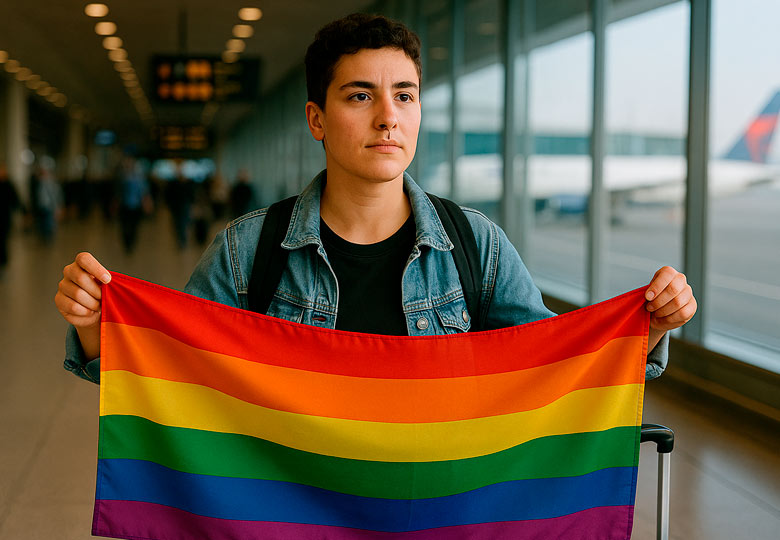
In addition, there are contexts where telling that story is almost impossible. For example, at borders such as Barajas Airport, where the procedure is resolved in just four days. Do you really have time to build trust, process fears and clearly explain why you are afraid to return home?
Invisibility, stereotypes and lack of evidence
One of the strongest criticisms of the report points to the lack of sensitivity in the assessment of credibility. There are those who are left out of the system simply because they do not fit into the idea that certain authorities have of what an LGTBIQ+ person “should be.”
Those who have had heterosexual relationships or have been forced to marry are questioned, for example. Intersectional realities, such as those experienced by lesbian women, trans or bisexual people, or those who do not identify with a binary category, are often ignored.
The so-called country of origin reports (COI), used to justify many decisions, do not help either. These documents tend to focus only on cis gay men, leaving out the specific violence suffered by other bodies and identities. And be careful, the absence of data does not equal the absence of persecution. It is simply another example of invisibility.
What does CEAR propose?
Faced with this reality, the report does not stop at criticism. It also offers specific proposals:
- Mandatory training in sexual and gender diversity for staff conducting interviews.
- Secure and confidential spaces that respect the identity of the applicant.
- Fewer invasive questions. More humanity.
- An intersectional and cultural approach in the evaluation of each case.
- Reinforcement of legal support, with special attention to the most vulnerable people.
All this with a clear objective: that asking for asylum is not a second violence for those who have already survived the first.
Is it enough?
Now, it is also worth looking at the other side of the mirror. Some critical sectors point out that this specific attention to the LGTBIQ+ population could cause inequalities within the asylum system itself. Others warn of the risk that the emotional focus of the story ends up reinforcing a spectacle logic of suffering, instead of promoting a more structural analysis of the persecution.

Also, how do you ensure that these recommendations do not remain just on paper? Is there really enough political will and resources to reform the system from within? Doubts are on the table.
An opportunity to change course
The CEAR report does not offer magic solutions, but it does open a way to rethink the international protection model in terms of human rights. If we want to be a country that welcomes with empathy, listening and diversity, the asylum system has to be transformed.
And you, what do you think? Do you think that Spain is prepared to offer a safe and dignified refuge for LGTBIQ+ people?