
In a world that aspires to be increasingly inclusive, the performing arts face a crucial challenge: ensuring that culture is a right accessible to all. This debate, far from being a novelty, has gained special relevance after the entry into force of the European Accessibility Law on June 28. Are we really building a cultural landscape where no one is left behind?
Invisible Barriers, Real Impacts
The current reality shows us that, for many people with disabilities, access to culture continues to be an obstacle course. The absence of subtitling or audio description, the inaccessibility of online ticket sales platforms or the shortage of adapted spaces are just some of the physical and digital barriers that persist. But the challenge goes further: the lack of adequate training of the staff who manages these events aggravates the situation, creating an invisible wall that makes full participation difficult.
A Meeting for Consciousness and Action
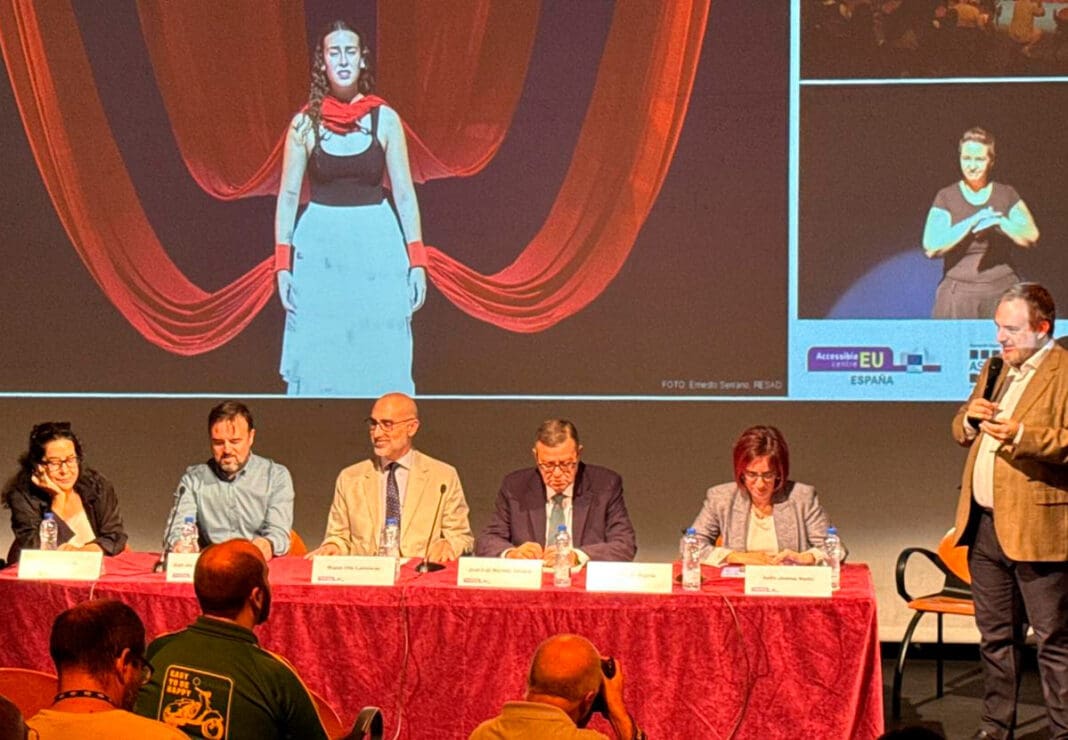
Against this backdrop, AccessibleEU Spain, the Spanish Association of Accessibility Professionals (ASEPAU) and the Royal Higher School of Dramatic Art (RESAD) have taken the initiative. Recently, the RESAD headquarters hosted a day dedicated to raising awareness about accessibility in the performing arts. An event that brought together students, teachers and public entities with a clear objective: to promote real change.
Prominent personalities such as Jose Luis Martínez Donoso, General Director of Fundación ONCE; Helena Pimenta, member of the Board of Directors of the Academy of Arts; Luis Cayo Pérez-Bueno, president of the State CERMI; Miguel Olite Lumbreras, director of Higher Artistic Education of the CAM; and Juan José de la Fuente Sánchez, director of RESAD, participated in this fundamental dialogue.
Building Bridges to Inclusion
The day was structured into debate tables that addressed everything from the design of inclusive spaces and advances in research, to the transformative role of technology and accessible communication in the cultural field. Architects, institutional managers and accessibility specialists shared experiences and proposed innovative solutions to break down existing barriers.
The second part of the meeting focused on user experience and the presentation of good practices. Professionals, artists and representatives of social entities shared inspiring cases that demonstrate how accessibility is not only an obligation, but also a powerful engine of creativity and innovation.
The event culminated with a presentation of conclusions and an emotional performance display by the RESAD students, consolidating this space as a key meeting and reflection point for the future of a truly inclusive culture.
What does the future hold for us?
This meeting takes place at a crucial moment, coinciding with the recent application of the European Accessibility Law. The ONCE Foundation, through its AccessibleEU initiative, has once again placed accessibility at the center of the social and cultural agenda, reminding us that it is a fundamental pillar to build a more just and equal society.
The question that remains is: are we all willing to take on the challenge? How can we, from our own spaces, contribute to the performing arts being a mirror of the diversity that makes us up, a place where each person can feel represented and fully enjoy culture? The answer lies in collective commitment and the will to continue dialogue and action.