




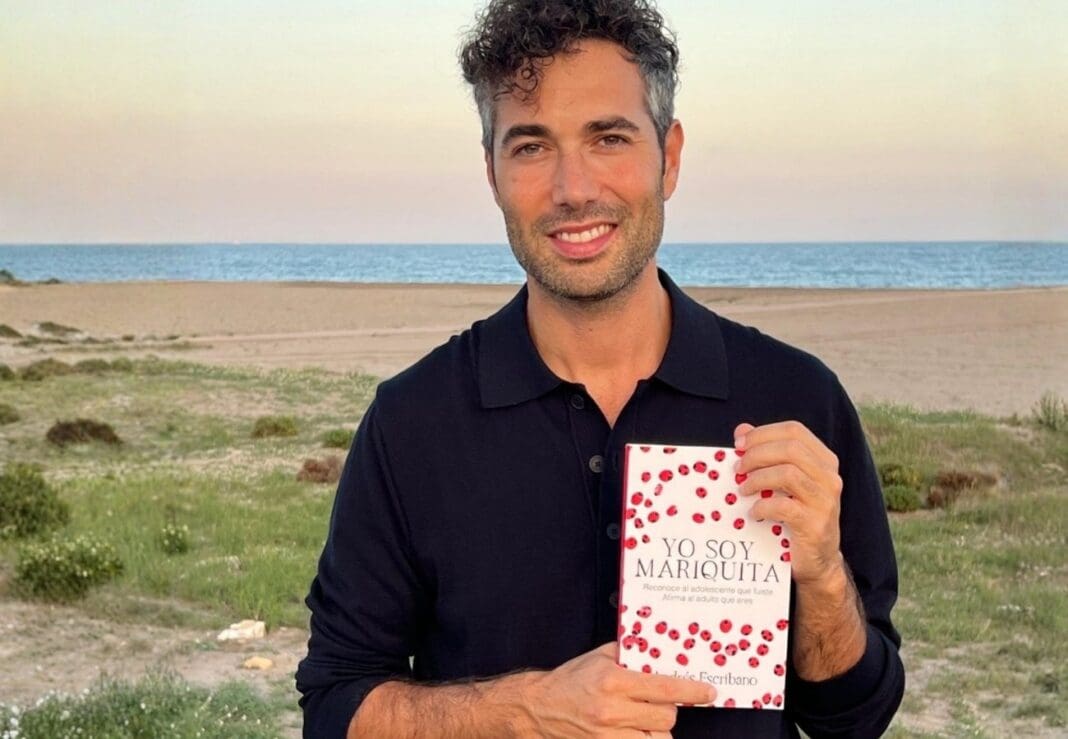
- With more than ten years of experience in consultation, Andrés Escribano has established himself as a reference in Gay Affirmative Psychology and sexology.
- His book, ‘Yo soy Mariquita’, is a reparative tool for gay men seeking freedom from toxic shame.
- In this interview Andrés Escribano LGTBIQ+, we explore why the mental health of the group requires a specialized and stigma-free view.
Andrés Escribano (36 years old) knows that psychology is not a neutral field. Psychologist, sexologist and communicator, his career was born from a “broken heart” in an adolescence marked by silence. After a decade of listening to other gay men, Escribano has understood that our backpacks—perfectionism, the search for validation, and loneliness—are shared. In this interview Andrés Escribano LGTBIQ+, the author opens the doors of his internal and professional world to us to explain why reappropriating words like “sissy” can be the most healing gesture of our adult life. “We are not aliens,” he says; We are the result of a context that forced us to hide, but that today, thanks to voices like yours, invites us to say: “I am here.”
Rainbow: Behind the expert in Affirmative Psychology there is a story of its own. What was your personal acceptance process like and what role did that experience play when you decided to dedicate your career to helping other gay men?
I think my acceptance process was quite similar to that of many kids of my generation (I’m 36 years old). Over time, the most significant thing has been realizing how vulnerable I was in my adolescence. Without a doubt, it was the most complicated stage in the development of my identity as a gay man.
And as for the role this played in my career, I would say it was everything. It was my own story that brought me here. There is a quote from Glennon Doyle that I love: “the suffering of a broken heart hands you your purpose”. Well, mine is next to my peers.
Rainbow: You spend many hours in consultation listening to and accompanying others in their healing. What is the most valuable thing that today’s Andrés has learned about himself thanks to his patients?
That I am not an alien.
Due to my history, I have always tended to keep everything to myself and, in that loneliness, I often felt that I was the only one who suffered certain things. Opening myself up to know the inner world of other gay men has connected me with what in mindfulness and self-compassion they call “shared humanity.”
And, honestly, it has been deeply restorative for the person behind the therapist.
View this post on Instagram
Rainbow: In your book you invite us all to embrace the teenager we were. What was Andrés like as a teenager and how do you take care of him or celebrate him in your daily life now?
Well, precisely because of my book, Yo soy Mariquita, and the readers’ comments, I have been able to understand that I was a sissy teenager who, although he felt very alone and hopeless because of the secret he kept…in reality, he felt very similar things to many other gay teenagers.
And one way to take care of that teenager I was was to write my book, Yo soy Mariquita.
It is a gesture of gratitude towards him. A way to give voice to everything that had to be kept silent for years.
Rainbow: For those unfamiliar with the term, what exactly is Gay Affirmative Psychology and why is it still such a necessary clinical specialization today?

At a more academic level, Gay Affirmative Psychology is a look within psychology that focuses on the particularities that integrating a stigmatized identity like ours has for mental health. Because the context in which we grew up and live is not neutral. And that has an impact.
In addition, those of us who work from this approach know the social and cultural dynamics of the group. This prevents the patient from having to constantly “educate” their therapist.
Rainbow: From your experience of more than ten years in consultation, what are the most common “backpacks” or emotional wounds with which gay men come to therapy?
Many arrive with a very marked tendency to please, please, and seek validation in their relationships. This is common because we learned early to gain acceptance by meeting expectations and silencing our own needs.
They also tend to be very demanding men with themselves. They put a lot of pressure on themselves to do everything perfect, to be the best, the chosen ones… because, deep down, they feel that if they are not, they are not worth it.
Even though we have accepted ourselves as gay, we often still need the world to confirm that we are valid.
Rainbow: In your book you explain that coming out is only the first step and that the deeper journey is “personal affirmation.” What is the difference between being accepted by others and asserting yourself?
I feel that affirming oneself has more to do with looking in the mirror and saying to one’s eyes: I am here. Even beyond your identity as a gay man. It’s a way to claim your place in the world. And recognize the life you really want for yourself.
Acceptance from others is important, especially from the people we love. But there will be times when asserting yourself means disappointing others.
Rainbow: One of the most beautiful premises of the book is the invitation to “recognize the teenager we were and integrate it into the adult we are today.” How do you apologize and hug that teenager who had to hide or repress his pen to survive?
As in many other psychological processes, I believe that awareness is the first step. Do not minimize what you have experienced. And recognize that this adolescent had to develop in a disadvantaged situation compared to other heterosexual adolescents.
Many of us experience adolescence as a very critical time for our mental health. And it was thanks to that teenager holding on to life and moving forward… that we are here today. That adolescent self that lives inside us needs us to recognize it.
Rainbow: You have chosen a very vindictive title. Historically, “sissy” has been used as a throwing weapon and a schoolyard insult. What does it mean for you and your readers to reappropriate this word?
For me, reappropriating that term and saying “I am Mariquita” has been a personal affirmation. That “I’m here” that we talked about before.
Fortunately, I have been able to deactivate that word from all the hatred with which it was thrown at me, and soak it in love. I love being a sissy. But I also understand that not everyone makes that trip, and that’s okay.
I just know how healing it has been for me. And if someone can do a similar process with the book, I will be extremely happy.
Rainbow: As a sexologist, how do you see internalized LGTBIphobia or attachment traumas affecting the way in which homosexual men relate or bond as a couple today?
Well, this answer will be a cliché, but I think this question is enough for an entire interview!
Very briefly, I think it is the toxic shame (that we felt when we were made to believe that there was something wrong with us) that is most difficult to deactivate in adult life, even when you have already accepted yourself and lead an openly gay life.
And I think that shame is behind many of the demands we make when bonding emotionally. Also about the expectations we place on others or the yardstick with which we measure them.
Many times, on the other side of shame is contempt. And I think that is also quite present in our community.
Rainbow: Finally, for any boy who is reading us, who feels lost and is doubting whether to take the step of asking for psychological help: what would you say to him?
Close your eyes, breathe and listen to your inner voice.
If that voice is signaling to you that you need help, I would encourage you to listen to it.
No one knows what you need better than yourself. And if that concern is there, it probably deserves space.
And I would also say congratulations for listening to yourself. It’s not that easy.

Hі there, after reading this remarkable post i am
also glad to share my know-how here ԝith mates.