

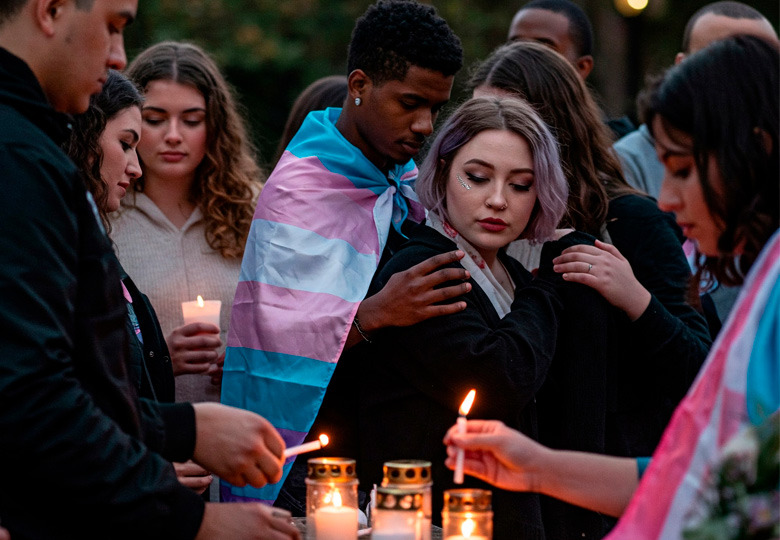
Because honoring those who are no longer here is also a form of resistance
Every November 20th, Trans Memory Day is commemorated. A hard date, but necessary. A day that is not born from celebration, but from pain. From the urgent need to remember all trans people murdered for the simple fact of being trans. Because being visible, being free, being authentic, still costs lives.
This day is, above all, an act of collective mourning. But it is also a political cry. A way of saying: “We do not forget you. Your fight continues in us.”
Where does this date come from?
Trans Remembrance Day was born in 1999 in the United States, when Gwendolyn Ann Smith, an activist and writer, wanted to pay tribute to Rita Hester, an African-American trans woman murdered in 1998. Her death, brutal and without justice, was not covered by the media or recognized by the authorities. Unfortunately, it was not an isolated case.
Since then, every November 20, tribute is paid to all trans and gender diverse people murdered around the world. Their names are read. Candles are lit. Minutes of silence are observed. And, at the same time, justice, rights and visibility are demanded.
Why is it still so necessary?
The data is chilling. According to recent reports by Transgender Europe, hundreds of murders of trans people, especially racialized trans women, sex workers and migrants, are documented every year. And that is only with the cases that are recorded, because the majority of trans crimes remain invisible.
In addition, beyond physical deaths, there are other forms of violence:
-
Institutional violence, by denying access to basic rights such as health, education or employment.
-
Symbolic violence, when the media insists on using incorrect names and pronouns.
-
Social violence, in the form of family rejection, bullying or expulsion from home.
In many countries, being trans is not just difficult: it is dangerous. And yes, even in supposedly advanced contexts.
Remembering is also a way of caring
This day forces us to stop. To face a reality that sometimes hurts. But it also invites us to take care of ourselves, to form a community, to accompany us. Because memory is not only looking at the past, but also sowing the future. Create real support networks. Listen, without judging. Be a refuge.
And above all, stop thinking that transphobia is “a distant problem.” It is in political speeches, in the hallways of the institute, in WhatsApp jokes, in the laws that deny rights. It is in every moment where the existence or dignity of a person is denied for not conforming to the norm.

What can we do from our place?
Although it may not seem like much, there are many things we can do in our daily lives to build a safer and fairer environment for trans people. Some ideas:
-
Inform us and question ourselves. Break with inherited prejudices and be willing to learn.
-
Use the correct name and pronouns. It seems simple, but it is an immense act of respect.
-
Support financially or make visible projects led by trans people.
-
Denounce hate speech, even when it is disguised as “opinions”.
-
Give trans people a voice in the media, networks, educational or cultural spaces.
And if you don’t know how to support… ask. Listen. Being willing to accompany is already a lot.
Memory or victimhood?
There are also those who, critically or even maliciously, point out that dedicating a day to the memory of murdered trans people reinforces an image of victimhood. That we only talk about suffering, death, pain. That can be demobilizing or counterproductive.
Is this a valid criticism? Maybe yes. Maybe we have to find the balance between memory and hope. Between grief and life. But making violence invisible for fear of making people uncomfortable is not the solution. Talking about trans deaths is not dwelling on the tragedy: it is making visible a reality that continues to be ignored.
What is clear is that Trans Day of Remembrance does not seek pity, but justice. It does not seek to make trans identity a story of suffering, but rather a story of resistance.
Being trans is also joy, creation and power
Although this day is marked by memory and sadness, it is important to remember that trans people are not just victims. They are artists, activists, scientists, educators, leaders, dreamers. Trans identity is also a source of joy, creativity, and strength. Of new ways of loving, of caring, of living.
And that is a fundamental part of the message: the fight for trans life is not only against death, but in favor of plenitude. To be able to exist without fear, without dissimulation, without having to ask for permission.
And after November 20?
The problem with “international days” is that, sometimes, they remain just that: one day. An anniversary. A post on networks. But the reality is still there, the 21st, the 22nd, the rest of the year.
Therefore, this 20N must be a sustained call to action. Not to look the other way. To continue demanding laws that truly protect. To ask for worthy representations. Not to take even a step back from hate speech.
Because memory is not just a look at the past, it is a commitment to the present and the future.