
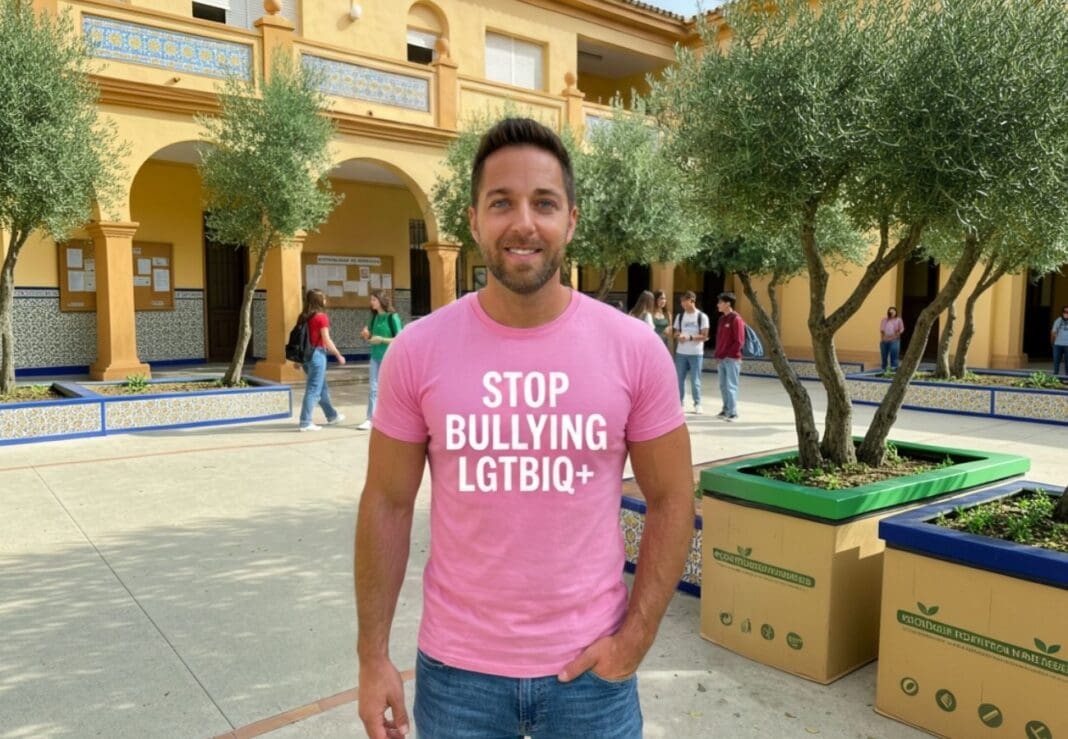
Hello, reader! What a joy that you join us today in this corner of analysis and reflection. If you have seen people on the street or on social media wearing pink today, it is not because of a passing fashion trend or because of the premiere of any movie. We are talking about a symbol of resistance that was born from an act of adolescent bravery and that, in 2026, continues to be more necessary than ever to protect our LGTBIQ+ childhoods and youth.
Take a moment for yourself. We are going to explain why a piece of fabric can mean so much and what the schoolyard is like today.
A little history: Two boys, a t-shirt and a revolution
To understand why we wear this garment, we have to travel back in time, specifically to 2007, in Nova Scotia, Canada. The story is one of those that restores your faith in humanity a little. A ninth grade boy was bullied on his first day of school simply for wearing a pink t-shirt. The abusers, with that rancid logic that we still try to eradicate today, thought that the color of their clothing was an invitation to humiliation.

But here’s the good thing: Travis Price and David Shepherd, two upperclassmen, did not sit idly by. They bought 50 pink T-shirts at a discount store and sent messages on social media (when social media was still a kinder place) asking everyone to wear them the next day.
The result was a pink tide that left the bullies speechless. It was the birth of Pink Shirt Day. An act of active solidarity that demonstrated that, when the majority sides with the victim, hatred loses its power.
The outlook in 2026: Have we really made progress?
I would like to tell you that in 2026, LGTBIQ+ bullying is a thing of the past, but as a journalist I owe it to the truth. Minerva has given me some graphs from this year that are food for thought. While there is greater awareness, harassment has become more sophisticated. It no longer just happens in the school hallway; now it is 24/7 thanks to hyperconnectivity.
Cyberbullying towards LGTBIQ+ adolescents has increased by 6% this year. The hate speeches that we see in politics and in certain media reach young people. When an opinion leader questions the existence of trans people or mocks diversity, they are giving “permission” to the class bully to do the same.
Why is pink still political?
Pink has historically been a feminized color and, therefore, despised by the patriarchy. By reappropriating it, we are saying that there is nothing wrong with what is “feminine”, what is different, or what breaks the norm. For a young boy who is discovering his orientation or for a trans girl who is beginning her transition, seeing her teachers or classmates wearing pink is a silent but powerful message: “You are safe here.”
The responsibility of institutions and families
We cannot leave all the weight on the students’ shoulders. At Rainbow we have analyzed the regional laws of 2026 and we see that, although anti-bullying protocols exist on paper, they often fail in practice due to lack of resources or teacher training.
What are we doing wrong? Perhaps we focus too much on punishing the bully and not enough on educating empathy from the base. Or perhaps, as a society, we are allowing the anonymity of social media to be a training ground for future haters. These are questions I ask myself every morning when I see the headlines. Do we really know what our children consume on their devices before going to sleep?
Keys to combat LGTBIQ+ bullying on a daily basis
Beyond the t-shirt, what can you and I do today? Here I leave you a small list of real actions:
- Active listening: If a young person tells you that they feel uncomfortable in class, do not minimize their pain. They are not “kids’ things.”
- Intervention: If you witness an LGTBIQphobic comment, do not laugh or look away. Silence is complicity.
- References: Help young people have access to books, movies and references from the LGTBIQ+ community that show them that there is a bright future waiting for them.
- Complaint: Know the protocols of educational centers and demand that they be complied with.
Towards a future without hate uniforms
I often wonder if we will ever stop needing days like this. I’d love to think that by 2030 or 2040, the color of a t-shirt will be just that: a color. But as long as hate continues to organize, we will have to organize ourselves more and better.

The story of Tephia that we covered recently taught us that invisibility is the first step toward repression. That’s why pink is light. That is to say: “I see you, I recognize you and I support you.”
Do you think that as a society we are doing enough to protect trans and diverse children, or are we settling for symbolic gestures? The answer, reader, lies in what we do tomorrow, when we take off the pink shirt and get back to the routine.
In the editorial office we will continue to be vigilant. For those who are, for those who are gone and for those who will come.