

Every June 27th the International Day of Deafblind People, a day that not only seeks to make visible a unique and complex condition, but also claim rights, dignity and social belonging.
This date was chosen in honor of the birth of Helen Keller (1880-1968), American deafblind writer, activist and educator, whose legacy continues to be a symbol of strength, communication and struggle.
Official recognition came in 1989, in Stockholm, during the first congress of the World Federation of the Deafblind.
Since then, this day reminds the world that deafblindness is not the sum of two disabilities, but a completely different way of perceiving the world, which requires also different responses.
👁️🗨️ What is deafblindness?
Deafblindness is understood a unique disability, caused by the combination of a visual and hearing impairment, which very significantly limits communication, access to information and mobility.
But beyond the medical or legal definition, deafblindness is a personal, social and cultural reality that varies enormously depending on factors such as:
- Age of acquisition
- Degree of vision and hearing
- Family and educational environment
- Access to supports and technology
- Social class, gender, identity or place of birth
That’s why, Talking about deafblindness from diversity and intersectionality is not optional: it is essential.
Helen Keller: much more than a symbol
Helen Keller was the first deafblind person to earn a college degree. He learned to communicate through palm spelling (tactile fingerprint alphabet) and, later, with more complex methods such as braille or typewriting.
But its relevance goes beyond the anecdotal.
Keller was a radical activist, defender of the female vote, socialism, labor rights and people with disabilities. His figure inspires and at the same time raises questions about how we represent functional diversity in media and education.
A date that is also political
June 27 is not just a tribute, it is a urgent call to action.
Because today, deafblind people continue to face enormous barriers:
- Lack of professionals in guide-interpreter
- Little specific training in educational environments
- Lack of touch accessibility in public spaces
- Invisibility in public diversity policies
- Poor access to LGTBIQ+, feminist or cultural information in appropriate formats
Double exclusion (due to disability and sensory diversity) multiplies when we add layers such as sexual orientation, gender identity, origin or social class.
Where are deafblind people in queer activism?
That is the question we can no longer avoid.
On too many occasions, LGTBIQ+ spaces are not designed for deaf, blind or deafblind people.
There are no guide-interpreters, interpreters, tactile adaptations, barrier-free access or braille materials.
And on the other hand, many deafblind people cannot talk openly about their orientation or gender identity because lack of references, emotional support or fear of rejection within their own care settings or institutions.
Intersectionality cannot remain in discourse. It must be translated into concrete action.
What can (and should) be done
If you work in the social, educational, cultural or activist field, here are some keys to celebrate this day actively and responsibly:
✅ Include touch language
Tactile sign languages and braille should not be optional. Its inclusion must be structural in events, publications and spaces of militancy.
✅ Make visible with dignity
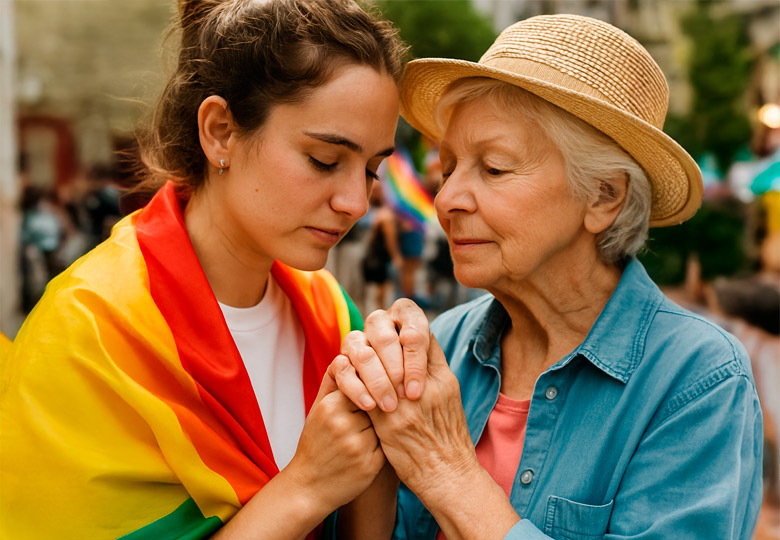
Do not infantilize or romanticize. Deafblind people are not “inspiring for existing”, but rather citizens with rights, stories, desires and political opinions.
✅ Facilitate real accompaniments
Are there guides-interpreters in your activity? Is there tactile access to art, to content, to discourse? Who has been summoned to speak?
✅ Listen beyond sound
There are other forms of communication. Of relationship. Of expression. And they are full of beauty, strength and sensitivity.
What if accessibility is also a form of love?
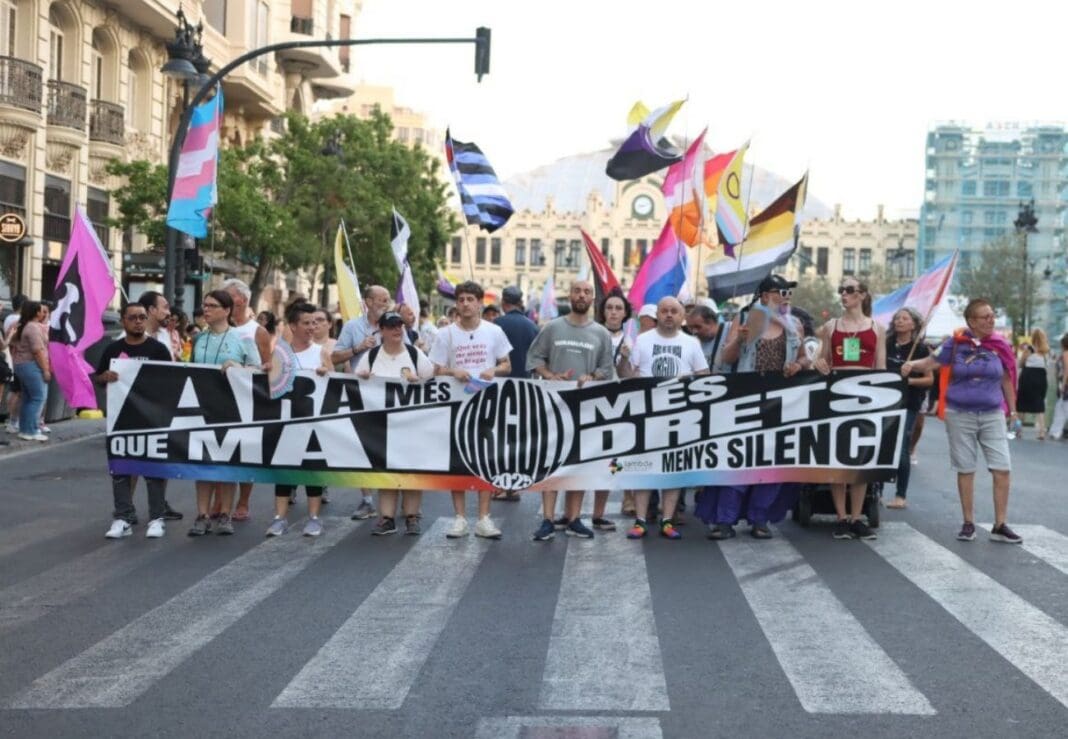
Can there be pride without accessibility?
Can there be community without sensory diversity?
Can there be a fight if we do not see or touch all the bodies that are involved in it?
Maybe we are so focused on “the visible” and “the audible” that it is difficult for us to think outside that framework.
But if we do not open our eyes, empathy and means, many people will continue staying out of the conversation, even though they have a lot to say.
💬 Testimonies from the center of silence
“I got tired of being only called to tell my story of improvement. I also want to talk about sex, politics and anger.” — Leire, 41 years old, bisexual and deafblind
“At Pride there was no one to accompany me. I went alone. I didn’t understand anything, but I finally felt part of something.” — Juan Manuel, 26 years old, gay and deafblind
“I am not a story of overcoming. I am a person, and my body also loves, feels, chooses and makes mistakes.” — Rocío, 52 years old, lesbian and deafblind
Conclusion: may this day not go unnoticed
June 27 is not just another day. It is a profound reminder that Diversity does not have a single form, nor a single voice, nor a single flag..
Deafblind people exist. They believe. They wish. They fight.
And if the world doesn’t see or hear you, the problem is not yours. It’s from the world.
At Rainbow, we celebrate your presence. His language. Its power.
And we are committed to continuing to make it accessible as well. what sometimes we don’t know how to name.