


Today we are looking at a significant change: X, the social network formerly called Twitter, has restricted access to pornographic content within the European Union. What is happening, and why now? I am going to tell you the situation with simplicity, with reflection, and with that human nuance that makes you feel heard. There won’t always be absolutely clear answers—you may also end up wondering what it all entails.
The weight of the DSA: a new European framework
The key here is the Digital Services Act (DSA), the European digital law that came into force in 2024 to regulate large online platforms, especially with regard to the protection of minors and digital missing persons. Platforms classified as “very large,” with more than 45 million users per month, must take serious measures against content that may harm minors—including pornographic content.
The goal is that only adults can access this type of content, through effective age verification systems. If they fail to do so, they face stiff penalties, including fines of up to 6% of global turnover.
And what has X done so far?
X has responded to that pressure, with a particular focus on Ireland and the United Kingdom. In Ireland, the regulator Coimisiún na Meán has warned about the lack of clear age measures for pornography and violent content, and has given X a deadline to justify compliance. In the United Kingdom, the new Online Safety Act requires rigorous verification systems. X ha comunicado que usará métodos como el “email address–based estimation” y la “reverse address book median age estimation” —técnicas que, básicamente, infieren la edad del usuarie a partir del correo o contactos.
But the system does not convince everyone. According to specialized media, X has adopted an approach called “multi-step age assurance”, which does not directly verify the user’s age. Rather, it is based on previous signals: account age, previous verification, age estimated by email or social connections. It works passively and without the person intervening directly.
A real (but partial) lockdown
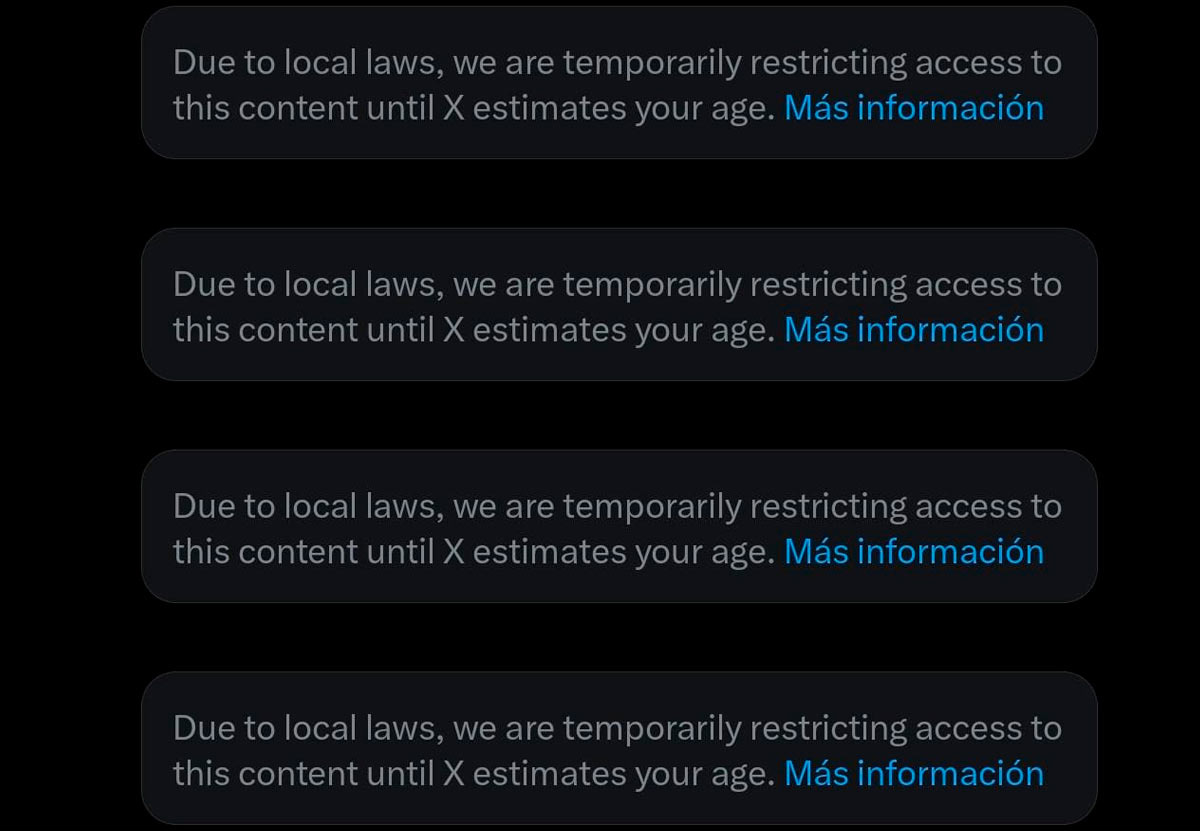
In some countries, such as Germany, concrete blocks have already been seen: profiles of people who publish adult content have been hidden from German users, in response to legal orders. This measure seeks to prevent minors from accessing pornographic content without age verification. And in general, within the EU, X has restricted or blocked the visibility of porn for users from European IPs, as part of compliance—although that raises questions: blocking or partial censorship?
What happens in Spain?
In our country, the Government had already warned that the digital protection of children would be a priority in this legislature. In fact, the Ministry of Youth and Children has promoted measures to require more robust age verifications on platforms with explicit sexual content. Although there is still no specific Spanish law like the British one, the pressure on platforms is increasing. Furthermore, in February 2025, the Spanish Data Protection Agency recalled that exposure to this type of content without control could violate the fundamental rights of minors. That is to say, in Spain active responsibility is also being demanded from technology companies, although visible blockages have not yet been reached as in Germany.
Open questions we would like to resolve
- Is this indirect estimate of age sufficient to guarantee real protection for minors?
- What will happen to people who use VPN or change their country settings?
- Will there be real transparency in the blocking or unblocking criteria?
- Does this affect the right to expression of adult content creators, especially within the LGTBIQ+ community?
Risks, benefits and balances
Visible benefits: The aim is to protect minors more seriously, with uniform criteria throughout the EU, and an attempt is made to prevent digital platforms from becoming uncontrolled channels.
Clear risks:
- Passive verification can be easily tricked or circumvented with VPNs or region settings.
- We could fall into a “gray zone” where content becomes unavailable without the reasons being clear.
- Additionally, there are real privacy concerns: these systems collect and process sensitive personal data.
Not everything seems resolved. This strategy can cover up corporate interests or regulatory excess that sacrifices fundamental rights. Are control systems being imposed under the banner of protecting minors, without guaranteeing transparency or effective alternatives such as sexual and digital education? An uncomfortable question arises: is this security or a pretext to increase control over content? Perhaps we are one step away from giving up freedoms without fully knowing it.
The restriction of porn in X within the EU arises from a more demanding legal framework: the DSA and national laws to protect minors. X has reacted with indirect verification methods, which do not convince either regulators or users. The debate remains open, with a question that runs through everything: how to balance child safety with freedom of expression and privacy? You, the reader, can also ask yourself: where would you draw that limit?