


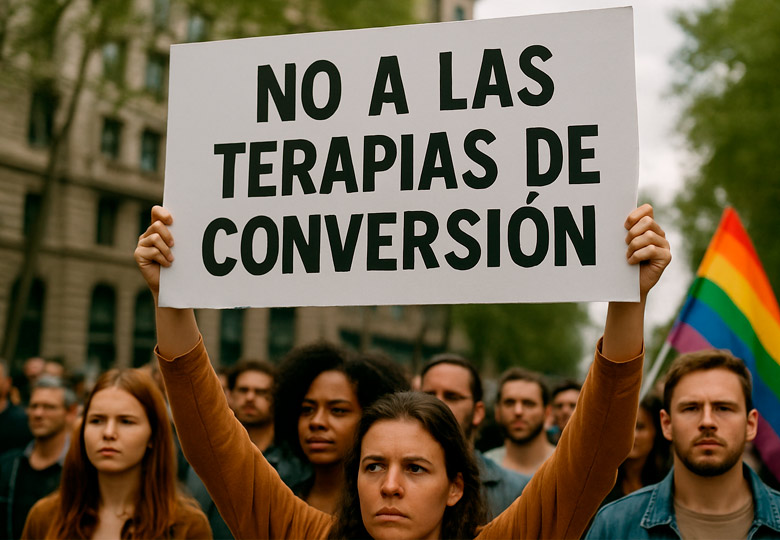
Is the Generalitat Valenciana opening a dangerous door with the reform of the Trans Law of 2017? That is the question that has emerged in the public debate after the recent amendments agreed between the Popular Party and Vox. The regional government flatly denies that so-called conversion therapies will be allowed. But is that as clear as they say?
What the Generalitat says
Stephane Soriano, general director of Diversity of the Generalitat, has been blunt: “Therapies against trans people are completely prohibited in the Valencian Community.” This is what he said in a statement sent to the media, seeking to calm the commotion caused by the legislative changes that affect several autonomous laws, including the one known as Trans Law.
Soriano relies on article 6 of the law itself, which expressly prohibits any treatment that involves aggression or intimidation of trans people. This includes therapies whose objective is to modify gender identity or expression. According to the Generalitat, the reform does not eliminate this protection, but rather introduces the possibility of accessing emotional or psychological support, always on a voluntary basis.
Accompaniment or covert intervention?
This is where the doubts begin. Compromís warns that the new wording opens a dangerous door by talking about therapies “as long as they are voluntary.” And the PSPV goes further: they denounce that part of the protection framework that guaranteed the rights of trans people, especially those of minors, is being dismantled.
The Generalitat insists that what it seeks is to reinforce support for families and provide more resources so that trans minors have real and constant support. But the problem is that the sometimes ambiguous legal language leaves room for interpretations that can have very different consequences in practice.
The underlying debate: neutrality or retreat?
Behind this modification lies a deeper political and ideological tension. Is this a technical and guarantee review, as the Consell says? Or are we witnessing a whitewashing of dangerous ideas, disguised as freedom of choice? No one denies that the transition process can be difficult and that psychological support can be essential. But who defines what is “accompaniment” and what is covert “conversion therapy”?
The line between real help and an attempt to redirect is still, for many, too fine.
A necessary reflection
Although the Valencian Government insists that the guarantees remain intact, there is something that we cannot ignore: the political alliance between PP and Vox, parties with visions opposed to the advance of LGTBIQ+ rights, generates distrust in broad social sectors. Is it possible to protect trans people when the same actors who criticize “gender ideology” push for legislative changes? Perhaps it’s not just about what the law says, but who has the power to enforce it and with what intent.
What exactly is prohibited according to the Trans Valencian Law?
❌ Therapies that seek to modify gender identity or expression.
❌ Treatments that involve intimidation or aggression.
✅ Psychological, social or emotional support, if the person requests it voluntarily.
✅ Continuous support for families and minors during the transition process.