

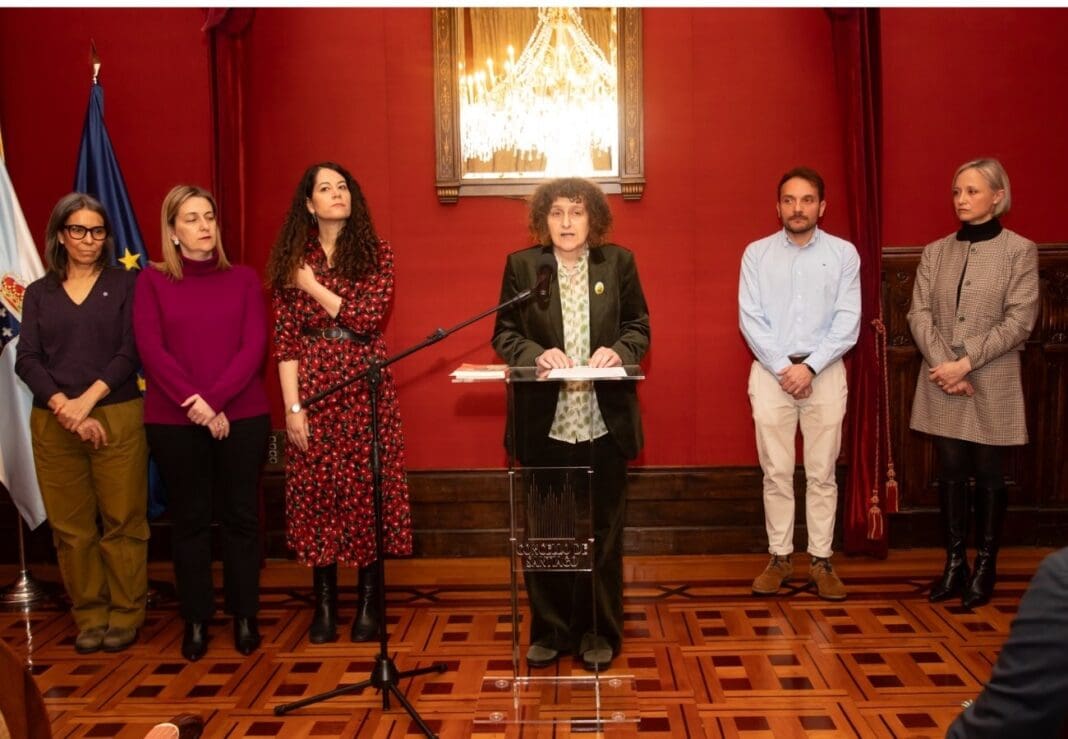
Mayor Goretti Sanmartín advances the creation of this new housing resource during the reading of the institutional manifesto of 8M, in a day that has also served to reward the recovery of the historical memory of Galician women.
Often, when we talk about violence, we focus on the numbers and forget the most urgent thing: shelter. At Rainbow we know that, for many people in our community and for women who suffer sexist violence, leaving a hostile environment is only the first step. The second, and sometimes the most difficult, is having a safe place to go. Therefore, today we bring hopeful news from the Galician capital: the City Council of Santiago de Compostela will provide a home for those who need it most.
A safe haven from violence
The announcement has been made public in a context full of symbolism: the institutional events on the occasion of International Women’s Day. The mayor of the city, Goretti Sanmartín, has confirmed that the next Government Xunta will give the green light to a vital measure.
This is the transfer of a flat, entirely municipally owned, which will be managed directly by the Department of Equality. Its function will be to serve as an emergency housing resource. It will be aimed at both women survivors of gender violence and people from the LGTBIQ+ community who are in a situation of extreme vulnerability.

For this space to open its doors, the City Council has explained that, after municipal approval, all that remains is to complete an administrative procedure to obtain definitive permission from the Xunta de Galicia.
Vindication and warning against hate speech
The confirmation of this new housing resource has served as a preamble for the reading of the joint declaration of the Municipal Corporation, supported by all political groups. In it, feminism has been vindicated as an indisputable transformative engine.
However, the Compostela town council wanted to issue a clear warning. In a global scenario where reactionary speeches are gaining ground, the Council has shown its deep concern about the normalization of hate. They have recalled that equality cannot be treated as a secondary policy, but as a transversal axis. For this reason, they have taken advantage of the platform to demand from the regional government (the Xunta) an injection of economic resources and more personnel to protect the Muller Information Centers (CIM).
Rescuing memory: The Xohana Torres Prize
The institutional day of 8M not only looked towards the future of social rights, but also towards the past. During the event, the prestigious Xohana Torres Award was presented.
This year, the award has fallen into the hands of journalist Raquel C. Pico for her brilliant investigation: Na procura da primeira estrela galega. Maruja del Mazo and the women of Galician cinema in the 20s. The author took advantage of her intervention to remember that figures like Maruja del Mazo, who at only 18 years old starred in the first film with a purely Galician vocation, represent all those women that official history has tried to erase.
After reviewing these initiatives, it is time to pause and analyze reality, reader: How many LGTBIQ+ people are forced to live with their attackers because they do not have access to a rental or an emergency housing resource? Do you think that a single municipal apartment is enough to cover the real demand of a city like Santiago, or should this be the first step in a much more ambitious public reception network? The walls of this new home will save lives, but the fight for a society where we do not need to flee must continue every day.