

A historic fine that reflects the growing digital repression against diversity in the country
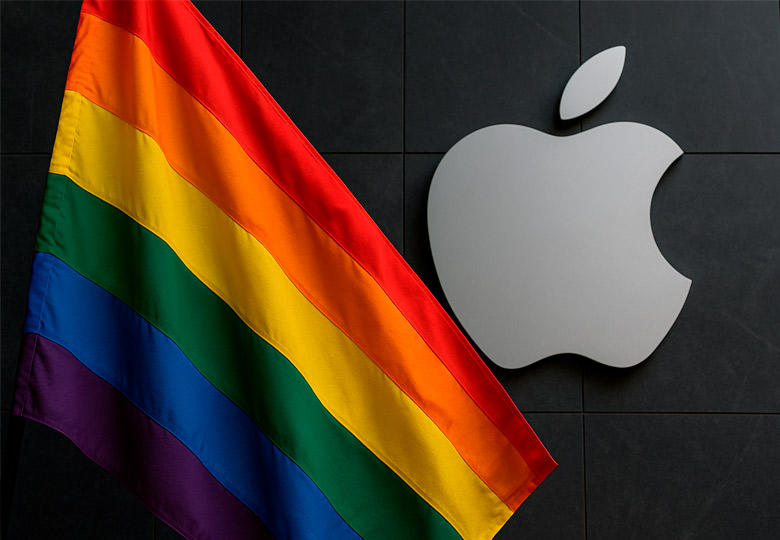
A Moscow court has imposed an unprecedented financial penalty on the technology company Apple for not removing LGTBIQ+-themed content from its platform, considered “extremist” under Russian legislation. This is the first time that the country’s authorities have fined the American multinational specifically for this reason.
The company has been sentenced to pay three fines of 2.5 million rubles each — around $93,000 in total — after being found guilty of three administrative violations, as reported by the state agency RIA Novosti. The trial took place in the Tagansky District Court and was held behind closed doors. The press only had access to hear the reading of the sentence.
A growing pattern of sanctions
This is not the first time Apple has taken on the Russian legal machine. In November of last year, the company was fined $36,900 for failing to eliminate “prohibited information” and, previously, in August 2023, with more than $42,000 for similar reasons. The novelty, in this case, is the explicitly LGTBIQ+ nature of the indicated content.
Since 2022, Russian legislation has tightened its restrictions on the rights of LGTBIQ+ people. After the approval of a law that prohibits any “propaganda” of non-traditional relationships, the margin of expression has been drastically narrowed. This regulation was reinforced in November of that same year, and a year later sex change surgical operations were prohibited, setting off all the alarms among trans groups.
What does Russia consider “propaganda”?
Under the current legal umbrella, Russian authorities prohibit any content that could be interpreted as a threat to traditional values. This includes materials that make relationships between people of the same sex visible, speeches that question the binary vision of gender or even cultural representations that do not align with what the State considers acceptable. After the declaration of the LGTBIQ+ movement as an “extremist organization” by the Supreme Court, repression has escalated to limits that are difficult to quantify.
A decision that raises doubts
To what extent can an international company guarantee its principles when operating under authoritarian regimes? What is the cost—ethical, economic and human—of remaining present in a market where fundamental rights are restricted? Apple, like other large platforms, faces the dilemma of respecting local laws without betraying the values of inclusion it promotes in other regions. But is it possible to maintain that balance? There are no simple answers. And maybe that’s where the importance of asking it lies.
Reactions and consequences
So far, Apple has not issued any official statement regarding the ruling. Meanwhile, human rights organizations and LGTBIQ+ groups observe with concern how these judicial decisions not only affect companies, but end up having a direct impact on the daily lives of millions of people who are part of the group in Russia.
The sanction sets a precedent. But beyond the economic figure, it reveals a clear intention: to silence any display of diversity that questions the dominant narrative.
However, not all voices believe that Apple’s response is up to the challenge. Some criticism points to the passivity of the company, which could have taken a firmer stance in defense of the LGTBIQ+ community, withdrawing its presence in Russia or publicly denouncing the restrictions. There are also those who wonder if continuing to operate in a country with these types of laws is not, in itself, a form of silent complicity. Can a global brand really stay neutral in contexts where neutrality is no longer an option?