
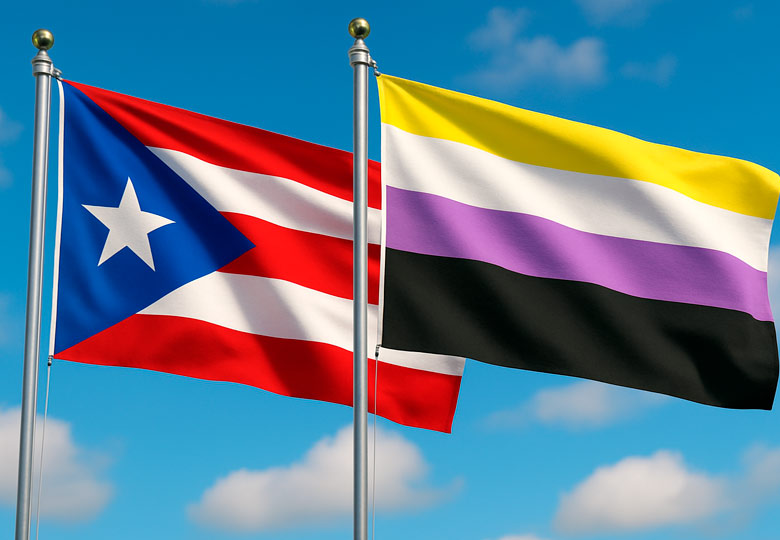
A historic decision by the Supreme Court paves the way for the official recognition of non-binary identities on the island
Puerto Rico has just taken a step that many consider essential and, for others, long-awaited: from now on, non-binary people will be able to reflect their identity on their birth certificates using the “X” option as a gender marker. This was ruled by the country’s Supreme Court, in a resolution celebrated by activists and human rights defenders as a “historic” advance in the fight for equality.
This is not just an administrative change. This ruling symbolizes legal and social recognition towards those who, for decades, have lived outside the margins of the binarism imposed by the system. Legally recognizing that not everyone identifies as a man or woman not only validates their existence, but also allows access with greater dignity to basic rights, such as employment, health or education.
What exactly does the ruling say?
The case came to Court after a lawsuit filed by six non-binary people against Governor Jenniffer González Colón, the Secretary of Health and other government figures. These people demanded something as essential as being recognized on their own identity documents.
Starting with this ruling, those who do not identify within the male/female binary may request that option “X” appear in the gender section on their birth certificate. This aligns Puerto Rico with an increasingly widespread trend in some US states and other parts of the world.
Pedro Julio Serrano, long-time activist and president of the LGTBIQ+ Federation of Puerto Rico, did not hesitate to describe the measure as a victory. “It recognizes the existence and dignity of non-binary people, who for too long have been made invisible by the system,” he said in statements reported by local media.
An implementation that still raises doubts
Governor González Colón has indicated that her administration is awaiting recommendations from the Department of Justice to proceed with implementation. “We will carefully analyze the legal and operational implications of this decision,” he declared.
Although the political will may seem favorable, the truth is that the practical details are still to be defined: when can the change be requested? What requirements will there be? Are the digital systems and staff trained to implement this change without obstacles?
These questions remain without a clear answer.
A path that did not begin yesterday
This new milestone comes seven years after a federal court in the United States ordered Puerto Rico to allow trans people to change their gender on their birth certificates. That ruling was key, and the current ruling seems to extend that same logic of rights to non-binary gender identities.
Civil rights groups and LGTBIQ+ organizations highlight that the island is now at the forefront of the recognition of diverse identities within US territories. But they also warn that there are still important obstacles: lack of legal protection against discrimination, difficulties in accessing basic services and an educational system that still has structural prejudices.
A real advance or a symbolic gesture?
Although the ruling represents a step forward, it also leaves open certain concerns. What will happen if implementation is delayed or becomes a bureaucratic obstacle course? Is the state apparatus truly committed to inclusion or is it simply complying with a judicial mandate?
In addition, not all voices within Puerto Rican society view this change favorably. Conservative sectors have already expressed their disagreement, and it is not ruled out that attempts will arise to reverse or block its application. There are also those who criticize that option “X” remains an ambiguous category, which does not fully recognize the richness of possible identities. Is a generic marker enough?

The ruling by the Supreme Court of Puerto Rico marks a milestone for the legal recognition of non-binary people. But it is clear that paper is not enough: the real challenge is to transform that decision into effective, accessible policies without discrimination. In this process, it will be key for the government to listen to the LGTBIQ+ community and act with responsibility and empathy. Because recognizing an identity is not just changing a letter. It is validating a life.