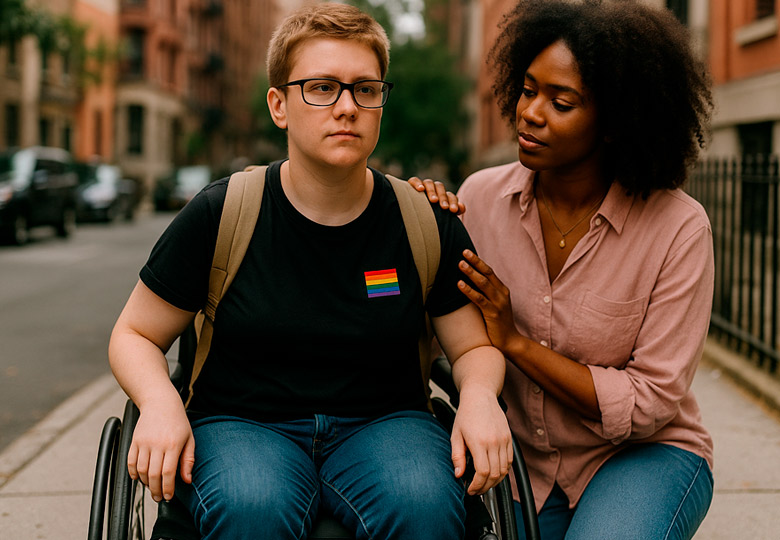


Being non-binary is not a trend. It is not a new invention. It’s not a confusion either.
But even so, many people still don’t really understand what it’s about. Not even those who are part of the LGTBIQ+ group.
Because non-binary does not easily fit into the blue or pink box. And that is disconcerting.
In this article we want to tell what is not always explained: how a non-binary person lives, feels and is accompanied, without needing to have all the answers, but with a great desire to learn.
📚 Let’s start with the basics: what does “non-binary” mean?
A non-binary person does not identify exclusively as a man or a woman. You may feel somewhere in between, move between genders, have none, or have a completely different identity.
It is important to know that:
-
It is not the same as being trans, although many non-binary people are part of the trans umbrella.
-
It has nothing to do with sexual orientation.
-
It does not necessarily imply changing your name, pronouns or appearance.
In summary: it is a gender experience outside the binary system, which is not always visible but is deeply real.
🧠 What is not seen (and sometimes no one explains)
1. Being non-binary does not mean being confused
It is not a “stage” nor a “previous step” to defining yourself as a man or woman. For many people, it is their stable and definitive identity. And although it may evolve, that does not make it any less valid.
2. Society forces you to choose, constantly
From the DNI to the public bathroom, everything is designed to divide between “men” and “women.” Non-binary people face structural microviolence every day: not knowing which box to check, no neutral clothing in stores, no one understanding their pronouns.
3. Language can be a trap
Many use the “e” as a gender-neutral mark, but it is not the only option. There are those who prefer “her”, others the “x”, or simply their name without further ado.
The important thing is not the format, but respect for the pronoun and the chosen identity.
4. Not everyone wants to take hormones or have surgery
Associating gender identity with physical changes perpetuates a normative idea. Being non-binary does not require medical validation or bodily transformation. Identity is in how you live, not in how you look.
5. Accompanying is also letting go of control
If you are a mother, father, partner, teacher or friend of a non-binary person, you will not understand everything at first. But it is not necessary. What is needed is to be available, listen, ask lovingly and not take it for granted.
🤝 How to accompany if you are not non-binary (and not screw up in the attempt)
Accompanying is not understanding everything. It’s choosing to be there. These are some keys to do it with respect and empathy:
✅ Ask for pronouns (and use them)
If you don’t know how to refer to someone, ask. And if you make a mistake, ask for forgiveness and correct it. Don’t make a drama out of it.
A simple “thank you for telling me, I will keep it in mind” is worth a thousand excuses.
✅ Don’t question their way of dressing
Gender expression does not define identity. That someone who is non-binary wears a skirt, beard, makeup or tie does not nullify their experience.
It is not up to you to decide if it “seems” what it says it is.
✅ Avoid asking invasive questions
“And how do you have sex?” “Did you have surgery?” “Does your family know?”
Before asking something, think: would I ask this if I were cis?
✅ Give up space and visibility
If you are in an environment where there are non-binary people, give them the floor, listen to their experiences, share their content and respect their processes.
Don’t talk about them without telling with them.
❓What sometimes hurts: even within the group
An uncomfortable reality is that non-binary people do not always feel welcomed within the LGTBIQ+ collective itself.
Many times, in events, media or even activist spaces, only binary identities are made visible.
They are questioned, denied a voice, or considered “too complex.”
And if we don’t even listen to each other at home, how do we want to change the world outside?
⚠️ Critical perspective: are we romanticizing non-binary?
Yes, there is a risk.
Sometimes, on social networks or in certain brands, non-binary identity has begun to be used as an aesthetic. Like something “cool”, “modern” or even “usable” for diversity campaigns.
And although making visible is necessary, reifying identities can also be violent.
Not everyone wants to be influencers. Not everyone wants to educate. Not everyone feels safe outside of anonymity. And that is also valid.
🌈 Being non-binary is living on the margins… and also in the center
Although the world insists on drawing borders, there are people who inhabit the margins with dignity. With doubts. Strongly.
Non-binary identity is real even if it is not seen. It is legitimate even if it is not understood. And it is important even if it is uncomfortable.
Accompanying someone who is non-binary is not just about using the correct pronoun.
It is opening your mind. It is learning to doubt. It is holding.
And, if you are, know that you are not alone. That there is space for you. That you don’t have to choose a side.