
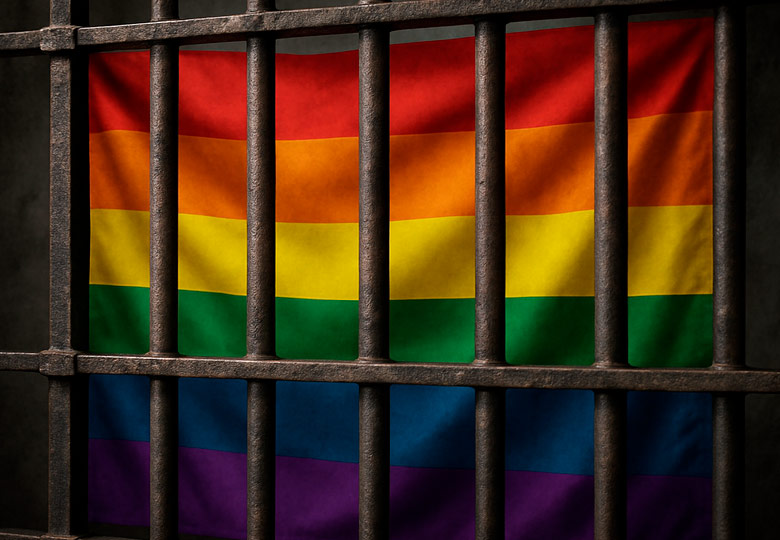
In the middle of 2025, there are still corners of the world where loving freely, being who you are, or simply expressing one’s gender authentically can cost one’s freedom… or even one’s life. While some countries celebrate diversity with pride, in others, being part of the LGTBIQ+ collective remains a crime. Yes, crime. As if identity were a crime.
Today we propose a trip, but not a pretty one. There are no paradisiacal beaches or rainbow cities. Let’s go through that other map, the one that we often ignore, where sexual orientation or gender identity is criminalized by law.
How many countries punish being LGTBIQ+?
Currently, more than 60 countries in the world maintain laws that criminalize relationships between people of the same sex or trans and non-binary identities. Although there has been timid progress in some territories, others have tightened their legislation, as if time was running backwards.
In at least 11 countries, homosexual acts can be punished with the death penalty: Iran, Saudi Arabia, Mauritania, Afghanistan, Yemen, Nigeria (in some states), Somalia (in areas controlled by Al-Shabaab), Pakistan, Brunei, Qatar and the United Arab Emirates.
In many of these countries, the laws are inheritance from British colonialismor are based on extreme interpretations of Islamic law. But be careful, not everything is reduced to religion or history. Sometimes it is pure politics, populism disguised as morality.
Particularly hostile regions
1. Sub-Saharan Africa
The region has a high number of countries with anti-LGTBIQ+ legislation. Uganda, for example, passed one of the harshest laws on the planet in 2023, which even penalizes “aggravated homosexuality” with life imprisonment. Nigeria, Tanzania and Ghana also harshly criminalize same-sex relationships.
2. Middle East and Central Asia
Many of the most severe penalties are concentrated here. In Iran, public executions for “crimes against morals” are sadly frequent. In Afghanistan, under the Taliban regime, LGTBIQ+ people not only have no protection, but are in real danger.
3. Caribbean and Central America
Jamaica, Barbados, Guyana and other islands maintain colonial laws that punish homosexuality with prison. Although they are not always applied, their mere existence perpetuates violence and social discrimination.
4. Eastern Europe and Russia
Although being LGTBIQ+ is not technically penalized in Russia, the law against “homosexual propaganda”, in force since 2013 and reinforced in 2022, criminalizes the mere visibility of the group. Being trans or doing activism is, in practice, persecuted.
What does “criminalize” really mean?
It’s not just about laws. It’s about everyday life. In many of these countries:
- There is no access to safe health services for trans people.
- Assaults and murders go unpunished.
- LGTBIQ+ activism is illegal or strongly repressed.
- The community is forced to live in silence, in fear, in the shadows.
Imagine that having a partner of the same gender can land you in prison. That uploading a photo to Instagram makes you a target of the police. That living your gender identity is considered “provocation.”
But there are also resistances
Despite the gloomy outlook, LGTBIQ+ people continue to exist, resist and fight in these contexts. There are activists who work underground, support networks that cross borders and people who refuse to hide, despite the risk.

In countries like India, Botswana or Angola, the decriminalization of homosexuality in recent years shows that change is possible, although slow. In 2025, there are new youth movements that are making a stand in countries where it was previously unthinkable.
What if we question it?
Now… What happens when the West, with its flag of human rights, points the finger at other countries while still not guaranteeing real protection for its own LGTBIQ+ population? How many times has the LGTBIQ+ cause been used as an excuse to justify racist policies or foreign interventions? Is it possible to demand changes without falling into moral colonialism?
It’s not a question with an easy answer, but it’s worth asking. The defense of rights cannot become a geopolitical weapon.
What can we do from here?
Because yes, although we do not live in Iran or Uganda, this also affects us. We can’t look the other way. The struggles of the LGTBIQ+ community are global, and solidarity knows no borders.
Some ideas:
- Support organizations that work on LGTBIQ+ rights in difficult contexts (OutRight, ILGA World, Human Dignity Trust…).
- Be informed and spread the word. The more we know, the more difficult it will be to make violence invisible.
- Pressure your governments to demand respect for human rights in their diplomatic relations.
- And above all: take care of your environment. If you can love freely, don’t take it for granted. Use that privilege to build bridges.
Being LGTBIQ+ should not be a crime anywhere in the world. And yet, in 2025, it still is in too many countries. Sometimes, it is by law. Others, by silence. But as long as there are people persecuted for being who they are, the fight is not over.
There are no easy answers, nor magic solutions. But one thing is clear: love, identity, freedom, should have no borders. And as long as there is only one person who is denied, this story will remain urgent to tell.